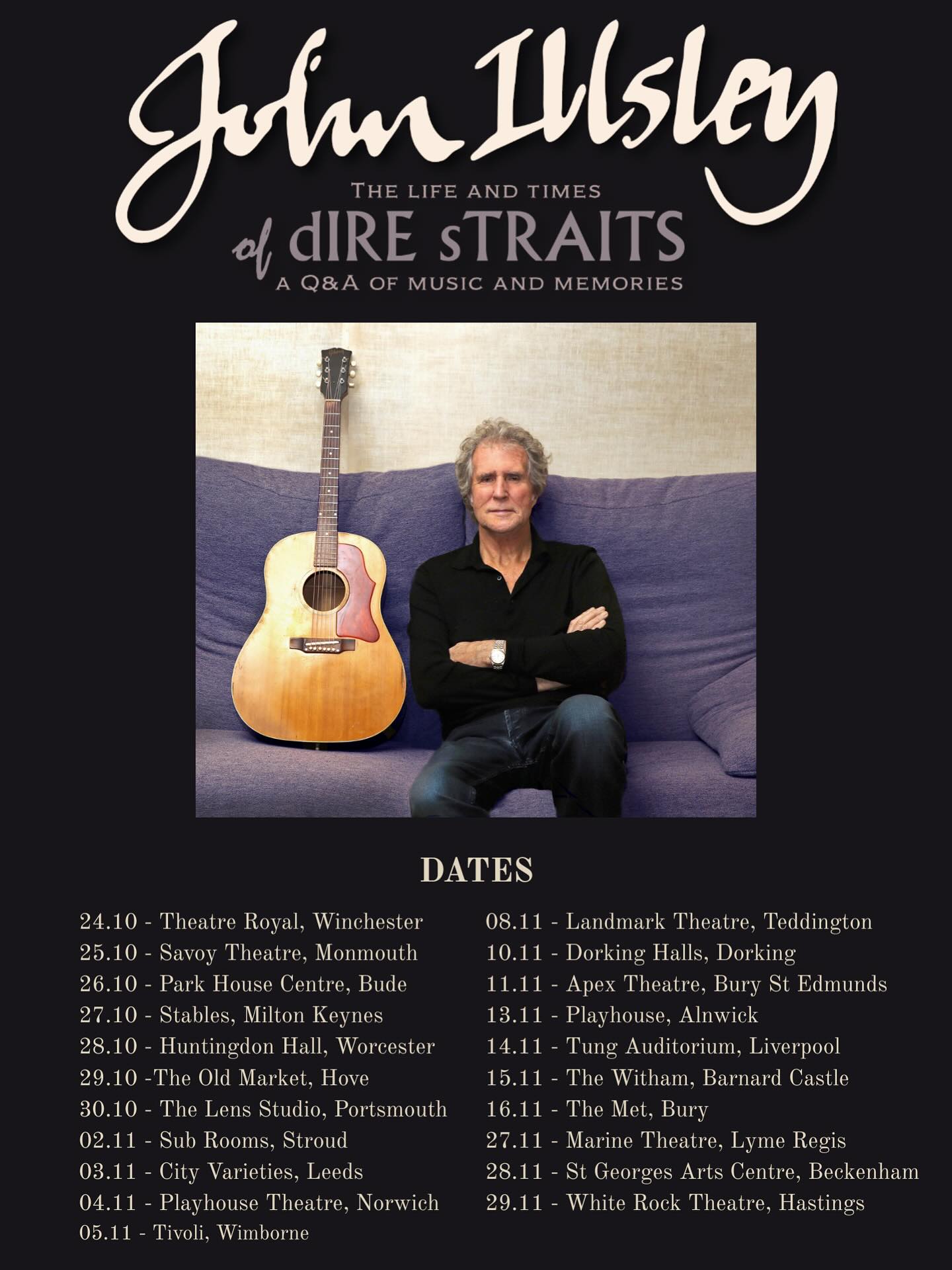
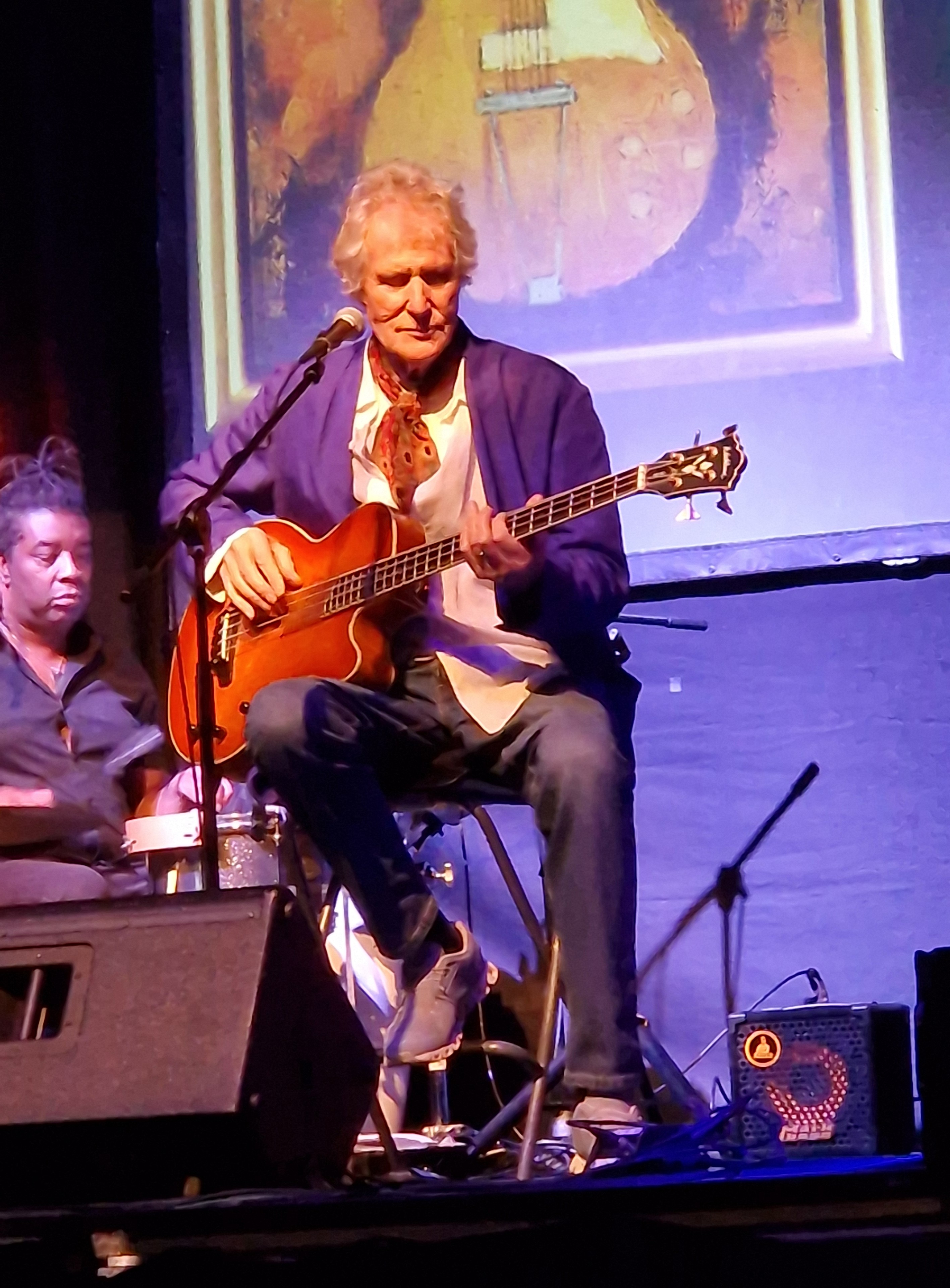
John Illsley, legendary bassist and Dire Straits co-founder, wound up a 21-date music and chat tour at the White Rock Theatre in Hastings. I never got to see Dire Straits back in the day, sadly. However, the fact that this was a chance to see John Illsley perform some Straits classics with a full band, as well as a chance to get a first-hand insight into his long career, made it too good an opportunity to pass over, even though (following Dave Hill and Slade the night before) it meant a second trip to the White Rock in the space of twenty-four hours.
A full two-hour show, the format was a Q&A session, with Illsley in conversation with long-time friend and former Dire Straits co-manager, Paul Cummins. This was followed by live music from the band then a short interval, followed by a further Q&A session and then more live music.
The first half of the show focused on the early part of his career, with the second part focusing on the Brothers In Arms days and beyond. Those early days and hearing about Illsley sharing a flat in Deptford with Mark Knofler’s brother, David, while studying at Goldsmiths held a particular fascination for me, as a former student of Goldsmiths myself who ended up spending twenty-odd years living in the Deptford area, not too far from the small council flat were Dire Straits was originally formed. An articulate, urbane and thoughtful man (even if he lived in what sounded like a filthy hovel at the time!) it was a fascinating insight into the early days of the band and the fairly swift pathway to their first hit single. The inspiration for that first hit came after an evening at a local pub, where Mark Knopfler heard a jazz band playing who called themselves ‘Sultans of Swing’. The rest is history…
The musical segment saw a clutch of songs from the first Dire Straits album, including the aforementioned ‘Sultans of Swing’ as well as a song apiece from Making Movies and Love Over Gold. The band are excellent and Illsley’s vocals are not a million miles away from Mark Knopfler.
After the interval it’s back to more chat, with a real focus on the story behind the astronomical success of Brothers in Arms. Illsley describes it as a perfect storm: Knopfler’s song-writing reaching another level, digital studio technology being newly available, Sony keen to push an album that could help propel sales of their new-fangled CD players, and MTV launching in Europe just a few months before the album’s release date. Both they and their US counterpart keen to give airtime to a single that name-checked them. Neither Illsley nor Mark Knopfler seemed particularly keen on the superstardom that followed, however, and in spite of monster world tours, Live Aid and Nelson Mandela’s 70th birthday gig at Wembley, there was to be only one more studio album.
Before long we’re back to more music. Unsurprisingly, songs from Brothers In Arms feature heavily. As well as the title track, there’s ‘So Far Away’, Walk of Life’ amd ‘Money for Nothing’ there’s also a song from Illsley’s most recent solo album. ‘It’s a Long Way Back’ is all about those early days in Deptford. Proceedings wrap up with ‘Where Do You Think You’re Going’ from the Communique album. Illsley and the band leave the stage to a well-deserved standing ovation.
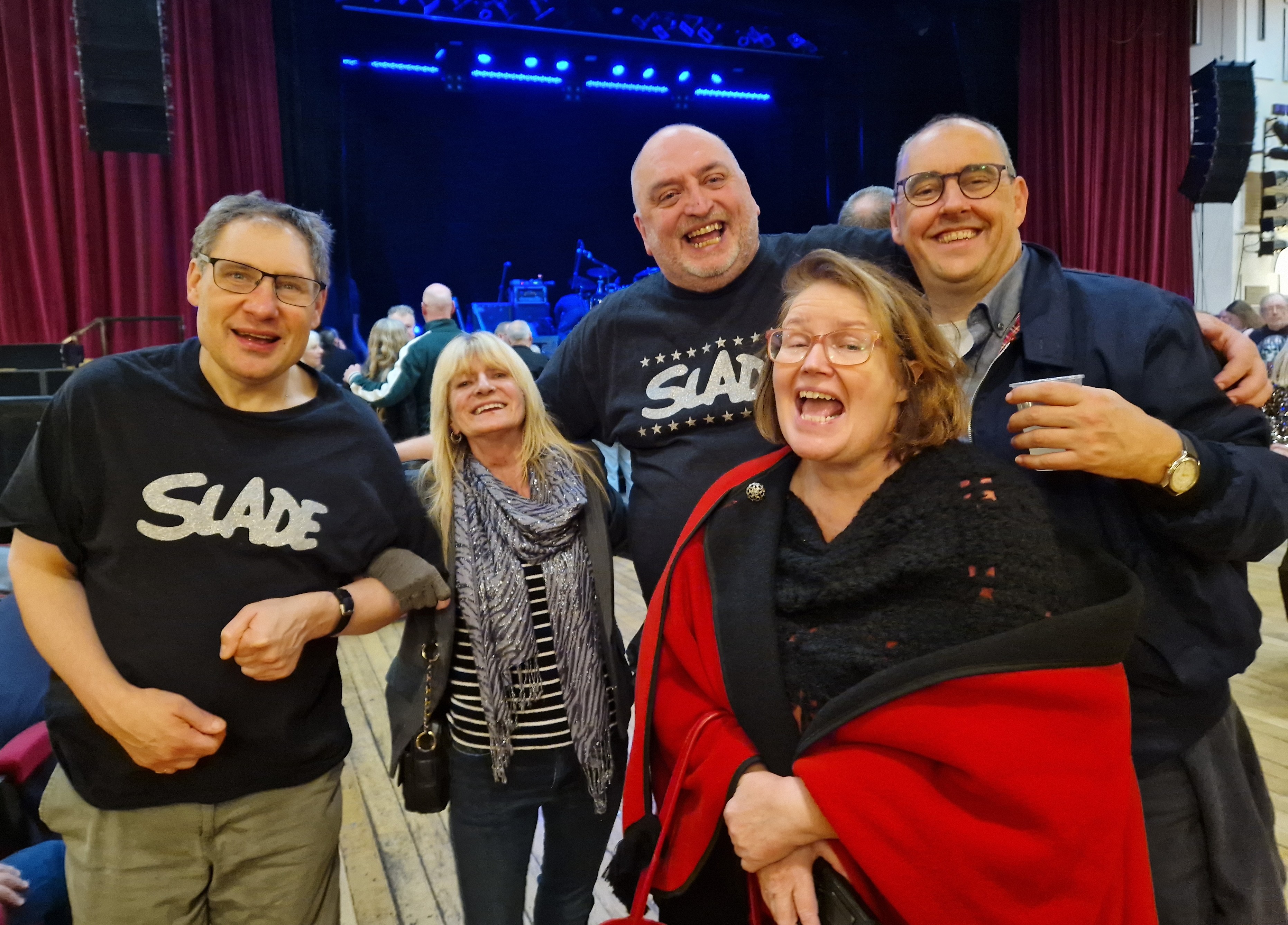
I was lucky enough to see the original line-up of Slade on one of their annual Christmas tours a couple of times back in the early 1980s. Then, after Dave Hill reformed the band with Don Powell in the early 1990s, seeing Slade every Christmas pretty much became an annual tradition. Health issues meant that Hill, now the only original remaining member, had to miss a couple of years in recent times. But now he’s back on the road for a ten-date UK tour. As he approaches his 80th birthday next April this has been advertised as the final ever Slade Christmas tour. They are not giving up playing live altogether, Hill reassures us all later on. There will still be the odd show, just not these big tours.
Yes, there’s no Noddy and Jim, the ones who actually wrote all of those Holder/Lea hits being blasted out tonight. Don departed some years ago amidst a certain amount of acrimony and so Dave with his ever-flamboyant stage-attire is the last man standing. But it’s a chance to see a bonafide ‘70s legend less than a mile from my front door and, most importantly, a chance to celebrate all those hits with as much communal stomping, swaying, singing and clapping as all of us can muster. I wouldn’t miss it for the world.
Looking forward to getting crazee with Slade!
It’s not exactly an unfamiliar set-list, either for long-time Slade fans or, indeed, almost anyone who had more than a passing acquaintance with the chart music of the 1970s and early ‘80s. Only three of the songs being played tonight came in below the Top Five in the UK singles charts! And the only things that may even slightly resemble anything like a ‘deep cut’ are ‘Lock Up Your Daughters’, a minor hit for the band the year after their post-Reading comeback; and ‘My Baby Left Me’, another minor hit recorded as a tribute to Elvis following the King’s death in 1977. Familiarity is what’s it’s all about tonight and kicking off with ‘Take Me Bak ‘Ome’ the big hits come thick and fast.
The classic Slade live format of lead guitar, rhythm guitar, bass and drums has been tampered with in recent years and rather than someone taking on Noddy Holder’s old role on second guitar, you now have Russell Keefe on keyboards. This works surprisingly well, especially given the prominence of the keyboards in so many of Slade’s mellower numbers, like ‘Everyday’, ‘My Friend Stan’ and ‘My Oh My’. What works less well is when Keefe takes lead vocal on several songs. Holder’s voice was gravelly but it was never gruff. In Slade’s glory days, Holder could yell louder than any of them but Tom Waites he was not.
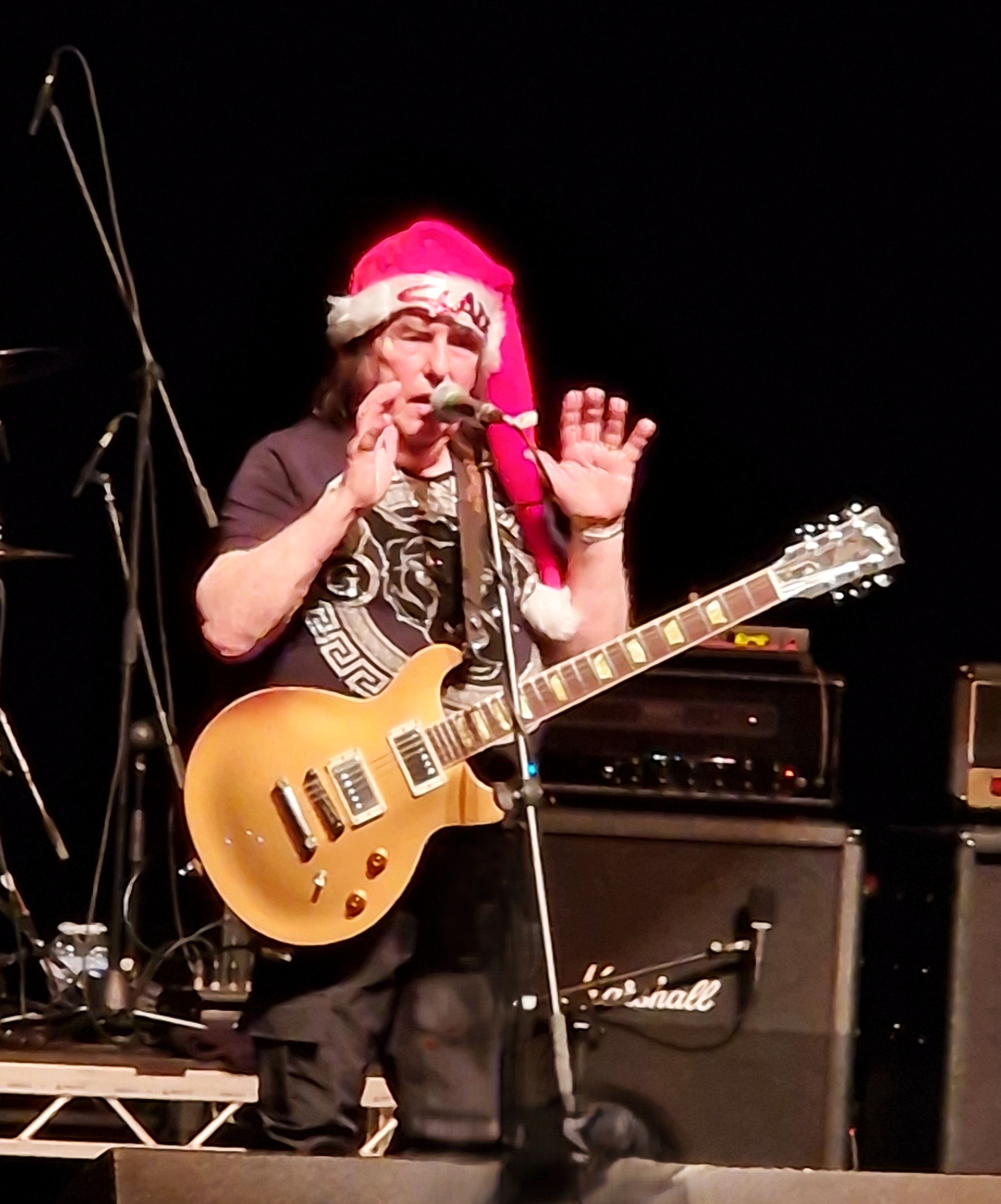
Without trying to mimic Holder, Hill’s long-time bass-player, John Berry, does a much more sympathetic job on the songs where he sings lead. The other new-boy, Alex Bines, pounds away on drums as the audience clap and stomp along, and the soon-to-be-octogenarian Hill nails all those familiar, classic, guitar solos.
An impassioned Dave Hill imploring the crowd to look to the future
It’s the first night of the tour and towards the end Hill seems genuinely moved by the rabble-rousing response from the audience tonight. After a suitably crazy ‘Mama Weer All Crazee Now’ the band exit the stage but soon they are back for an encore with an epic singalong rendition of ‘My Oh My’, followed by a wonderfully raucous ‘Cum On Feel The Noize’.
But wait, it’s nearly December, it’s the start of the Slade Christmas tour and there’s obviously one song left to do. The roadies are on hand to distribute Santa hats, Dave Hill gives an impassioned plea about looking to the future, even though times might be right now, and soon we’re all yelling along to Merry Xmas Everybody’ at the top of our voices and leaving with a real spring in our step ready to face 2026.
Setlist:
Take Me Bak ‘Ome Lock Up Your Daughters Look Wot You Dun Everyday Coz I Luv You Run Runaway My Friend Stan Far Far Away The Bangin’ Man My Baby Left Me Gudbuy T’Jane Mama Weer All Crazee Now My Oh My Cum On Feel the Noize Merry Xmas Everybody
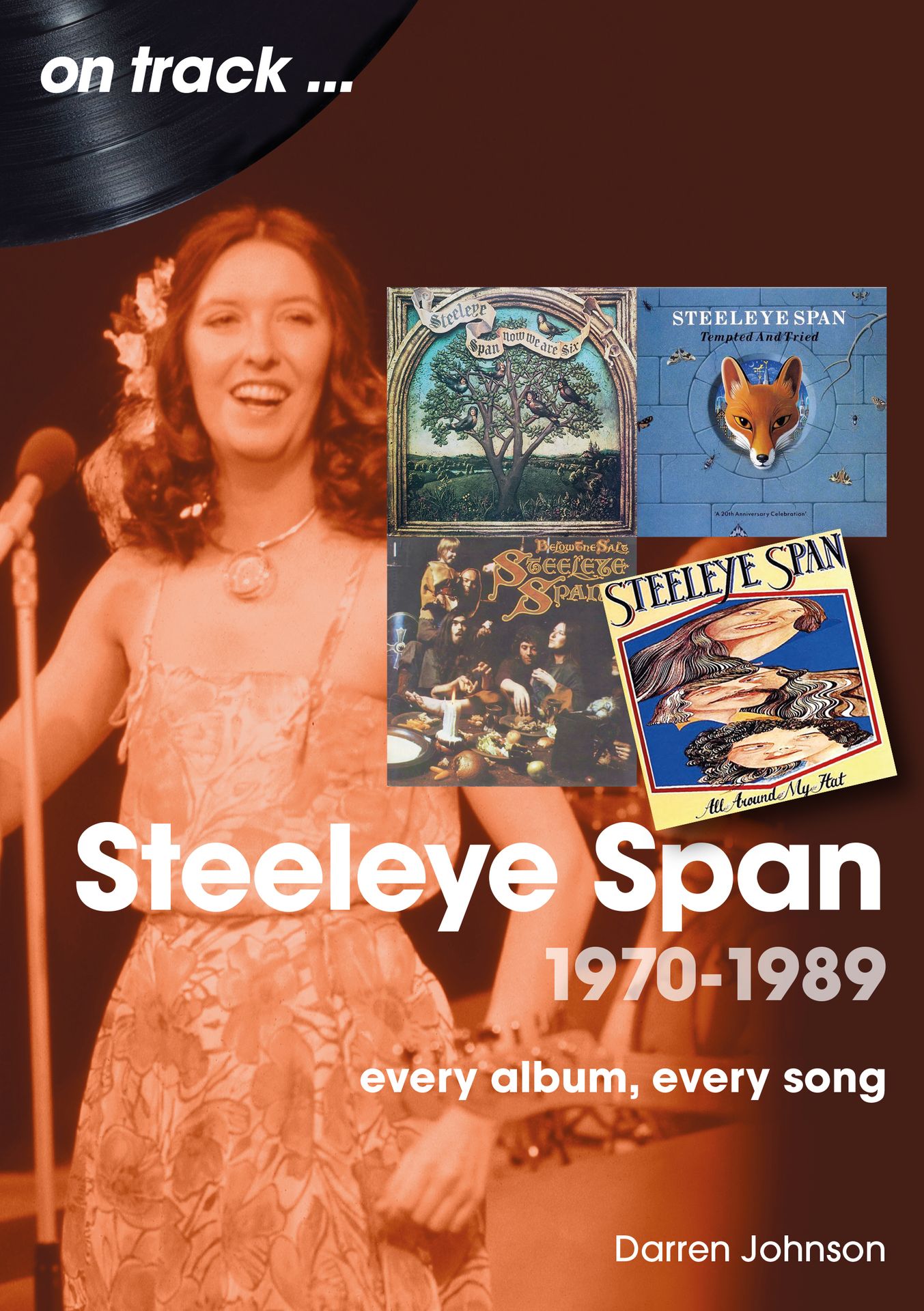
Following my ‘glam rock trilogy’ on Slade, Sweet and Suzi Quatro, my fourth book for Sonicbond Publishing came out in August 2025: Steeleye Span 1970-1989 On Track: Every Album, Every Song. I’ve been really heartened by the enthusiastic responses from readers so far (reaching Number 2 on Amazon’s Music Encyclopaedias Chart) and the many kind words from reviewers.
Darren Johnson
“Both satisfying and engrossing, what should’ve been a simple task to read and comment on, became a series of rabbit holes, as songs and entire albums had to be revisited or indeed investigated. Both for the purposes of research and pure enjoyment, as well as a degree of nostalgia.”Folk North West (read full review here)
“Darren Johnson has done a remarkable job in squeezing the details of fourteen albums into this slim volume” “Johnson’s research is thorough”RnR magazine
“I hadn’t heard some of these records for a very long time, but this deep dive into the band, their music and indeed the history behind some of the traditional songs they performed, caused me to listen again with fresh ears. Check it out if ‘The Span’ or indeed folk rock in general are your thing.” The Afterword (read full review here)
“The book though is very fair in recognizing it’s sources. It brings together a lot of info into a well written book – definitely recommended!” A Celebration of Steeleye Span (read full review here)
Steeleye Span 1970-1989 On Track can be purchased via Amazonhere as well as most other major book-sellers. And via the publisher’s own online shop at Burning Shedhere
Assembled as a showcase for the songwriting of North Carolina-based Cameron Thomas, songs that “share the humble joys, struggles and mysteries of Southern life”, the North Carolina-based four-piece Sufferin’ Fools recently released their second EP.
Sufferin’ Fools are singer/songwriter and guitarist, Cameron Thomas (who played and toured with The Delta Drift and The Corduroy Road); lead guitarist/pedal steel man, Andrew Wagley (a former member of Po Boyz); bass-player, Christopher (a former sound engineer); and drummer, Pete Schreiner (ex- Songs: Ohia/Magnolia Electric Co.)
Following an excellent debut (the four-track EP Bound To Get Burned, released in 2024) a five-track follow-up Forest for the Trees, came out in September this year.
Announcing the release of Forest for the Trees, Thomas said: “Even the best memories fade. Art, and music specifically, is a way to capture moments, preserve emotions good and bad, and memorialise life’s victories and failures – because they tell a story of who we are.”
Indeed, Forest for the Trees doesn’t shy away from the times when life hits you hard and the hard-learned lessons that stem from that. Most of the songs were written in the months preceding Hurricane Helene which caused catastrophic damage and numerous fatalities across the Southeastern United States, then promptly recorded in the aftermath of the storm.
“Musicians’ feelings can’t help but come out through soundwaves,” reflected Schreiner. “We were lucky to have a place to channel our emotions.”
“One of the greatest pleasures of this project for me,” added Thomas, “is being accompanied by an authentic and experienced group of musicians who perform as if the stories are their own to tell. I think they make my voice as a songwriter stronger, more real and far more effective.”
Rootsy and gutsy but deliciously laid-back, with gorgeous pedal steel and heartfelt vocals addressing everyman themes, whether you’re in the rugged mountain regions of North Carolina or here on the south-coast of England, what you’ll find in Forest for the Trees is warm, honest rock and roll Americana, for the heart and for the soul.
I’ve been to several memorable gigs at the excellent dedicated live venue adjoining the Brunswick pub in Hove but until I turned up on Sunday afternoon I’d never even realised they also had a downstairs cellar bar venue. It was here in this small, sweaty cellar that the recently-formed X Generation X played their debut gig. As the tour’s official warm-up gig we were treated to a short but explosive set, followed by an equally lively band Q&A and some impassioned reflections from some of the old punks in the audience recalling those heady days of the birth of punk.
Read my interview with X Generation X’s Mark Laff here
A few hours later we’re back in that same tightly-packed, low-ceilinged venue for a full-length gig and an even more explosive performance. Assembled to mark the coming 50th anniversary of punk and to celebrate the music of Generation X, the band features Generation X’s own Mark Laff on drums, Spandau Ballet’s Steve Norman on guitar, Westworld’s Elizabeth Westwood on vocals, Vice Squad’s Michael Giaquinto on bass and, as a late addition, James Stevenson from the final Gen X line-up also on guitar.
Mark Laff shares memories with fans during the Q&A
Kicking off with punk anthem ‘Ready Steady Go’ and with Norman and Stevenson cranking out those fast and furious riffs, it’s the perfect opener and Westwood immediately proves herself to be an inspired choice to front this project. She’s not trying to be Billy Idol, of course, as Laff himself noted when I interviewed him ahead of the tour. But she truly inhabits the spirit of these songs with energy and verve.
Elizabeth Westwood
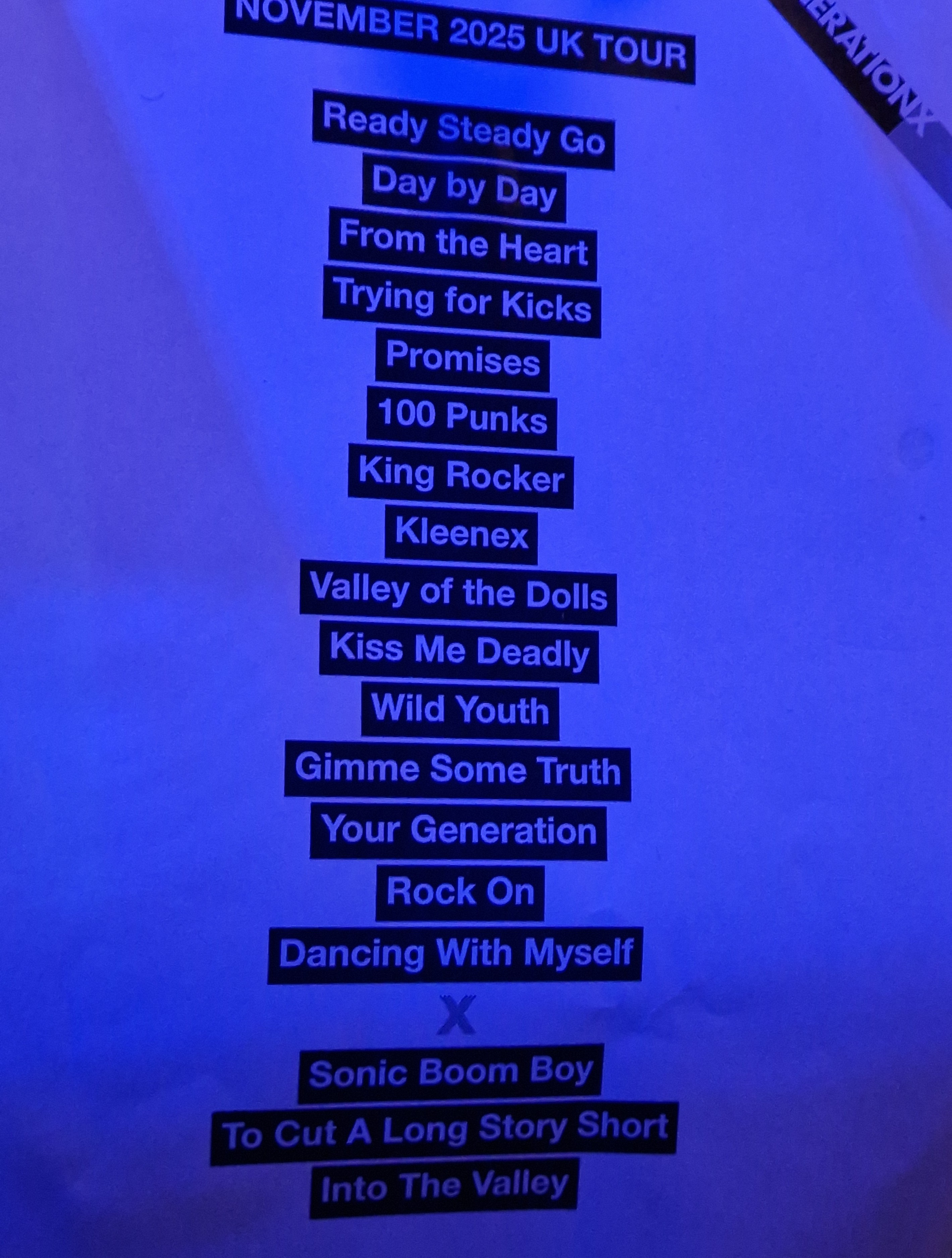
The earlier part of the set is heavily dominated by songs from the first Generation X album and a thunderously tight Laff and his bandmates more than do justice to old favourites like ‘Promises Promises’, ‘One Hundred Punks’ and ‘Kiss Me Deadly’. There’s a couple of songs from the second album, Valley of the Dolls, thrown in as well though: the title track and ‘King Rocker’, introduced by Laff as his “biggest hit” – the only Generation X single to almost make the Top Ten. Throw in the essential early singles, ‘Wild Youth’ and ‘Your Generation’, a couple of deep cuts in the form of a cover of John Lennon’s ‘Gimme Some Truth’ (originally recorded as a B-side) and Gary Glitter’s ‘Rock On’ (originally recorded for a Peel session) and you’ve got the perfectly-curated Generation X set-list.
As things begin to draw to a close there’s one song left that we’re all expecting and we’re not disappointed. The band launch into a wonderfully raw and frenetic version of ‘Dancing With Myself’, from the third album and the album that Stevenson recorded with the band before the song went on to develop a more familiar life of its own outside of the confines of Gen X.
Steve Norman and James Stevenson
We’re then treated to an encore of Westood’s own “biggest hit”, Westworld’s ‘Sonic Boom Boy’, along with a cover of Norman’s debut hit with Spandau Ballet ‘To Cut a Long Story Short’ and a cover of the Skids ‘Into The Valley’. It’s an unforgettable gig and an energy-packed night to kick off the X Generation X tour in style.
Making light of the seeming incongruity of launching a UK tour on a Sunday, Westwood asked the happy but clearly refreshed crowd at one point if they all had to be up in the morning. “No!!” the crowd yelled back in unison. “They’re all retired!” quipped Steve Norman. That’s as maybe but for 75 glorious minutes it was 1976 all over again and here in this sweaty cellar bar the spirit of punk was recaptured in all of its incendiary glory.
Jim Borrows will not be a name many people will have heard of but back in July, after a lifetime of playing piano primarily for his own amusement, he fulfilled a long-held ambition of releasing his debut album. Of course, many musicians have trodden a similar path and while many aspects of the modern-day music industry may be broken, technology has made it easier than ever for emerging artists to record and release new music these days.
What immediately marks Borrows’ venture out from many others, however, is the friends he’s been able to call upon to bring his dream to fruition. Firstly, it’s produced by experienced multi-instrumentalist and highly talented producer, James Wood, who also contributes guitars, keyboards, percussion and backing vocals to the album.
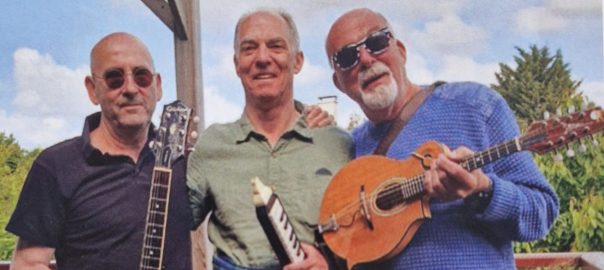
James wood, Jim Borrows and Dave Pegg
Moreover, and of particular interest to any fans of folk rock legends Fairport Convention, it features the band’s veteran bass-player, Dave Pegg, who contributes bass, mandolin and electric guitar. And just to underline the Fairport connections even further, the album also features an additional guest appearance from the band’s fiddle supremo, Ric Sanders, who contributes electric violin on one track, a cover of Dylan’s ‘Seven Days’.
As Sanders recollects in this summer’s Cropredy festival programme, Borrows’ and Fairport’s paths first crossed when the band were doing some of their European riverboat cruises and they performed various themed karaoke nights together. “Jim was without doubt the star performer,” noted Sanders. “Not only a great singer but also a fine pianist.”
Anyone who has seen Fairport on stage with guest artists will know that Peggy and co. can turn their hand to a whole panoply of musical styles, far beyond the folk rock canon with which they are most closely associated. Carry Me Back To My Old Front Door is no exception.
Featuring seven of Borrows’ own compositions and alongside six Bob Dylan covers and a couple of further covers of Neil Young and Sandy Denny songs, it’s an entertaining album. Borrows own compositions are highly personal chronicles of a range of his experiences and thoughts on themes including time, life and love; and they reflect his multiple influences, including The Beatles and Bob Dylan. Sleeve notes and lyrics for the self-penned compositions are contained in the detailed twelve-page CD liner notes.
With Borrows’ piano and vocals front and centre, ably assisted by the hugely talented Pegg and Wood, Carry Me Back To My Old Front Door creates a jazzy, bluesy singer-song-writer vibe with some compelling rock elements. It’s well worth checking out.
As Fairport Convention’s own Chris Leslie sums it up: “A lovely album with some fab song writing from Jim.”
Released: 18 July 2025 – Available to stream and download from all major platforms. For CDs, contact jimborrows@yahoo.co.uk
Five years on from the release of his critically-acclaimed glam comeback album, The Last Glam in Town, and four years on from his tragic passing, new music from Glitter Band founder, John Rossall, has recently been hitting the airwaves.
The stream of glowing reviews for Last Glam in Town were a surprise even to Rossall. When I interviewed him back in 2020, he told me: “It’s like I’ve written them myself almost! It’s a surprise. The reviews everywhere – it’s been beyond my wildest dreams really.”
What people may not know, however, is that before he died John Rossall recorded a follow-up album to Last Glam In Town. John’s close friend and former PR, Anne Street, has worked tirelessly to get that final album released and made available to fans. While that wish so far remains unfulfilled, a track from the album and an accompanying video has been officially launched via You-Tube and has also been picking up enthusiastic airplay on Heritage Chart Radio and many other stations, including Kim Smith’s show on Radio Northwich and Jan Bjerrum’s show on Sunshine Radio.
The single ‘Not Good Enough’ is a collaboration between John Rossall, David Philp and Mark Standley. The video celebrates John’s Blackpool heritage – with colour and black and white segments marking a nod to both his 1970s Glitter Band heyday and his 1960s early career in the Boston Show Band. The video was created by Dave Forward of Manchester band, The Cathodes, who posted the video to his own YouTube channel.
Anne Street explained the background to both the single and the unreleased final album in a recent announcement on Facebook:
“When John was diagnosed with Stage 4 cancer in March 2021 he set about spending all his remaining time writing and recording a final glam album. He hoped to see it released before he died, but his record label procrastinated over the final mixes and this delay has continued. A renowned Dutch DJ and producer more recently offered to do the final mix free and for the benefit of John’s family, but record label would only agree if paid!
Meanwhile, John had collaborated with David Philp on one track, and Mark Standley was credited too. David as co-writer was eventually allowed to bring out his final mix which John had approved in 2021.
I met up with David at his home in Beverly Hills, L.A., June 2024, and we discussed the importance of getting this song out for John’s fans and as a tribute to John’s memory. It features both John Rossall and David Philp. However, David had to overcome all sorts of publishing hurdles and it’s finally ready.”
While the song is yet to receive an official release so that fans are able to purchase it through the main digital platforms, Anne Street remains hopeful that this can happen in the near future.
“It’s a fab, glamtastic song and hoping you’ll enjoy it,” she added.
The track entered Mike Read’s Heritage Chart Radio in the Top 40 following release. Currently at No. 38, it is expected to rise higher. The You-Tube video is also featured on Mike’s Heritage Chart TV Showfor Talking Pictures.
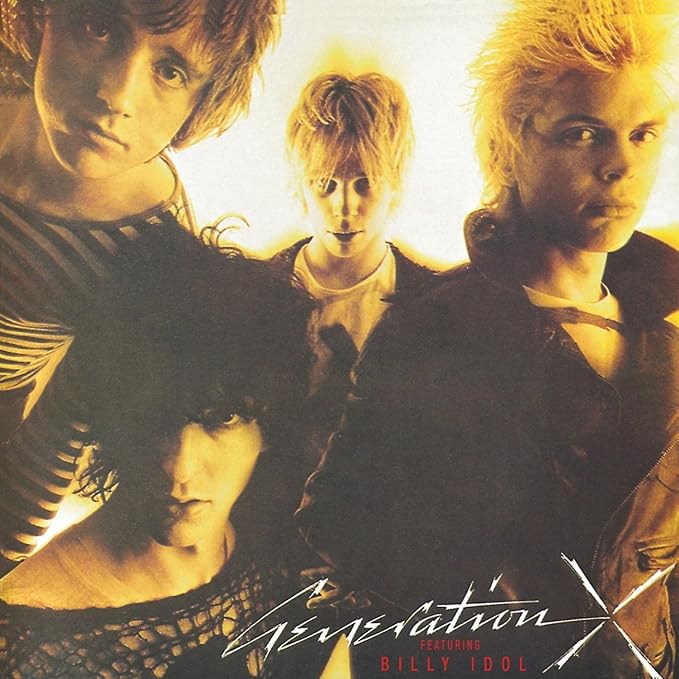
In November, Generation X drummer, Mark Laff, tours with his new project X Generation X – featuring Mark, alongside Westworld’s Elizabeth Westwood on vocals, Spandau Ballet’s Steve Norman on guitar and Vice Squad’s Michael Giaquinto on bass. I catch up with Mark to discuss the emergence of punk, the rise and fall of Generation X and the forthcoming UK tour.
So, the first question: we’ll go right back to the beginning. It’s coming up to 50 years, what are your reflections on the emergence of the punk scene in the UK in ’76?
For me, at the time, it was a situation whereby you felt with the bands that you liked, they had stepped across a great divide. And you really were not connected anymore. So, when the punk rock thing came you had an opportunity to get involved or not. I took the chance to get involved.
The emergence of it was incredible for me. I was a big fan – I still am a big fan – of the Sex Pistols. All the bands to me were making a statement, which I felt I could connect to and was, most importantly, really exciting.
Mark Laff – Photo Credit: Olga Rozewin Photography
After playing with Subway Sect, as punk was taking off, you then got a call to join Generation X in time to make their first album. How did that come about, moving from Subway Sect to Generation X?
Well, I won’t pass this one lightly because I’m eternally grateful to all the members of Subway Sect and The Clash camp for almost parental guidance, really. Subway Sect was a wonderful opportunity and great guys.
I think what’s important to say, just for the record also, is that I auditioned for The Clash the same day as Topper Heaton did. And Topper got it. I didn’t. And they liked what I was doing and offered me back to another situation, which I initially was told was with a guitar player, Keith Levine. But over the weekend, the Subway Sect drummer had left to join the army. So, I did the audition with the guys. Really liked it, went upstairs to Bernard (Rhodes – Clash/Subway Sect manager). And he said, “What do you think?” I said, “Yeah, let’s do it”. And he said, “Have you got a passport? I said, “No.” He said, “Well, can you get one by Wednesday? We’re going to Paris on Thursday.”
So, it was a dream come true from playing the drums at a really early age. And to be thinking those things maybe aren’t possible. To be in that situation where somebody says, “Get a passport, you’re going to Paris.” I’d never been abroad, Darren!
It was incredibly exciting. You had the Buzzcocks. You had the Jam on some of the dates. You had the Slits. You had the Subway Sect, and of course the Clash. This was like watching the future happen all on one night!
So, hearing the Generation X tape, I thought I really like that. So halfway through the tour, I was at Dingwalls in London. And who was there? John Ingham, who was the manager of Generation X. And we got chatting, and he said, “Why don’t you come down?” So, there was a little gap in the middle. I went for an audition. I didn’t hear anything back and I was just pleased that I went really because I was making myself available. I decided within myself that I probably wasn’t going to stick with the Subway Sect for a period much longer than the tour. And it really was just a musical thing. I wanted a bit more chaos. So, the tour started, I think, in St Albans and Tony James came up to me and said, “You’ve got the job.”
So, I finished the tour and literally we finished at Dunstable – California Ballroom. The drum kit came off the stage into the manager’s car and we were off. It was a seamless transition from one band to another.
And you toured with Generation X and then you made the first album?
Well, there were some rehearsals to be done and… actually the first few dates weren’t too successful. We were falling a little bit flat. And as it happened we ended up at Dingwalls and it all clicked. And record companies were there and the interest started. And yes, the rest is music history, I suppose.
We tried to stick with our first plan, which was to work with high-end engineers who knew their stuff. And we went in to do ‘Your Generation’, which was always gonna be the first single. I really liked that song. And ‘Day By Day’ was the B-side. And it didn’t work in the studio. We kind of realized, everybody realized, that the song was just falling a little bit short. We kind of thought, well where do we go with this? So, in discussions with the record company, Chrysalis Records, we decided to go with a guy called Phil Waiman who had, at the time, a real notable resume.
Yes, Sweet, Mud, Bay City Rollers and all that from the glam era a few years before.
And he was a drummer and he knew what he was doing. And we got to record… four songs, three and a half really. Well, we did some more but it just wasn’t clicking. It wasn’t clicking, I don’t think, with Billy and Tony with Phil. Probably a little bit too sweet-sounding.
So, we ended up with Martin Rushent. I don’t mean that to sound as a failing, Martin was fantastic in creating ‘the room’. He was like almost the fifth member of the band in terms of conversation and making sure everyone was happy. Just getting it to feel good in the room because, you know, we were young guys then, 18, 19. Tony was a lot older, but we were still young people and a little bit naïve. Wet behind the years with it all. So, he created a great feeling. And I think that’s the feeling that people really like after all these years on the first album.
It absolutely stands up as a classic rock and roll album. Absolutely.
Thank you very much.
And then looking at the second Generation X album, I believe you clashed with producer, Ian Hunter, in the studio. Ian is one of my all-time musical heroes so I will be fascinated to hear a little bit about this (laughs). But was that a frustrating album to make and was that the beginning of the end in terms of your involvement?
Yes, yes and yes are the short answers. But I will colour it in for you. I should say that we arrived at that situation with Ian Hunter because we’d released ‘Your Generation’, which did well but it didn’t chart in the Top 30. And we went with ‘Wild Youth’ – which again did well, but it didn’t chart Top 30. You’ve got to understand we signed a very big record deal that year. I think it was the biggest record deal of the year.
Then we stuck out ‘Ready Steady Go’, which did well again, got a lot of radio play. It was a real fans’ favourite, but it didn’t chart particularly well. We were aiming for Top 30. All of these got Top of the Pops performances so the record company dug deep and suggested that we go with somebody that we liked. Tony and Billy were all over the Mott The Hoople thing. I thought they were okay. It wasn’t my favourite band. I had a couple of records but I understood the process there.
We were all asked who should produce it. I went out on a limb and said I think Jimmy Page should produce us because he’ll make it sound incredibly different and very, very rock and roll.
You could already feel that commerciality was coming onto the table. “We’ve got to get commercial. We have to have hits to pay back the debt so that we can blah blah blah…” And especially America. So, Ian came in, and it was a rehearsal room in Camden, Chalk Farm I think. Atlantic rehearsal rooms.
And we worked a song. Ian didn’t like my drum kit. It was a Premier drum kit, and he said, “This is shit. You need a Ludwig.” Because his drummer had a Ludwig and they obviously sounded much, much better than mine. And Ludwig drums do sound rather sweet, especially the maple ones. So, he said, “Get yourself a Ludwig kit.” And, of course, I didn’t have the money for that. Ludwig drums are an absolute fortune, so it was a very difficult situation for me. We had to record the drum track three times. So, I had to layer it, layer it, layer it. You’ve got to understand here, I’m 18, 19. This is all too much for me, you know? It would have been too much for Phil Collins! Plus getting the right feel and not playing together was a different dynamic to control for me and for everybody else.
So anyway, we came out with ‘King Rocker’, which was a hit record. Very successful. So, everybody suggested that we move forward with Ian and go again. We did a second single called ‘Valley of the Dolls’. I was under pressure again. He wanted this four-on-the-floor, with a drum machine. There were no proper drum machines at the time, so I had to listen to this bossa nova beat and try and play a straight rock beat over that. So, it was a hellish experience, once again. I really like that song, I really like both those songs, ‘King Rocker’ and ‘Valley of the Dolls’. Playing with the drum machine was a bridge too far for me at the time.
We got it done. I was happy with it. He didn’t like the fact that it was taking that amount of time to do it. We got it done in an afternoon, but he wanted it done in three takes. So, I was at home one night. I think we’d been just rehearsing and I got a call very late in the evening about a band meeting. I think it was like one o’clock in the morning. Ridiculous you know. I went across and I was told that Ian had said, “Look, there’s a deal on the table for you here. We want you to seriously think about this.” Ian’s take on it was he didn’t want to spend that amount of time on the drums. I understand that. He felt that time was better spent on Billy’s vocals, and certainly the guitar playing. I get that. The deal was three takes. If you’re not done in three takes, we need somebody else to come in and do it very quickly. So, I was under pressure again to do this. I was given a choice of either Clive Bunker from Jethro Tull…
…and listen, punk rock fans don’t like to hear it, but I like Jethro Tull. I really do. Some of the songs, they are fantastic, especially the early stuff…
So, I had the choice of either Clive or Paul Thompson – Roxy Music. I don’t think Paul was available so Clive came in and was very, very supportive. He saw the pressure. He understood the situation and it was a pleasant working relationship with him and me. So, I think I did all the tracks and Clive did some tracks, and we did some tracks together.
And I was in a strange situation, Darren, because I’d be playing the drums, with Clive over there playing, and I’m thinking, “This is nuts! Why is he recording two drummers?” It was a bizarre situation. What really threw me off was that I was very emotionally involved in terms of influence with a drummer called Keith Moon and I think within the first week of doing the album he passed away. And it was a shocking experience for me. I was really, really upset. It was like, I hadn’t lost a close family member but it felt like the removal of someone very, very special – the whole thing you’re never going to see them again.
We’d just recently been rehearsing and Billy was at one function – I think it was Paul McCartney’s – I can’t remember what it was. Anyway, Billy very kindly brought Keith Moon down to the rehearsal room to see me. He came with Graham Chapman from Monty Python. So, I’m at the back of the rehearsal room, and in through the door I could see it’s down there, you know. I thought, oh my God it’s Keith! It’s all the crazy stuff that you feel, you know. And Graham Chapman walked in and Keith sat at the drum kit, and they did three songs with the band. It was absolutely incredible. He broke the bass drum pedal. Fantastic! He wasn’t in great shape, bless him, at the time. You could see he was suffering badly and he was only 33, I think. And it was kind of sad to see. And he was bloated, and there was obviously medication going on there which wasn’t helping.
And for Keith to die at that period was, well, it’s the death knell for me. I lost a lot of enthusiasm for doing that album, and it became a chore to me. But we got it done and it was well received to a point.
It was a transition process. We all knew that. That it was going to move away. We weren’t going to do the first album – part two. For Bob Andrews, it was a direction in the wrong direction, in that his influence on that record was not recognised copyright-wise. Neither was mine. I think he’s only one credit, which is ‘Running With The Boss Sound’. Which is shocking, really, because Billy and Tony should have sat down with the two of us and said, “Look, this is what we’ll do.” Come up with some arrangement.
The band was polarised anyway, and this is important, in that there was a class divide. Myself and Bob, you’d have to say, were working class. I came from a council flat, albeit a very posh one, Darren! Bob was from a working-class family, and Billy and Tony were middle class. So, there was a university divide there, if you will.
So that created a problem in itself as time went on and I think, possibly, Bob pressed the mute button. Became silent, non-responsive. And had he spoken up, he would have got what he wanted because I think what’s important to tell you here, Darren, is that Bob Andrews was by far the best guitarist in town at the time. 17, 18 years old, playing that stuff. Incredible. There was no one around to touch him, not within the punk rock thing, and he’d wiped the floor with a lot of notable guitar players. And I’m not blowing his trumpet. I don’t need to. That’s how it was.
But he pressed the mute button and went further into reclusive behaviour. And it was a divide of me and him, and Billy and Tony. And it made things a little bit uncomfortable to the point you could feel it. You could feel it where it was going to break and it eventually did break after a period. A very short period after the album. We did tour that album, and it was fun. The irony here is that that was meant to introduce us to America. We never went to America, sadly. Billy went on a promotional visit, but that was it. During this time, also, there were very uncomfortable managerial problems. We lost John Ingham because he had an argument with Tony James. And Tony wasn’t going to be listening to any of that so John had gone.
Time went on I think in ’79 and Bob decided to leave and I thought well that’s probably it. I can’t remember that period too much, other than speaking to him and he’s saying, “It’s not happening… blah blah blah.” All the usual suspects of why a group splits up. You know somebody in a band that you don’t like at all wants to bring in the influence. You’re thinking, “Well this is not where I want to go.”
Also, it must be said that we were still growing up at that time. 18, 19. You’re not fully formed. And Tony, being six years older than us, he was ahead of the game. And was using that to his advantage, I think.
In fairness they went to Bob and said, “Look, come on. We can probably sort this out.” And he decided to come back. And we went to Japan and tried to do a third album. We went into Olympic Studios in Barnes with an engineer again. We’d reverted back to the initial idea. What was coming through the speakers wasn’t sounding great. There were some good songs there. ‘Dancing with Myself’ was there. We’d done that. Done enough stuff for an album which we’d had rehearsed. We’d all gone away for a week to Banbury in Oxfordshire. All being together and trying to make it up, if you will, which kind of worked. At this time, I think Billy was finding the frustration of the non-communication and the lack of response to his ideas not working.
It was uncomfortable for us to be together. And Bob decided to go again. We came into the end of the year. I thought, “Well, I’m just going to have to wait for the call here and see what happens.” Rather than throw the hat in. So, I went to Chrysalis Records one day only to find Billy and Tony in a management meeting with the record company. I thought, “Well, that’s it. It’s done.” So, it was done. It wasn’t a big surprise but there was some hurt there that it could have been done a lot better than that. So that was it.
Unfortunately, matters got worse with the band in that Billy and Tony decided to hang on to the equipment. Made us all sign the disclaimers for God knows what. And we parted company. And then, as you know, Billy and Tony recruited Terry and James for a tour. Then, I’m told from Tony that he found out that Billy was on his way to New York without saying goodbye. So, there you have it.
Billy obviously went on to stratospheric levels of success as a solo artist. Are there regrets that it wasn’t Generation X having that kind of success and longevity? Or do you just feel that there were so many personality differences, musical differences or whatever, that it could never have worked anyway?
I think the latter really, Darren. I still had this yearning for craziness. And we were going down the big commercial route now. We were trying to find formulas. And with the influence I had, that was all getting quashed. And Bob felt the same. It was all getting a bit – and this isn’t a slant on Billy – it was all getting a bit ‘Mony Mony’. I mean, I’ll go on record as saying I think Billy’s Rebel Yell would have been the album that Bob and I wanted Generation X to do.
Interesting, yeah. I can see that.
That’s what we would have loved to have done. It’s a fantastic record, as you know, with those songs. And so it’s ironic that Billy would have to go to America. I mean, he tried with ‘Mony Mony’. Please don’t think this is me having a go, and I’m very pleased for his success. He tried with ‘Mony Mony’, which wasn’t a particularly good hit. Met Steve Stevens via the Kiss manager, Bill Aucoin. Hugely influential in Billy’s career, it must be said. Bill Aucoin introduced him to so many different aspects of how to be a star, and you can see that he became the Billy Idol that people know him for today. It certainly wasn’t the Billy Idol that was in Generation X. So, a total change of character, if you will, to meet the American market.
The Americans love guitar bands. A pop thing could be very momentary, so for longevity the big rock thing – which Rebel Yell really is – a big rock album with some great commercial songs on it. And you know the following one Whiplash Smile I thought was really good. He tried to go into a more European feel with Keith Forsey, with the big drum machines all going on – but still with a big rock guitar with some great tunes on there.
And it must be said that for anyone that doesn’t know, Tony wrote the words and Billy came in with tunes, you know, or chords I should say. And some songs. And it was all coloured in by the band. So, I think Billy felt frustrated at the time that we were together because the journalism at the time was vicious, to say the least. If they wanted to kill you off, they would. You had some notable people at the NME, Charles Shaar Murray, who wasn’t shy in saying what he felt, Tony Parsons, Nick Kent. I think Nick Kent liked us, actually, but we were savaged in the press. I think because of the Pistols having their facial was totally different to a Generation X facial. It was a pretty boy thing versus ‘don’t bring that boy home’, you know? Yeah, so there was frustration in the press as well, but we would have got around that.
I think had we gone to America, it would have broadened our horizon. We would have understood a lot more about how it should be, but it didn’t happen, Darren. You know it was meant to be the way it was meant to be. So, I would have to say I blame that on management, who’d have another story to tell but we should have gone to America. Everyone had gone to America. The Damned had gone, the Clash had gone, Pistols had gone famously and ended up in San Diego. Susie had gone. We hadn’t, you know. Went to the Isle of Man!
Credit: Olga Rozewin Photography
So, to bring things right up to date now, what do you want to tell us about the X Generation X tour in November?
Well really for me, it’s wanting to be a part of the 50th anniversary of Punk Rock. I wanted to do something in 2019 with Bob Andrews and another group that I was in, Twenty Flight Rockers. And obviously we know what happened in 2020. So, two, two and a half, three years ago, I thought, what should I do? And I thought, well, we’ve got this anniversary coming up. It’s going to take me a while to find the right people to launch it.
And there is nobody going out there doing Generation X songs. I think it’s the right time for me to do that. And I think people will appreciate seeing it. There’s no Billy Idol. I’ve chosen female singers to front it. I think the comparison would be too difficult. I think Billy Idol’s shoes – although a small foot – probably a nine – they’re probably still too big to fill, you know. To get a guy in. So, I see this as a rolling thing of maybe working with different musicians in the X Generation X thing over the next few years and just trying to enjoy it really. And I feel that it’s very relevant today. The way things are in the UK at the moment is there are similarities to be drawn on, with the political side of things which are happening.
X Generation X – Photo Credit: Olga Rozewin Photography
Absolutely, yeah. A blast of punk could do us all the world of good! I actually think this kind of template you’ve got with the band is a is a great way forward for celebrating the music of iconic bands. You’re not a tribute band. You’ve still got a connection to the original band. You’ve got great professional musicians who come with their own CV and their own admirable track record. No one is dressing up, pretending to be Billy Idol or whoever. So, I think that’s a really good template for authentically celebrating the music of an iconic band like Generation X.
That’s very kind of you to say so, Darren, and it gives me a lot of inspiration to hear that It’s very hard to be in a band these days because the music industry, the way it is, everybody’s so busy in other projects. So, I’m left with no choice but to use other musicians in the future, really, because people aren’t available. We’re lucky to have all of us available at this time to be able to do it. So, Steve’s particularly busy with his own career; has been for some time. Elizabeth is incredibly busy. And Michael is seeking employment— I’m kidding! Probably the nicest guy in the band, actually, Michael. Why does he have the most ribbing? I don’t know. No, Michael’s fabulous. He makes me sound good, so I really appreciate what you said there. Are you going to be able to come to any of the shows?
Yeah, I’m going to be at Hove. Because I’m based on the south coast in so I’m going to be at Hove on the first night and very much looking forward to it. Is there anything else you want to say before we wrap up?
Hey, listen, come and check it out. This might be the only time you see these four people do this this which is exciting in itself. Makes it sound a little bit like a theatre production but it’s not at all, it’s really a rock and roll thing. But it’s going to be exciting. It’s going to be loud. Thunderous. Angry. And yeah, I hope people enjoy it!
Mott The Hoople were a band I happened upon quite by chance as a young teenager in the early 1980s while I was flipping through the second-hand album racks in Preston’s Action Records. Even though I’d never heard of Mott The Hoople (and with the name reminding me a bit of the fictitious Monty Python band, Toad The Wet Sprocket), I was somehow drawn to the bright pink cover of the Mott album and decided it was worth a punt. Getting it home, I was immediately transfixed by songs like ‘All The Way From Memphis’, ‘Violence’ and ‘I Wish I Was Your Mother’ and a lifelong love affair with the band began.
Mott The Hoople had been defunct for several years by then, of course, but in the years that followed I avidly followed Ian Hunter’s solo career, saw the band on each of the three Mott reunion tours and attended the previous Mott The Hoople convention in 2016.
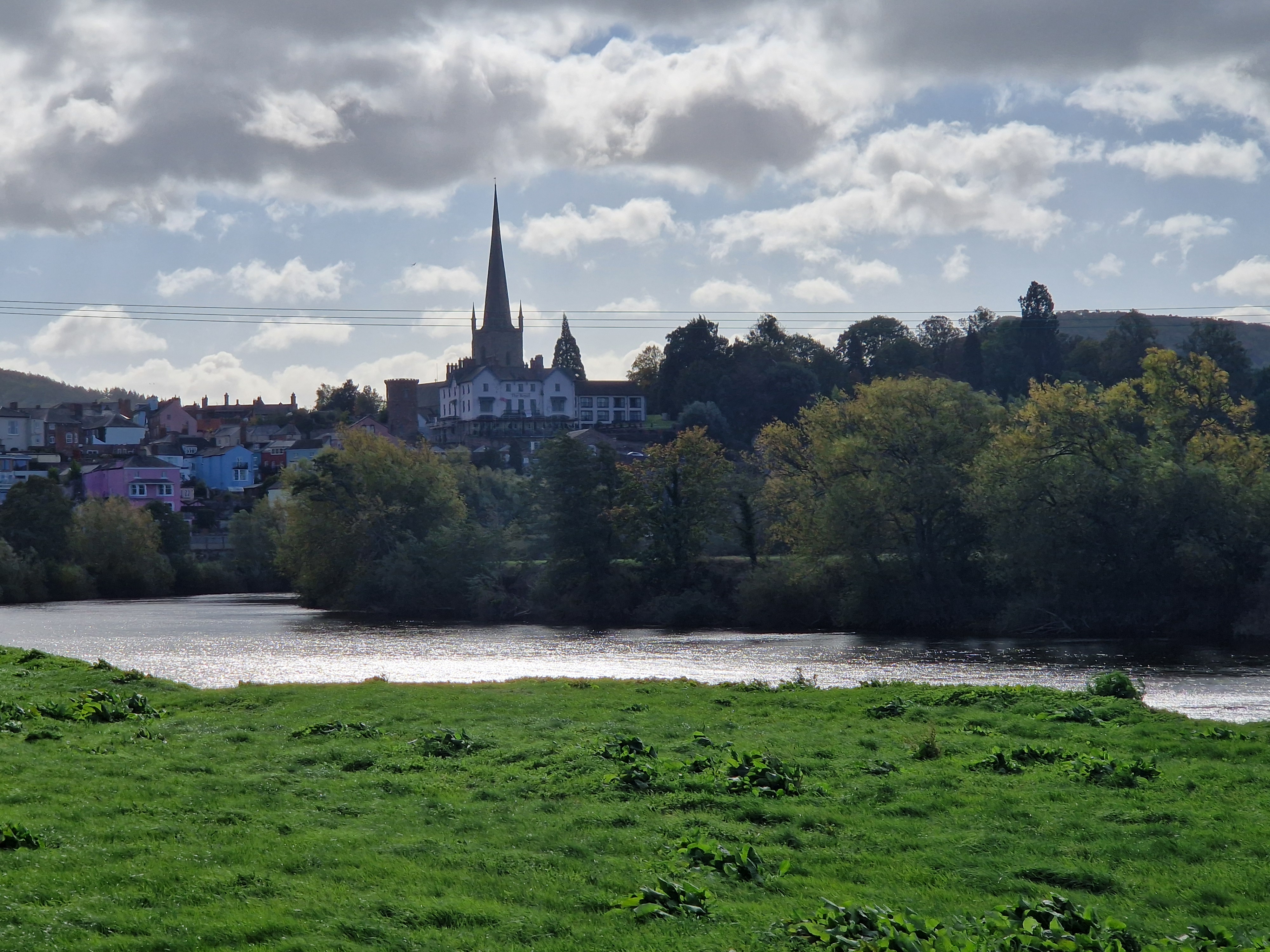
Ross on Wye on the Herefordshire/Welsh border is quite some journey from Hastings but I thought I’d make a mini-Autumn break of it and so found myself a holiday apartment for four nights so I could do a little exploring of the local area as well as enjoying Mott Fest on the Friday evening and all day Saturday.
Ross on Wye from the banks of the River Wye
Friday
With the expectation that this would almost certainly be the last gathering of its kind, the historic but compact Corn Exchange venue was absolutely packed out. The acoustics of this high-ceilinged building, combined with the excitable background chitter-chatter of long time Hoople devotees reconnecting with one another meant that I struggled to understand a word of any of the spoken-word bits. Plus things were late getting started and the video screen wasn’t working. It was all promising to be a bit different from the previous convention nine years earlier, but from these ramshackle beginnings (not unlike the history of Mott The Hoople itself, as some wags may have put it!) the magic began to shine through.
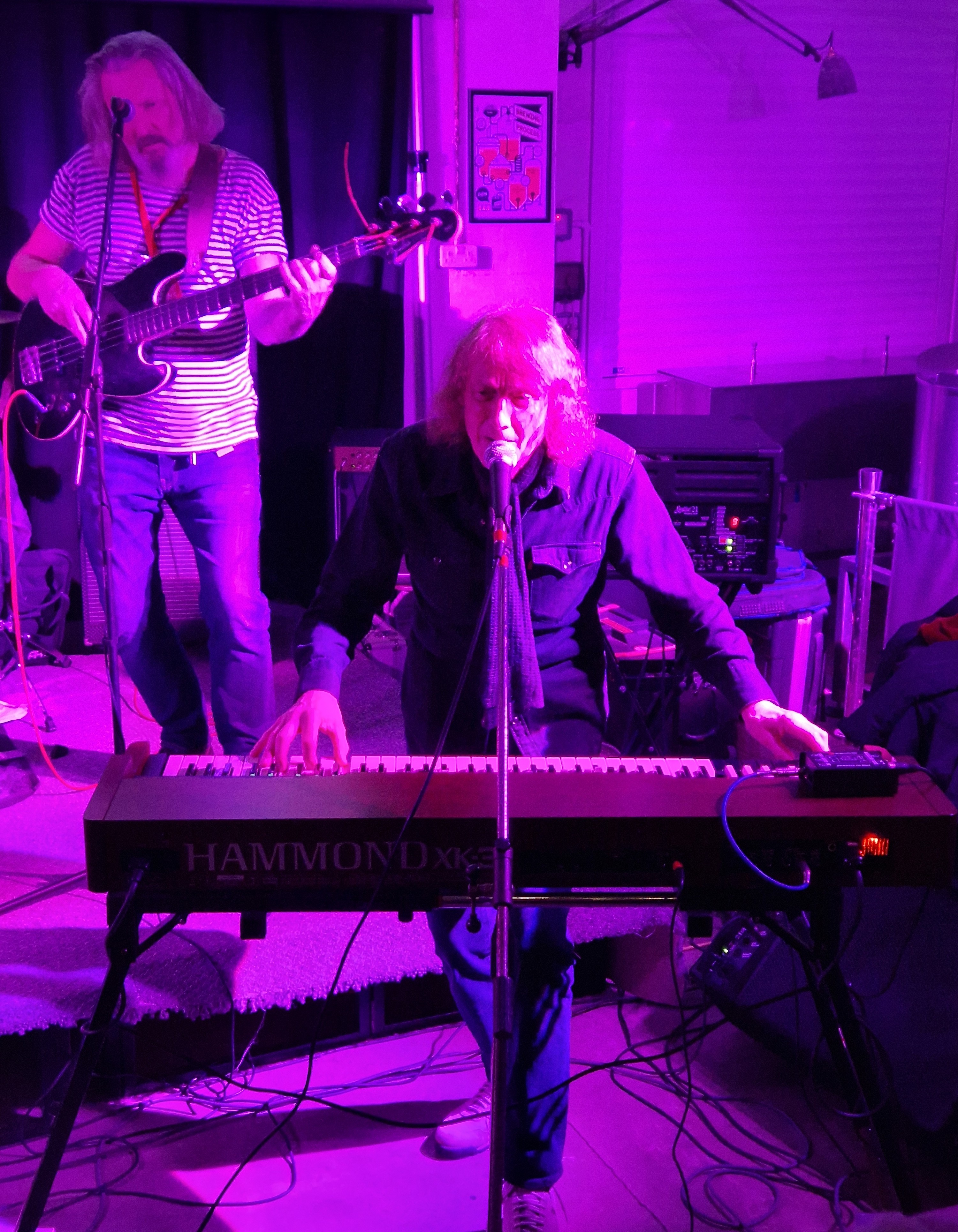
Verden Allen performing on the Friday evening
The highlight of the Friday night was the live set from Verden Allen and The Worried Men, with whom Allen had worked with on his Soft Ground album. The set, with a mix of Mott The Hoople classics and material from his solo career, absolutely made the evening. It was just sublime to hear the familiar pounding of that distinctive Hammond in an intimate venue like this.
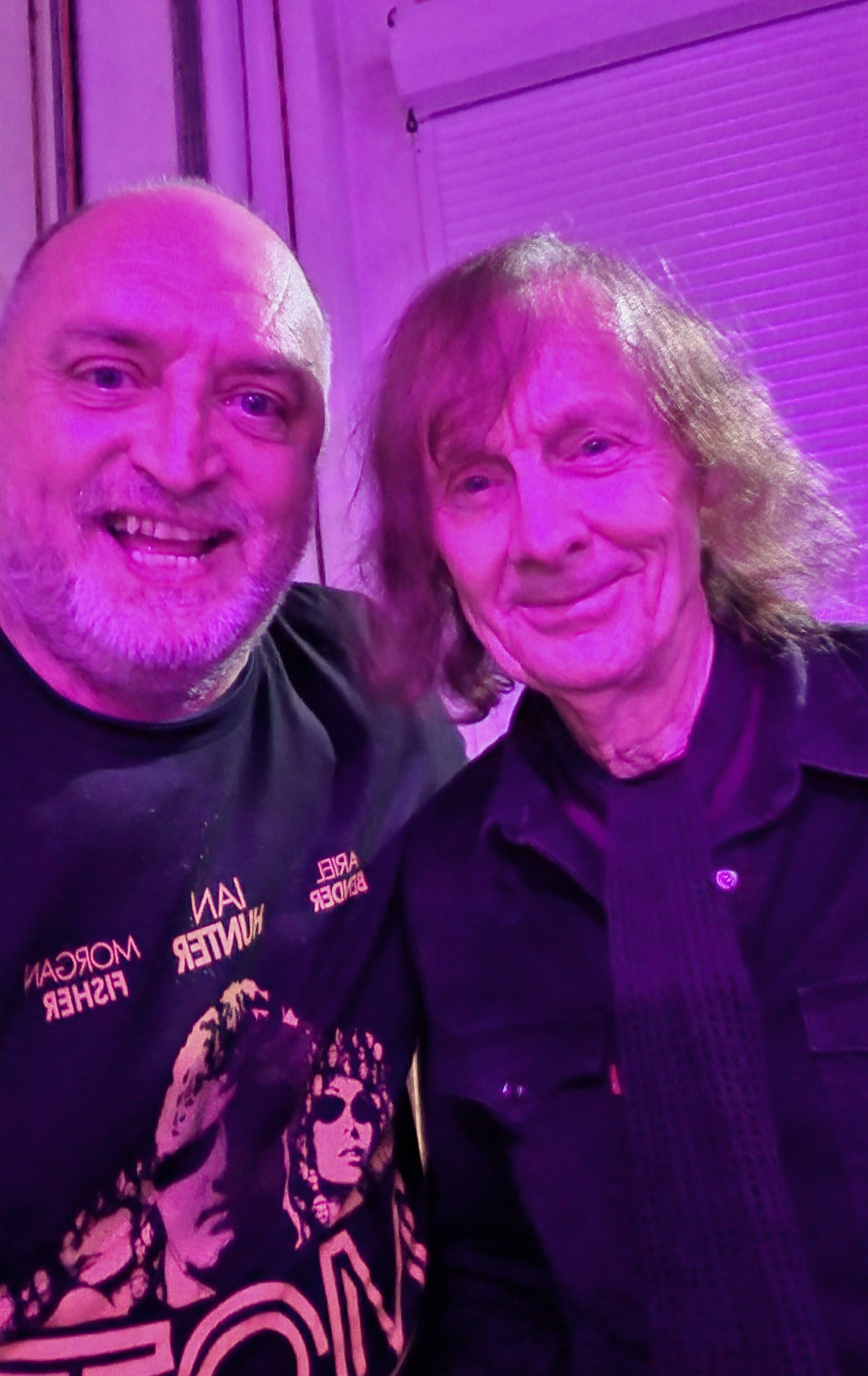
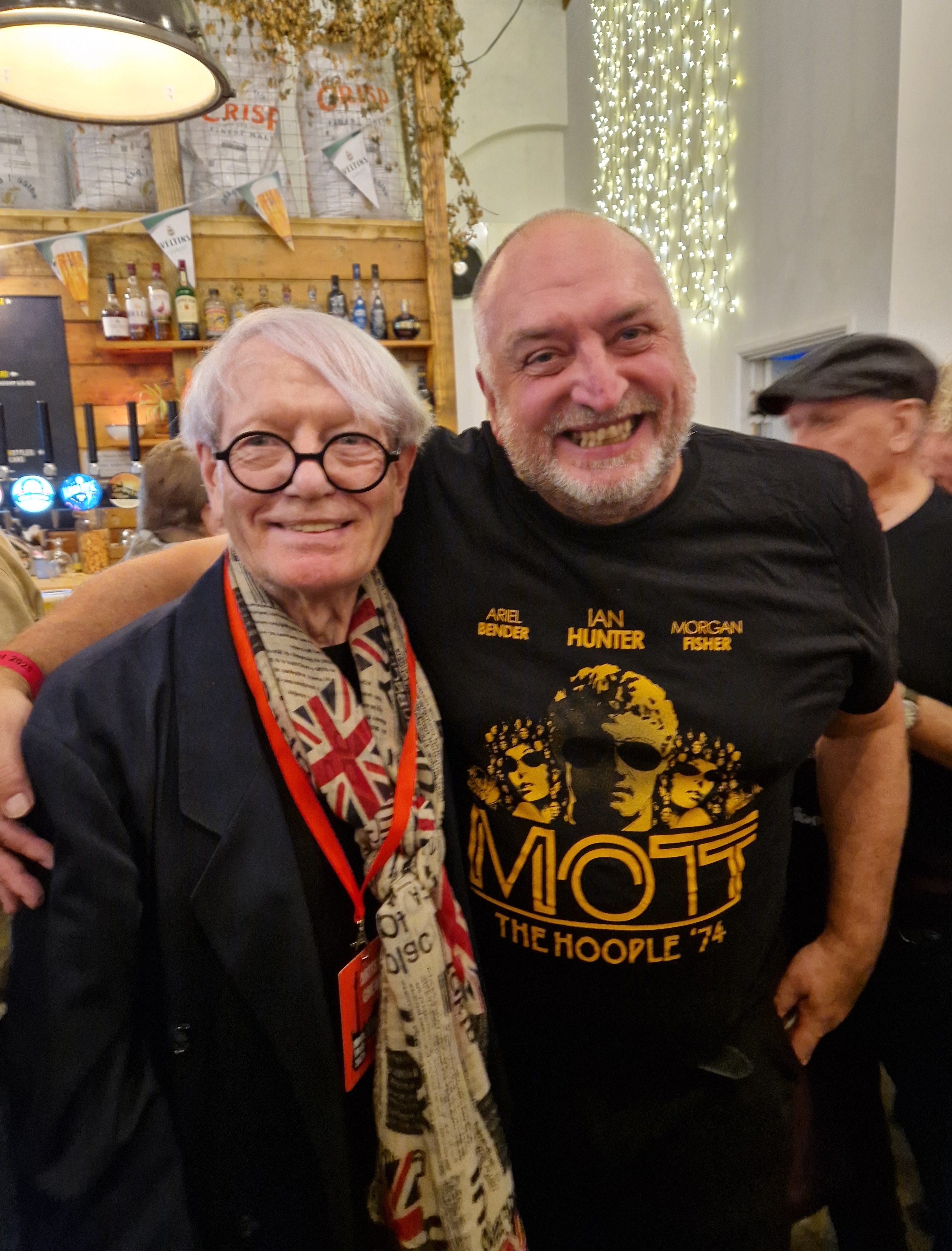
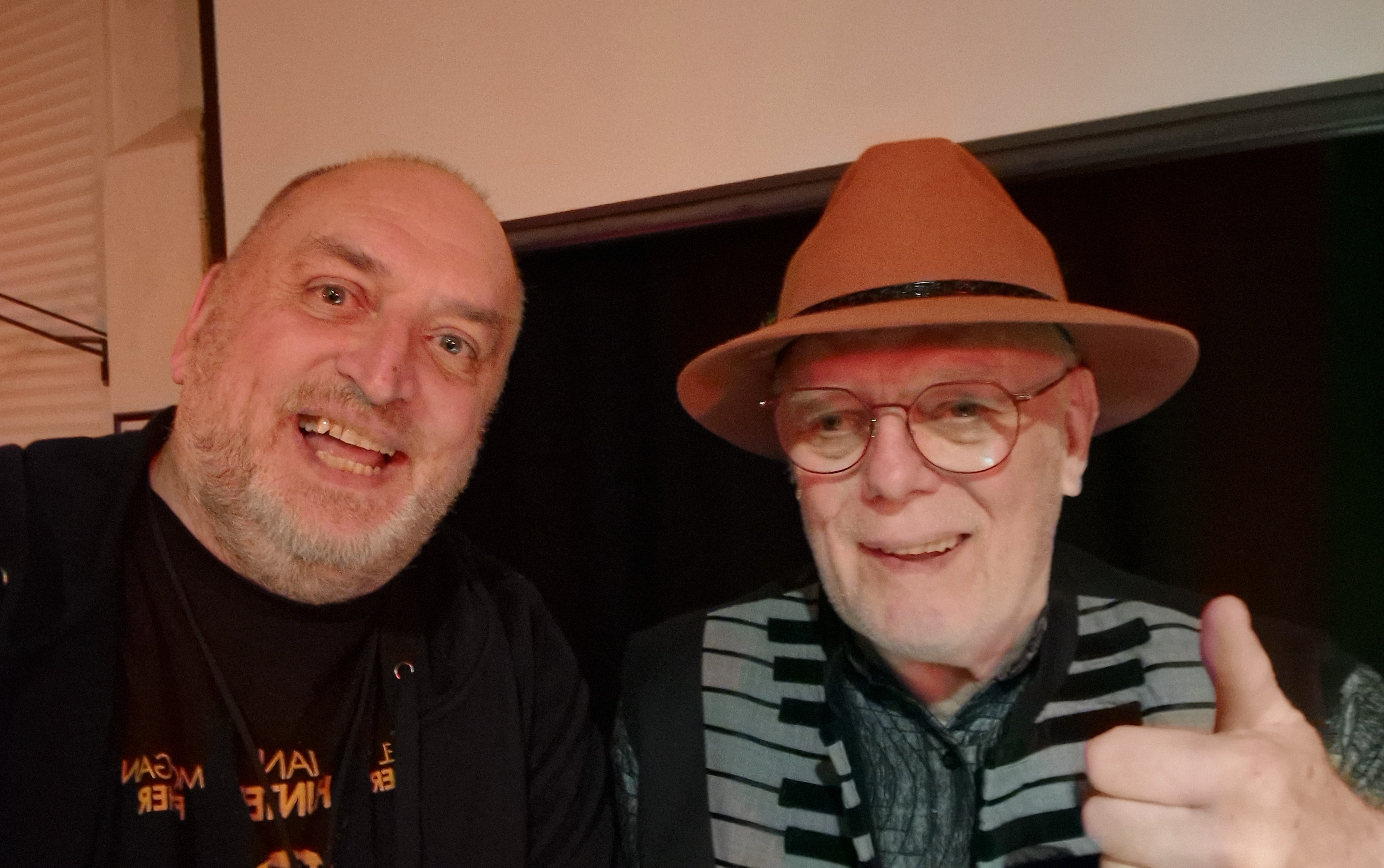
Selfie with Verden AllenWith Luther Grosvenor (Ariel Bender)Selfie with Morgan Fisher
Saturday
Whether it was due to a better sound balance, improved audience discipline or my hearing starting to get used to the acoustics (probably a mixture of all three to be fair), the spoken word parts of Saturday’s line-up were much easier to follow and I could finely make out what was being said. Plus the video screen was now up and running!
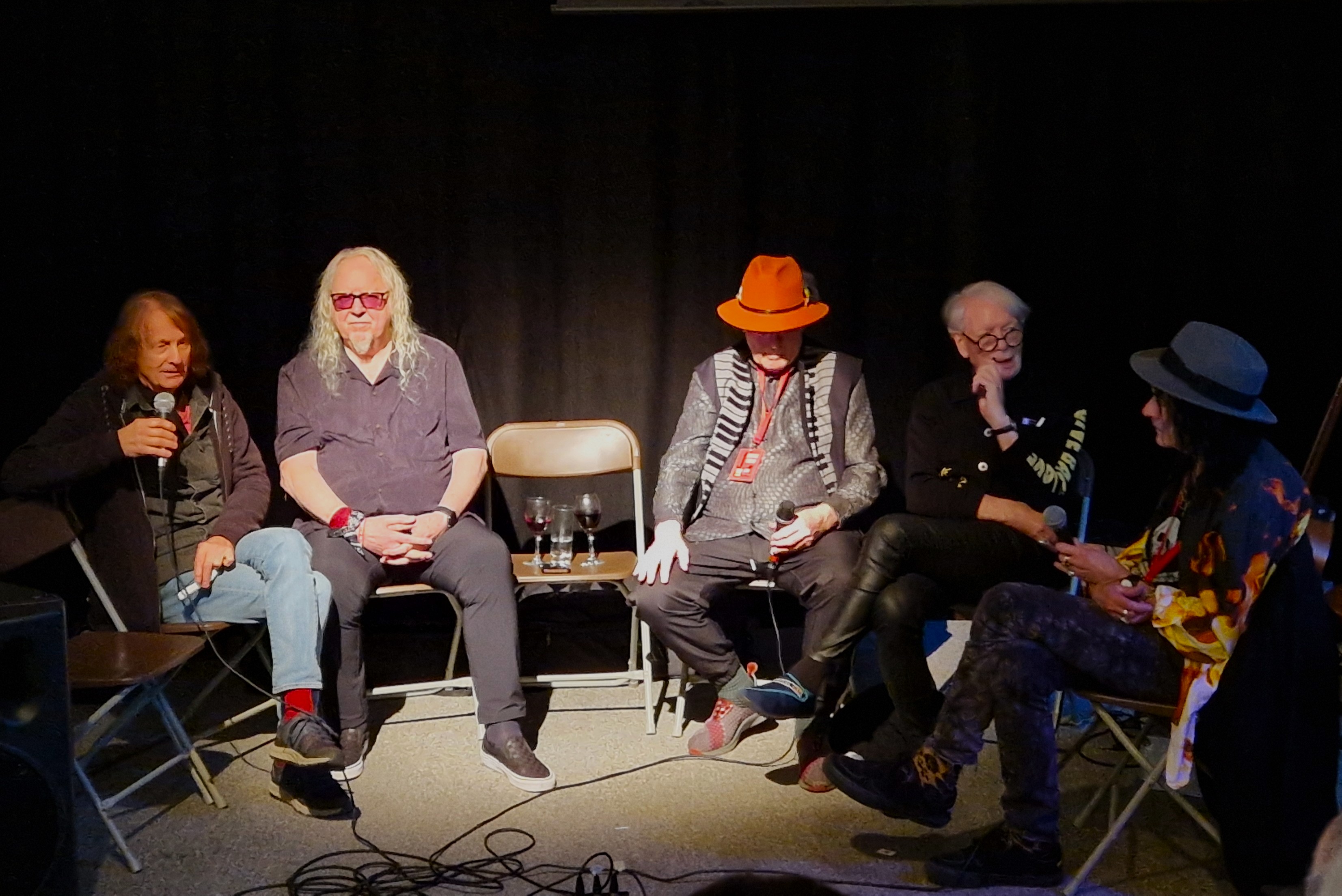
Mott The Hoople/British Lions alumni in conversation with Kris Needs
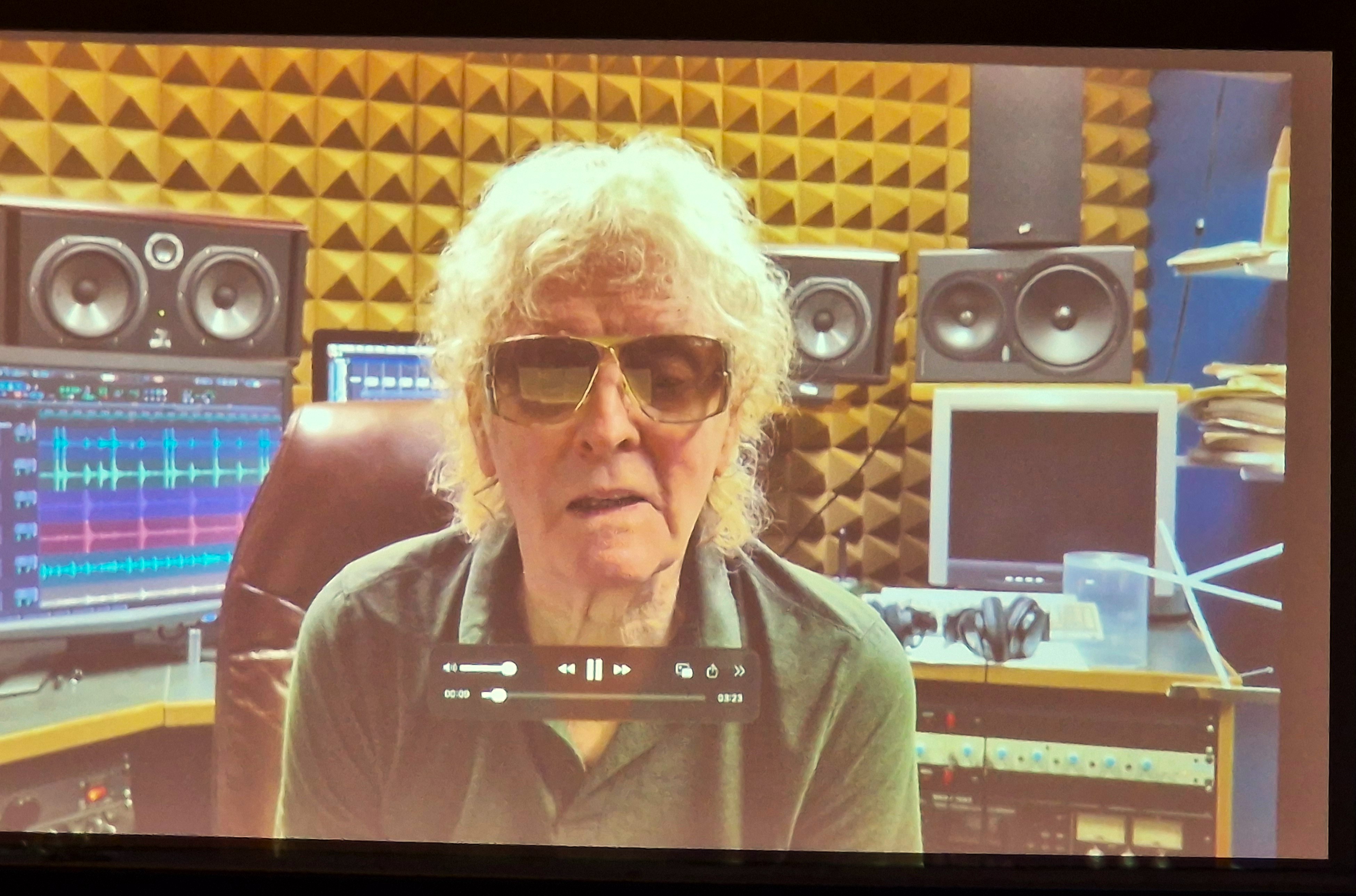
After a panel discussion of Mott fans sharing their early memories of the band with veteran fan club founder and long-time music writer, Kris Needs, there was a similar panel featuring all of the surviving musicians who were present from Mott The Hoople and its Mott and British Lions offshoots (namely Verden Allen, Ariel Bender, Morgan Fisher and John Fiddler), as well as various short film segments, including a video message from Ian Hunter, now the only other surviving member.
Ian Hunter sends a video message to Mott Fest 2025
The afternoon also saw a charity auction for St. Michael’s Hospice and the Alzheimer’s Society. After being outbid for an original gold disc marking sales of the ‘Roll Away The Stone’ single, I ended up splashing out £40 on a band publicity shot signed by Overend Watts and Dale Griffin – the only two Mott The Hoople members who I never got to meet to ask for an autograph in person!
Luther Grosvenor (Ariel Bender)
Then it was over to the live music, with sets from Luther Grosvenor (Ariel Bender) featuring acoustic material from his recent solo albums and accompanied by Morgan Fisher on piano; from British Lions frontman, John Fiddler, accompanied by Dave Bucket Colwell (the man who played alongside and then subsequently replaced none other than Mick Ralphs in Bad Company); and from Morgan Fisher who also took on the role of Musical Director for the weekend.
John Fiddler and Dave ‘Bucket’ Colwell
The highlight of this latter set, and indeed the most moving and poignant moment of the whole weekend, was Fisher’s rendition of ‘Rest In Peace’ accompanied by a video montage featuring images of Dale Griffin (who passed away in 2016), Overend Watts (who passed away the following year) and Mick Ralphs (who died in June this year). Definitely a not-a-dry-eye-in-the-house-moment.
Morgan Fisher
The evening closed with a gloriously ramshackle finale, giving all of us present a chance to yell along to ‘All The Young Dudes’ and ‘Saturday Gigs’ at the top of our voices and featuring on stage Morgan Fisher, Ariel Bender, John Fiddler, Dave ‘Bucket Colwell, Kris Needs, John Otway and Dale Griffin’s brother, Bob, alongside key members of the festival organising team.
The grand finale
Sunday
This wonderful weekend of all things Mott rounded off on the Sunday with family members unveiling a memorial bench dedicated to Dale Griffin and Overend Watts and with the Mayor of Ross on Wye unveiling a blue plaque commemorating the location where the pair performed their first gig. A fitting end to a fantastic weekend.
Overend Watts’ sister Jane and Dale Griffin’s brother Bob at the memorial benchBench plaqueCrowds gather for the unveiling of the blue plaqueThe Mayor of Ross on Wye unveils the plaqueThe Mott The Hoople plaque
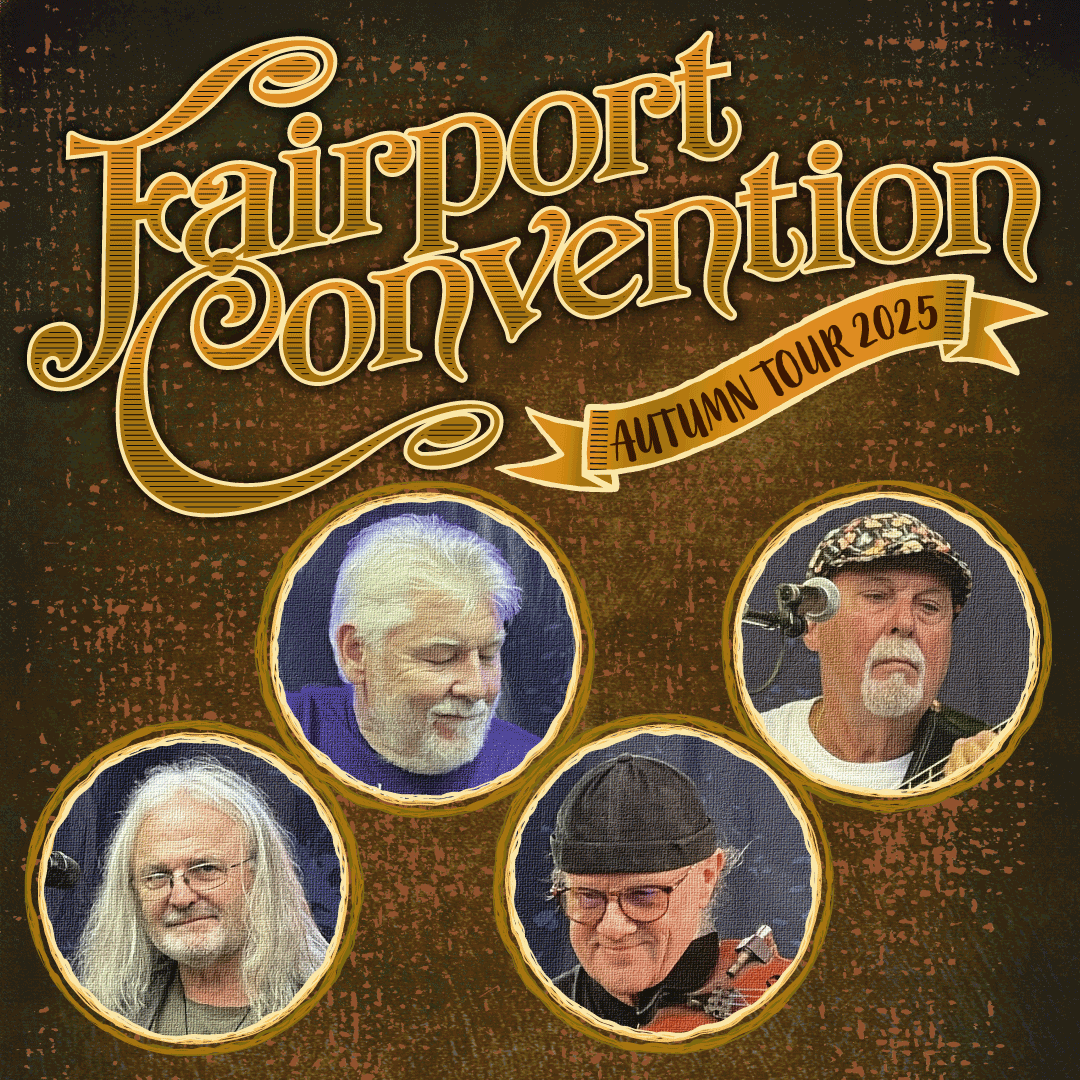
Following a triumphant sold-out Cropredy festival this summer (see my review here), folk rock legends Fairport Convention embark on an Autumn 2025 UK tour.
Playing as a stripped back four-piece, Simon Nicol, Dave Pegg, Ric Sanders and Chris Leslie will take to the road in October with 23 dates across England, Scotland and Wales, rounding things off in Liverpool on November 2nd.
Interviewing Dave Pegg earlier in the year, he emphasised how important playing live still was to the band:
“We still enjoy touring enormously and treading the boards has always been what Fairport is good at. We’ve had more success playing live than we’ve had making albums.”
You can read my full interview with Dave Pegg here.
Dave Pegg at Cropredy- Photo: Simon Putman
2025 marks 40 years since the Gladys’ Leap album – the first of the reunited Fairport Convention, featuring Simon Nicol, Dave Pegg and the first contributions from Ric Sanders.
Interviewing Ric Sanders ahead of this summer’s Cropredy, we discussed the Gladys’ Leap album, and how Sanders thought he was merely being asked to contribute to a Dave Pegg side project when he first got the call:
“Peggy had this offshoot group – a fun outfit it was – and they were called Dave Pegg’s Cocktail Cowboys, of which Chris was a member as well. At this time, around about ‘85, I was just doing jazz gigs around the Midlands. Just going out, playing with different rhythm sections, like jazz musicians used to. And it wasn’t hugely lucrative, but I got by. Peggy sent me this tape and I thought he was asking me to play on a Cocktail Cowboys record because I had no idea that Swarb had decided that he didn’t want to carry on with Fairport. And so when the tape arrived and I listened to it, I thought, hello? Well, that’s Peggy playing the bass, obviously. That’s Dave Mattacks on drums. And that guitar I could tell straight away. And yeah, it turned out to be Gladys’ Leap. And I went along and my first day was just recording those three tracks that I did on the album. The standout track for me, and the one that stayed in the repertoire, is ‘The Hiring Fair’.”
You can read my full interview with Ric Sanders here.
Ric Sanders – Photo Kevin Smith
Fairport Convention’s Autumn Tour runs from 8th October to 2nd November, with some shows already sold out. Tickets are available to purchase now on the links below.
Fairport Convention – Autumn 2025 UK Tour
Wed, 8th Oct 2025 The Green Hotel, Kinross – TICKETS
Thu, 9th Oct 2025 The Green Hotel, Kinross – TICKETS
Fri, 10th Oct 2025 Byre Theatre, St Andrews – SOLD OUT














 Darren's music blog