Five years on from the release of his critically-acclaimed glam comeback album, The Last Glam in Town, and four years on from his tragic passing, new music from Glitter Band founder, John Rossall, has recently been hitting the airwaves.
The stream of glowing reviews for Last Glam in Town were a surprise even to Rossall. When I interviewed him back in 2020, he told me: “It’s like I’ve written them myself almost! It’s a surprise. The reviews everywhere – it’s been beyond my wildest dreams really.”
What people may not know, however, is that before he died John Rossall recorded a follow-up album to Last Glam In Town. John’s close friend and former PR, Anne Street, has worked tirelessly to get that final album released and made available to fans. While that wish so far remains unfulfilled, a track from the album and an accompanying video has been officially launched via You-Tube and has also been picking up enthusiastic airplay on Heritage Chart Radio and many other stations, including Kim Smith’s show on Radio Northwich and Jan Bjerrum’s show on Sunshine Radio.
The single ‘Not Good Enough’ is a collaboration between John Rossall, David Philp and Mark Standley. The video celebrates John’s Blackpool heritage – with colour and black and white segments marking a nod to both his 1970s Glitter Band heyday and his 1960s early career in the Boston Show Band. The video was created by Dave Forward of Manchester band, The Cathodes, who posted the video to his own YouTube channel.
Anne Street explained the background to both the single and the unreleased final album in a recent announcement on Facebook:
“When John was diagnosed with Stage 4 cancer in March 2021 he set about spending all his remaining time writing and recording a final glam album. He hoped to see it released before he died, but his record label procrastinated over the final mixes and this delay has continued. A renowned Dutch DJ and producer more recently offered to do the final mix free and for the benefit of John’s family, but record label would only agree if paid!
Meanwhile, John had collaborated with David Philp on one track, and Mark Standley was credited too. David as co-writer was eventually allowed to bring out his final mix which John had approved in 2021.
I met up with David at his home in Beverly Hills, L.A., June 2024, and we discussed the importance of getting this song out for John’s fans and as a tribute to John’s memory. It features both John Rossall and David Philp. However, David had to overcome all sorts of publishing hurdles and it’s finally ready.”
While the song is yet to receive an official release so that fans are able to purchase it through the main digital platforms, Anne Street remains hopeful that this can happen in the near future.
“It’s a fab, glamtastic song and hoping you’ll enjoy it,” she added.
The track entered Mike Read’s Heritage Chart Radio in the Top 40 following release. Currently at No. 38, it is expected to rise higher. The You-Tube video is also featured on Mike’s Heritage Chart TV Showfor Talking Pictures.
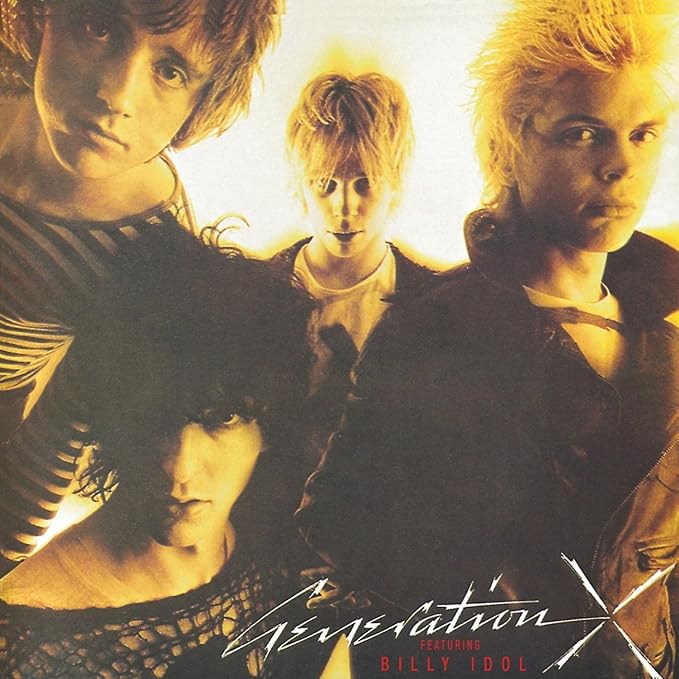
In November, Generation X drummer, Mark Laff, tours with his new project X Generation X – featuring Mark, alongside Westworld’s Elizabeth Westwood on vocals, Spandau Ballet’s Steve Norman on guitar and Vice Squad’s Michael Giaquinto on bass. I catch up with Mark to discuss the emergence of punk, the rise and fall of Generation X and the forthcoming UK tour.
So, the first question: we’ll go right back to the beginning. It’s coming up to 50 years, what are your reflections on the emergence of the punk scene in the UK in ’76?
For me, at the time, it was a situation whereby you felt with the bands that you liked, they had stepped across a great divide. And you really were not connected anymore. So, when the punk rock thing came you had an opportunity to get involved or not. I took the chance to get involved.
The emergence of it was incredible for me. I was a big fan – I still am a big fan – of the Sex Pistols. All the bands to me were making a statement, which I felt I could connect to and was, most importantly, really exciting.
Mark Laff – Photo Credit: Olga Rozewin Photography
After playing with Subway Sect, as punk was taking off, you then got a call to join Generation X in time to make their first album. How did that come about, moving from Subway Sect to Generation X?
Well, I won’t pass this one lightly because I’m eternally grateful to all the members of Subway Sect and The Clash camp for almost parental guidance, really. Subway Sect was a wonderful opportunity and great guys.
I think what’s important to say, just for the record also, is that I auditioned for The Clash the same day as Topper Heaton did. And Topper got it. I didn’t. And they liked what I was doing and offered me back to another situation, which I initially was told was with a guitar player, Keith Levine. But over the weekend, the Subway Sect drummer had left to join the army. So, I did the audition with the guys. Really liked it, went upstairs to Bernard (Rhodes – Clash/Subway Sect manager). And he said, “What do you think?” I said, “Yeah, let’s do it”. And he said, “Have you got a passport? I said, “No.” He said, “Well, can you get one by Wednesday? We’re going to Paris on Thursday.”
So, it was a dream come true from playing the drums at a really early age. And to be thinking those things maybe aren’t possible. To be in that situation where somebody says, “Get a passport, you’re going to Paris.” I’d never been abroad, Darren!
It was incredibly exciting. You had the Buzzcocks. You had the Jam on some of the dates. You had the Slits. You had the Subway Sect, and of course the Clash. This was like watching the future happen all on one night!
So, hearing the Generation X tape, I thought I really like that. So halfway through the tour, I was at Dingwalls in London. And who was there? John Ingham, who was the manager of Generation X. And we got chatting, and he said, “Why don’t you come down?” So, there was a little gap in the middle. I went for an audition. I didn’t hear anything back and I was just pleased that I went really because I was making myself available. I decided within myself that I probably wasn’t going to stick with the Subway Sect for a period much longer than the tour. And it really was just a musical thing. I wanted a bit more chaos. So, the tour started, I think, in St Albans and Tony James came up to me and said, “You’ve got the job.”
So, I finished the tour and literally we finished at Dunstable – California Ballroom. The drum kit came off the stage into the manager’s car and we were off. It was a seamless transition from one band to another.
And you toured with Generation X and then you made the first album?
Well, there were some rehearsals to be done and… actually the first few dates weren’t too successful. We were falling a little bit flat. And as it happened we ended up at Dingwalls and it all clicked. And record companies were there and the interest started. And yes, the rest is music history, I suppose.
We tried to stick with our first plan, which was to work with high-end engineers who knew their stuff. And we went in to do ‘Your Generation’, which was always gonna be the first single. I really liked that song. And ‘Day By Day’ was the B-side. And it didn’t work in the studio. We kind of realized, everybody realized, that the song was just falling a little bit short. We kind of thought, well where do we go with this? So, in discussions with the record company, Chrysalis Records, we decided to go with a guy called Phil Waiman who had, at the time, a real notable resume.
Yes, Sweet, Mud, Bay City Rollers and all that from the glam era a few years before.
And he was a drummer and he knew what he was doing. And we got to record… four songs, three and a half really. Well, we did some more but it just wasn’t clicking. It wasn’t clicking, I don’t think, with Billy and Tony with Phil. Probably a little bit too sweet-sounding.
So, we ended up with Martin Rushent. I don’t mean that to sound as a failing, Martin was fantastic in creating ‘the room’. He was like almost the fifth member of the band in terms of conversation and making sure everyone was happy. Just getting it to feel good in the room because, you know, we were young guys then, 18, 19. Tony was a lot older, but we were still young people and a little bit naïve. Wet behind the years with it all. So, he created a great feeling. And I think that’s the feeling that people really like after all these years on the first album.
It absolutely stands up as a classic rock and roll album. Absolutely.
Thank you very much.
And then looking at the second Generation X album, I believe you clashed with producer, Ian Hunter, in the studio. Ian is one of my all-time musical heroes so I will be fascinated to hear a little bit about this (laughs). But was that a frustrating album to make and was that the beginning of the end in terms of your involvement?
Yes, yes and yes are the short answers. But I will colour it in for you. I should say that we arrived at that situation with Ian Hunter because we’d released ‘Your Generation’, which did well but it didn’t chart in the Top 30. And we went with ‘Wild Youth’ – which again did well, but it didn’t chart Top 30. You’ve got to understand we signed a very big record deal that year. I think it was the biggest record deal of the year.
Then we stuck out ‘Ready Steady Go’, which did well again, got a lot of radio play. It was a real fans’ favourite, but it didn’t chart particularly well. We were aiming for Top 30. All of these got Top of the Pops performances so the record company dug deep and suggested that we go with somebody that we liked. Tony and Billy were all over the Mott The Hoople thing. I thought they were okay. It wasn’t my favourite band. I had a couple of records but I understood the process there.
We were all asked who should produce it. I went out on a limb and said I think Jimmy Page should produce us because he’ll make it sound incredibly different and very, very rock and roll.
You could already feel that commerciality was coming onto the table. “We’ve got to get commercial. We have to have hits to pay back the debt so that we can blah blah blah…” And especially America. So, Ian came in, and it was a rehearsal room in Camden, Chalk Farm I think. Atlantic rehearsal rooms.
And we worked a song. Ian didn’t like my drum kit. It was a Premier drum kit, and he said, “This is shit. You need a Ludwig.” Because his drummer had a Ludwig and they obviously sounded much, much better than mine. And Ludwig drums do sound rather sweet, especially the maple ones. So, he said, “Get yourself a Ludwig kit.” And, of course, I didn’t have the money for that. Ludwig drums are an absolute fortune, so it was a very difficult situation for me. We had to record the drum track three times. So, I had to layer it, layer it, layer it. You’ve got to understand here, I’m 18, 19. This is all too much for me, you know? It would have been too much for Phil Collins! Plus getting the right feel and not playing together was a different dynamic to control for me and for everybody else.
So anyway, we came out with ‘King Rocker’, which was a hit record. Very successful. So, everybody suggested that we move forward with Ian and go again. We did a second single called ‘Valley of the Dolls’. I was under pressure again. He wanted this four-on-the-floor, with a drum machine. There were no proper drum machines at the time, so I had to listen to this bossa nova beat and try and play a straight rock beat over that. So, it was a hellish experience, once again. I really like that song, I really like both those songs, ‘King Rocker’ and ‘Valley of the Dolls’. Playing with the drum machine was a bridge too far for me at the time.
We got it done. I was happy with it. He didn’t like the fact that it was taking that amount of time to do it. We got it done in an afternoon, but he wanted it done in three takes. So, I was at home one night. I think we’d been just rehearsing and I got a call very late in the evening about a band meeting. I think it was like one o’clock in the morning. Ridiculous you know. I went across and I was told that Ian had said, “Look, there’s a deal on the table for you here. We want you to seriously think about this.” Ian’s take on it was he didn’t want to spend that amount of time on the drums. I understand that. He felt that time was better spent on Billy’s vocals, and certainly the guitar playing. I get that. The deal was three takes. If you’re not done in three takes, we need somebody else to come in and do it very quickly. So, I was under pressure again to do this. I was given a choice of either Clive Bunker from Jethro Tull…
…and listen, punk rock fans don’t like to hear it, but I like Jethro Tull. I really do. Some of the songs, they are fantastic, especially the early stuff…
So, I had the choice of either Clive or Paul Thompson – Roxy Music. I don’t think Paul was available so Clive came in and was very, very supportive. He saw the pressure. He understood the situation and it was a pleasant working relationship with him and me. So, I think I did all the tracks and Clive did some tracks, and we did some tracks together.
And I was in a strange situation, Darren, because I’d be playing the drums, with Clive over there playing, and I’m thinking, “This is nuts! Why is he recording two drummers?” It was a bizarre situation. What really threw me off was that I was very emotionally involved in terms of influence with a drummer called Keith Moon and I think within the first week of doing the album he passed away. And it was a shocking experience for me. I was really, really upset. It was like, I hadn’t lost a close family member but it felt like the removal of someone very, very special – the whole thing you’re never going to see them again.
We’d just recently been rehearsing and Billy was at one function – I think it was Paul McCartney’s – I can’t remember what it was. Anyway, Billy very kindly brought Keith Moon down to the rehearsal room to see me. He came with Graham Chapman from Monty Python. So, I’m at the back of the rehearsal room, and in through the door I could see it’s down there, you know. I thought, oh my God it’s Keith! It’s all the crazy stuff that you feel, you know. And Graham Chapman walked in and Keith sat at the drum kit, and they did three songs with the band. It was absolutely incredible. He broke the bass drum pedal. Fantastic! He wasn’t in great shape, bless him, at the time. You could see he was suffering badly and he was only 33, I think. And it was kind of sad to see. And he was bloated, and there was obviously medication going on there which wasn’t helping.
And for Keith to die at that period was, well, it’s the death knell for me. I lost a lot of enthusiasm for doing that album, and it became a chore to me. But we got it done and it was well received to a point.
It was a transition process. We all knew that. That it was going to move away. We weren’t going to do the first album – part two. For Bob Andrews, it was a direction in the wrong direction, in that his influence on that record was not recognised copyright-wise. Neither was mine. I think he’s only one credit, which is ‘Running With The Boss Sound’. Which is shocking, really, because Billy and Tony should have sat down with the two of us and said, “Look, this is what we’ll do.” Come up with some arrangement.
The band was polarised anyway, and this is important, in that there was a class divide. Myself and Bob, you’d have to say, were working class. I came from a council flat, albeit a very posh one, Darren! Bob was from a working-class family, and Billy and Tony were middle class. So, there was a university divide there, if you will.
So that created a problem in itself as time went on and I think, possibly, Bob pressed the mute button. Became silent, non-responsive. And had he spoken up, he would have got what he wanted because I think what’s important to tell you here, Darren, is that Bob Andrews was by far the best guitarist in town at the time. 17, 18 years old, playing that stuff. Incredible. There was no one around to touch him, not within the punk rock thing, and he’d wiped the floor with a lot of notable guitar players. And I’m not blowing his trumpet. I don’t need to. That’s how it was.
But he pressed the mute button and went further into reclusive behaviour. And it was a divide of me and him, and Billy and Tony. And it made things a little bit uncomfortable to the point you could feel it. You could feel it where it was going to break and it eventually did break after a period. A very short period after the album. We did tour that album, and it was fun. The irony here is that that was meant to introduce us to America. We never went to America, sadly. Billy went on a promotional visit, but that was it. During this time, also, there were very uncomfortable managerial problems. We lost John Ingham because he had an argument with Tony James. And Tony wasn’t going to be listening to any of that so John had gone.
Time went on I think in ’79 and Bob decided to leave and I thought well that’s probably it. I can’t remember that period too much, other than speaking to him and he’s saying, “It’s not happening… blah blah blah.” All the usual suspects of why a group splits up. You know somebody in a band that you don’t like at all wants to bring in the influence. You’re thinking, “Well this is not where I want to go.”
Also, it must be said that we were still growing up at that time. 18, 19. You’re not fully formed. And Tony, being six years older than us, he was ahead of the game. And was using that to his advantage, I think.
In fairness they went to Bob and said, “Look, come on. We can probably sort this out.” And he decided to come back. And we went to Japan and tried to do a third album. We went into Olympic Studios in Barnes with an engineer again. We’d reverted back to the initial idea. What was coming through the speakers wasn’t sounding great. There were some good songs there. ‘Dancing with Myself’ was there. We’d done that. Done enough stuff for an album which we’d had rehearsed. We’d all gone away for a week to Banbury in Oxfordshire. All being together and trying to make it up, if you will, which kind of worked. At this time, I think Billy was finding the frustration of the non-communication and the lack of response to his ideas not working.
It was uncomfortable for us to be together. And Bob decided to go again. We came into the end of the year. I thought, “Well, I’m just going to have to wait for the call here and see what happens.” Rather than throw the hat in. So, I went to Chrysalis Records one day only to find Billy and Tony in a management meeting with the record company. I thought, “Well, that’s it. It’s done.” So, it was done. It wasn’t a big surprise but there was some hurt there that it could have been done a lot better than that. So that was it.
Unfortunately, matters got worse with the band in that Billy and Tony decided to hang on to the equipment. Made us all sign the disclaimers for God knows what. And we parted company. And then, as you know, Billy and Tony recruited Terry and James for a tour. Then, I’m told from Tony that he found out that Billy was on his way to New York without saying goodbye. So, there you have it.
Billy obviously went on to stratospheric levels of success as a solo artist. Are there regrets that it wasn’t Generation X having that kind of success and longevity? Or do you just feel that there were so many personality differences, musical differences or whatever, that it could never have worked anyway?
I think the latter really, Darren. I still had this yearning for craziness. And we were going down the big commercial route now. We were trying to find formulas. And with the influence I had, that was all getting quashed. And Bob felt the same. It was all getting a bit – and this isn’t a slant on Billy – it was all getting a bit ‘Mony Mony’. I mean, I’ll go on record as saying I think Billy’s Rebel Yell would have been the album that Bob and I wanted Generation X to do.
Interesting, yeah. I can see that.
That’s what we would have loved to have done. It’s a fantastic record, as you know, with those songs. And so it’s ironic that Billy would have to go to America. I mean, he tried with ‘Mony Mony’. Please don’t think this is me having a go, and I’m very pleased for his success. He tried with ‘Mony Mony’, which wasn’t a particularly good hit. Met Steve Stevens via the Kiss manager, Bill Aucoin. Hugely influential in Billy’s career, it must be said. Bill Aucoin introduced him to so many different aspects of how to be a star, and you can see that he became the Billy Idol that people know him for today. It certainly wasn’t the Billy Idol that was in Generation X. So, a total change of character, if you will, to meet the American market.
The Americans love guitar bands. A pop thing could be very momentary, so for longevity the big rock thing – which Rebel Yell really is – a big rock album with some great commercial songs on it. And you know the following one Whiplash Smile I thought was really good. He tried to go into a more European feel with Keith Forsey, with the big drum machines all going on – but still with a big rock guitar with some great tunes on there.
And it must be said that for anyone that doesn’t know, Tony wrote the words and Billy came in with tunes, you know, or chords I should say. And some songs. And it was all coloured in by the band. So, I think Billy felt frustrated at the time that we were together because the journalism at the time was vicious, to say the least. If they wanted to kill you off, they would. You had some notable people at the NME, Charles Shaar Murray, who wasn’t shy in saying what he felt, Tony Parsons, Nick Kent. I think Nick Kent liked us, actually, but we were savaged in the press. I think because of the Pistols having their facial was totally different to a Generation X facial. It was a pretty boy thing versus ‘don’t bring that boy home’, you know? Yeah, so there was frustration in the press as well, but we would have got around that.
I think had we gone to America, it would have broadened our horizon. We would have understood a lot more about how it should be, but it didn’t happen, Darren. You know it was meant to be the way it was meant to be. So, I would have to say I blame that on management, who’d have another story to tell but we should have gone to America. Everyone had gone to America. The Damned had gone, the Clash had gone, Pistols had gone famously and ended up in San Diego. Susie had gone. We hadn’t, you know. Went to the Isle of Man!
Credit: Olga Rozewin Photography
So, to bring things right up to date now, what do you want to tell us about the X Generation X tour in November?
Well really for me, it’s wanting to be a part of the 50th anniversary of Punk Rock. I wanted to do something in 2019 with Bob Andrews and another group that I was in, Twenty Flight Rockers. And obviously we know what happened in 2020. So, two, two and a half, three years ago, I thought, what should I do? And I thought, well, we’ve got this anniversary coming up. It’s going to take me a while to find the right people to launch it.
And there is nobody going out there doing Generation X songs. I think it’s the right time for me to do that. And I think people will appreciate seeing it. There’s no Billy Idol. I’ve chosen female singers to front it. I think the comparison would be too difficult. I think Billy Idol’s shoes – although a small foot – probably a nine – they’re probably still too big to fill, you know. To get a guy in. So, I see this as a rolling thing of maybe working with different musicians in the X Generation X thing over the next few years and just trying to enjoy it really. And I feel that it’s very relevant today. The way things are in the UK at the moment is there are similarities to be drawn on, with the political side of things which are happening.
X Generation X – Photo Credit: Olga Rozewin Photography
Absolutely, yeah. A blast of punk could do us all the world of good! I actually think this kind of template you’ve got with the band is a is a great way forward for celebrating the music of iconic bands. You’re not a tribute band. You’ve still got a connection to the original band. You’ve got great professional musicians who come with their own CV and their own admirable track record. No one is dressing up, pretending to be Billy Idol or whoever. So, I think that’s a really good template for authentically celebrating the music of an iconic band like Generation X.
That’s very kind of you to say so, Darren, and it gives me a lot of inspiration to hear that It’s very hard to be in a band these days because the music industry, the way it is, everybody’s so busy in other projects. So, I’m left with no choice but to use other musicians in the future, really, because people aren’t available. We’re lucky to have all of us available at this time to be able to do it. So, Steve’s particularly busy with his own career; has been for some time. Elizabeth is incredibly busy. And Michael is seeking employment— I’m kidding! Probably the nicest guy in the band, actually, Michael. Why does he have the most ribbing? I don’t know. No, Michael’s fabulous. He makes me sound good, so I really appreciate what you said there. Are you going to be able to come to any of the shows?
Yeah, I’m going to be at Hove. Because I’m based on the south coast in so I’m going to be at Hove on the first night and very much looking forward to it. Is there anything else you want to say before we wrap up?
Hey, listen, come and check it out. This might be the only time you see these four people do this this which is exciting in itself. Makes it sound a little bit like a theatre production but it’s not at all, it’s really a rock and roll thing. But it’s going to be exciting. It’s going to be loud. Thunderous. Angry. And yeah, I hope people enjoy it!
Mott The Hoople were a band I happened upon quite by chance as a young teenager in the early 1980s while I was flipping through the second-hand album racks in Preston’s Action Records. Even though I’d never heard of Mott The Hoople (and with the name reminding me a bit of the fictitious Monty Python band, Toad The Wet Sprocket), I was somehow drawn to the bright pink cover of the Mott album and decided it was worth a punt. Getting it home, I was immediately transfixed by songs like ‘All The Way From Memphis’, ‘Violence’ and ‘I Wish I Was Your Mother’ and a lifelong love affair with the band began.
Mott The Hoople had been defunct for several years by then, of course, but in the years that followed I avidly followed Ian Hunter’s solo career, saw the band on each of the three Mott reunion tours and attended the previous Mott The Hoople convention in 2016.
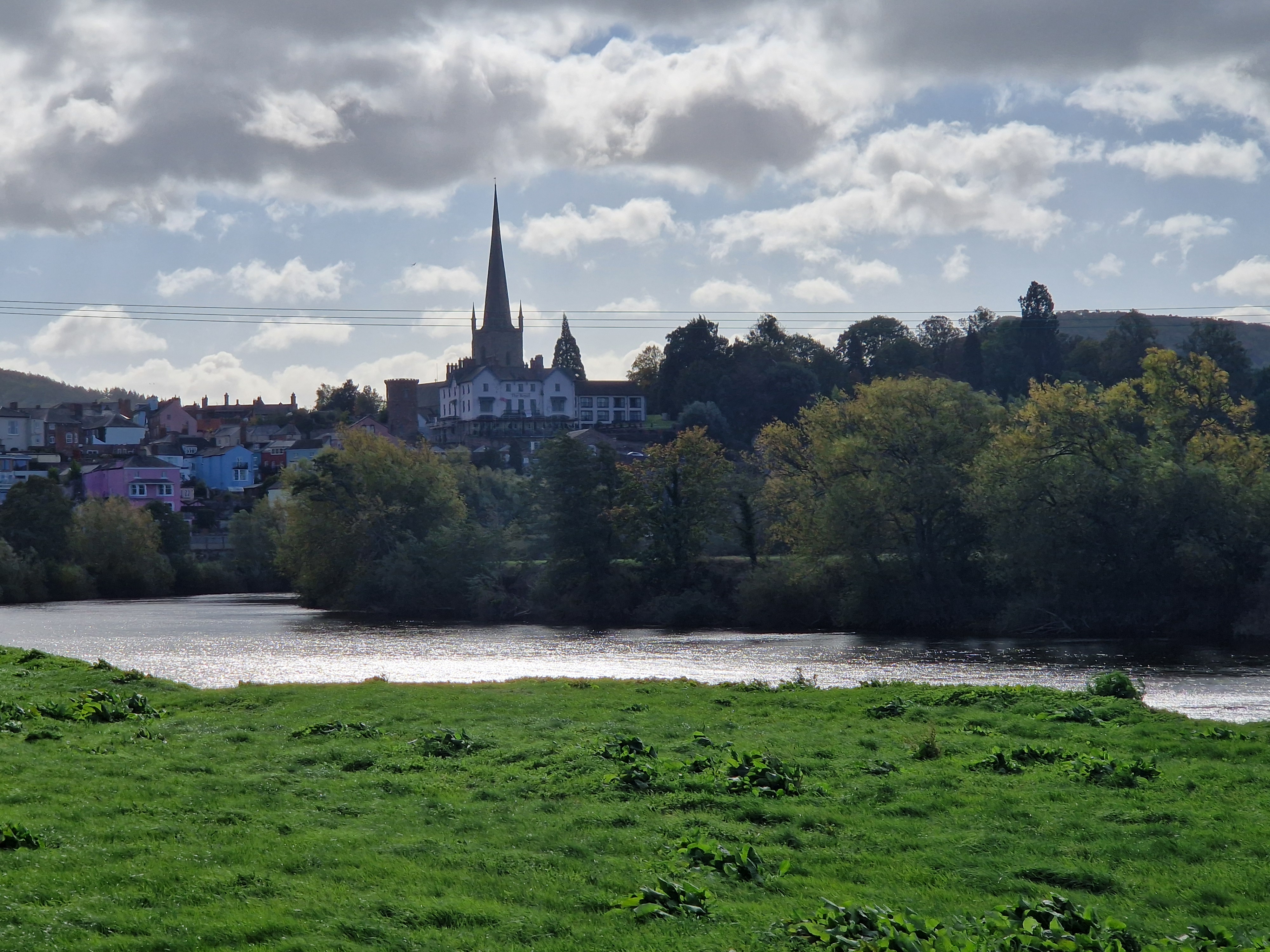
Ross on Wye on the Herefordshire/Welsh border is quite some journey from Hastings but I thought I’d make a mini-Autumn break of it and so found myself a holiday apartment for four nights so I could do a little exploring of the local area as well as enjoying Mott Fest on the Friday evening and all day Saturday.
Ross on Wye from the banks of the River Wye
Friday
With the expectation that this would almost certainly be the last gathering of its kind, the historic but compact Corn Exchange venue was absolutely packed out. The acoustics of this high-ceilinged building, combined with the excitable background chitter-chatter of long time Hoople devotees reconnecting with one another meant that I struggled to understand a word of any of the spoken-word bits. Plus things were late getting started and the video screen wasn’t working. It was all promising to be a bit different from the previous convention nine years earlier, but from these ramshackle beginnings (not unlike the history of Mott The Hoople itself, as some wags may have put it!) the magic began to shine through.
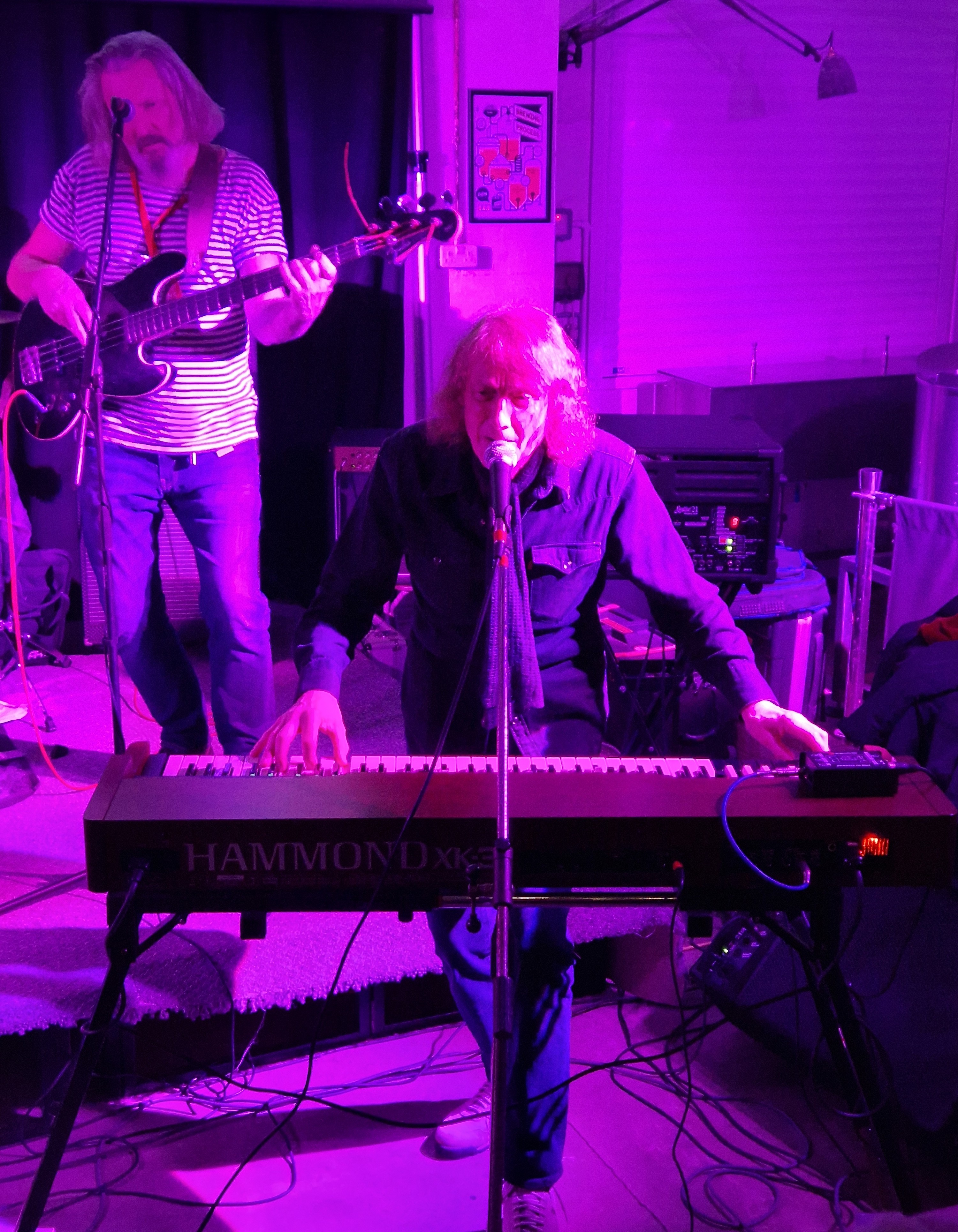
Verden Allen performing on the Friday evening
The highlight of the Friday night was the live set from Verden Allen and The Worried Men, with whom Allen had worked with on his Soft Ground album. The set, with a mix of Mott The Hoople classics and material from his solo career, absolutely made the evening. It was just sublime to hear the familiar pounding of that distinctive Hammond in an intimate venue like this.
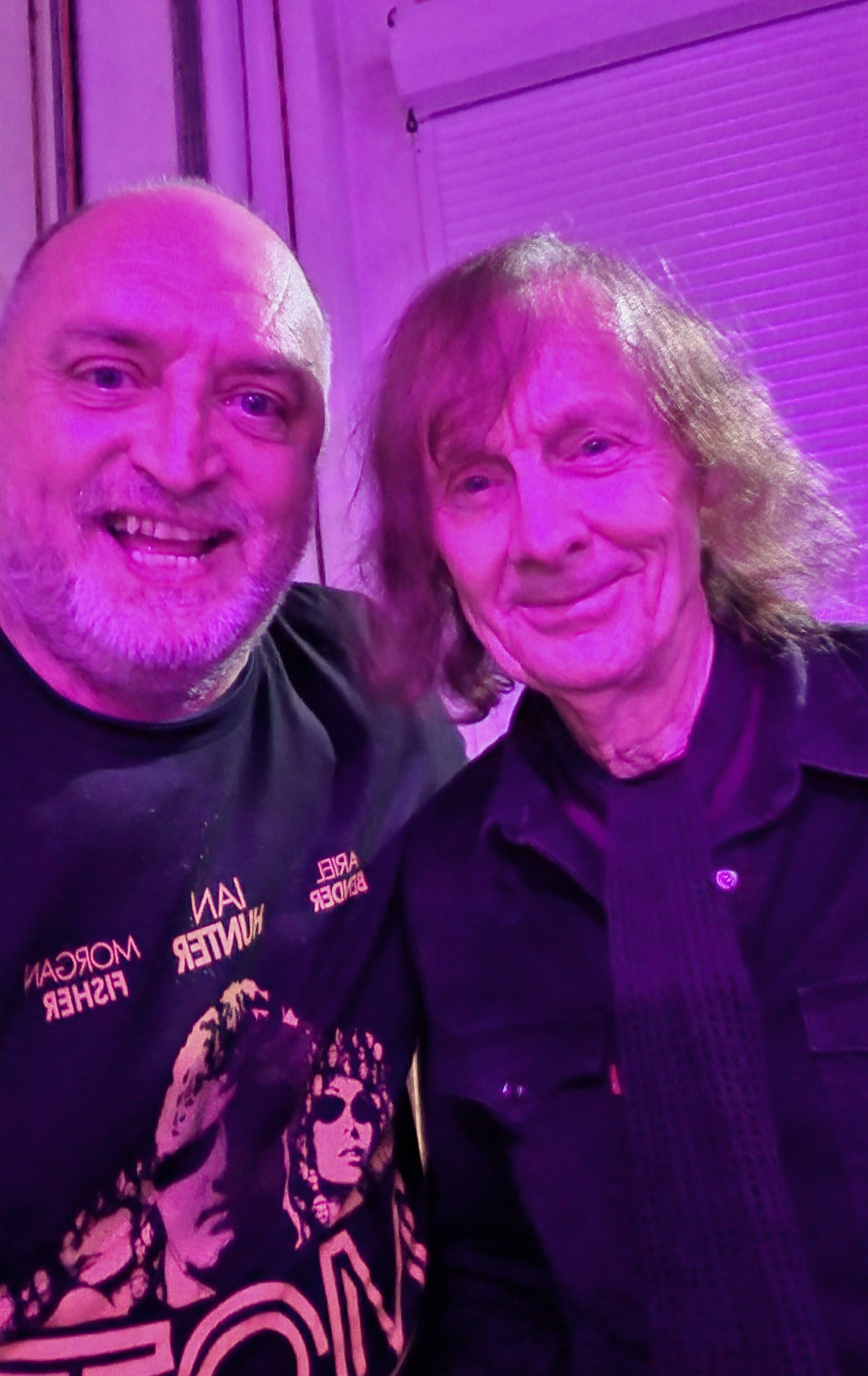
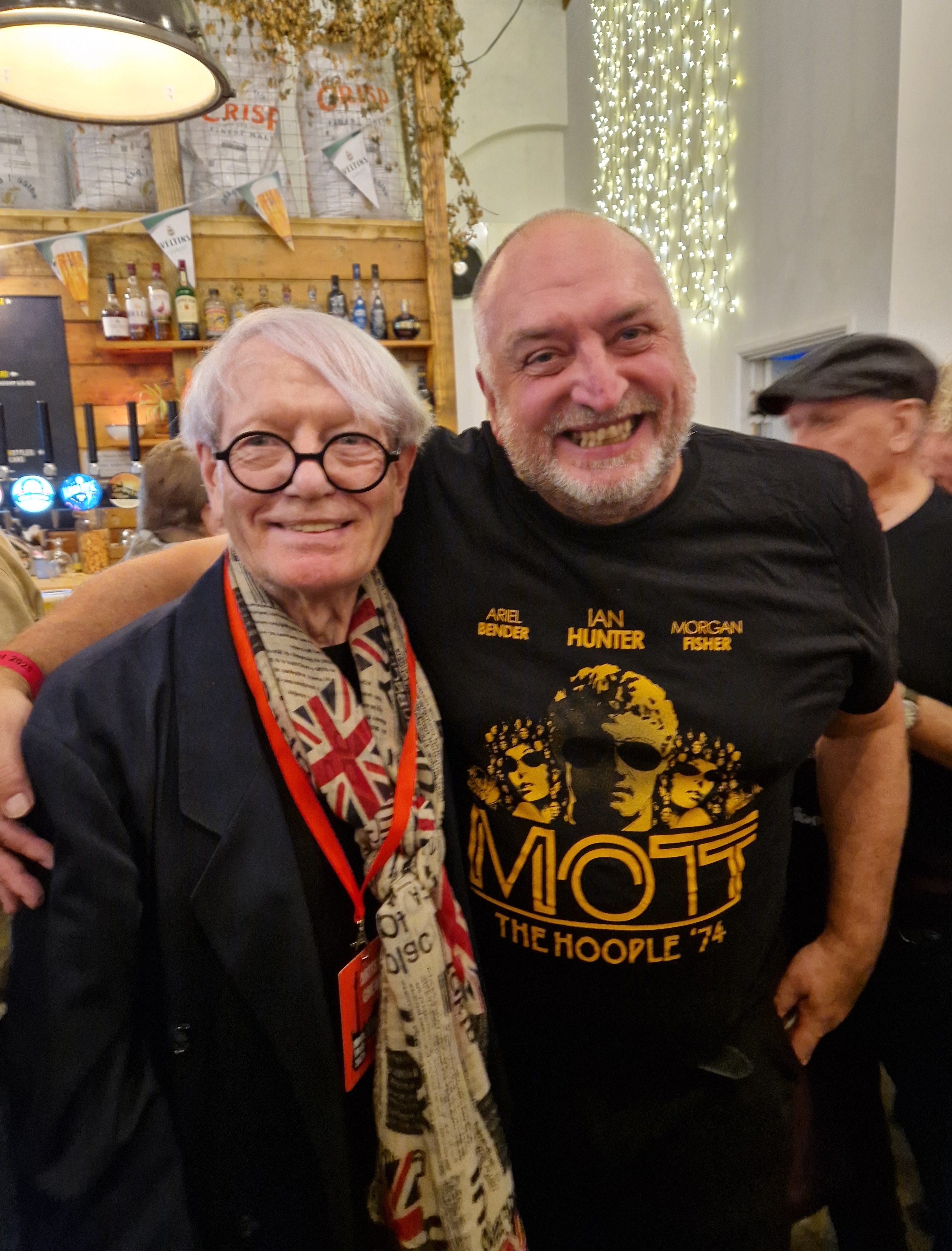
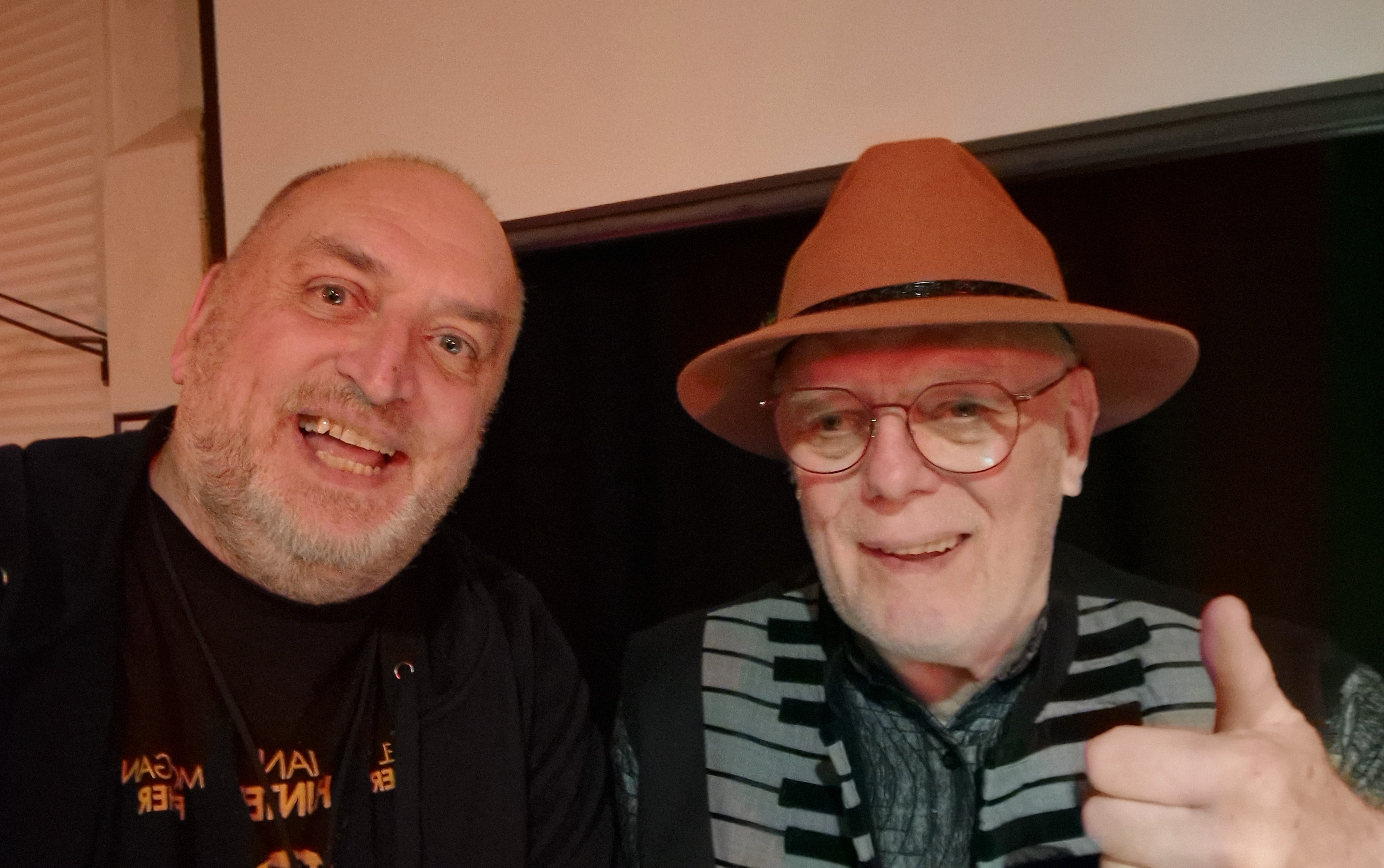
Selfie with Verden AllenWith Luther Grosvenor (Ariel Bender)Selfie with Morgan Fisher
Saturday
Whether it was due to a better sound balance, improved audience discipline or my hearing starting to get used to the acoustics (probably a mixture of all three to be fair), the spoken word parts of Saturday’s line-up were much easier to follow and I could finely make out what was being said. Plus the video screen was now up and running!
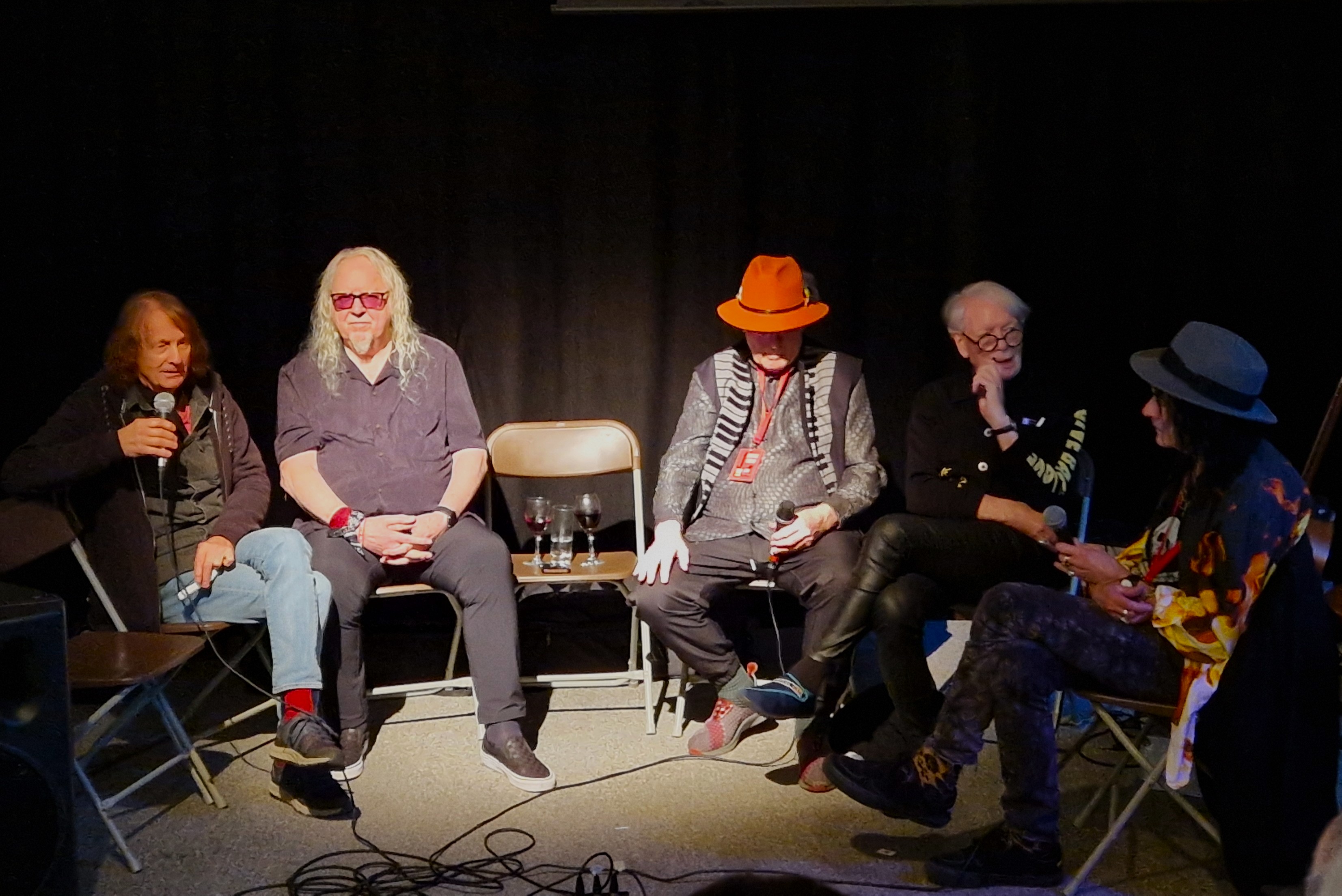
Mott The Hoople/British Lions alumni in conversation with Kris Needs
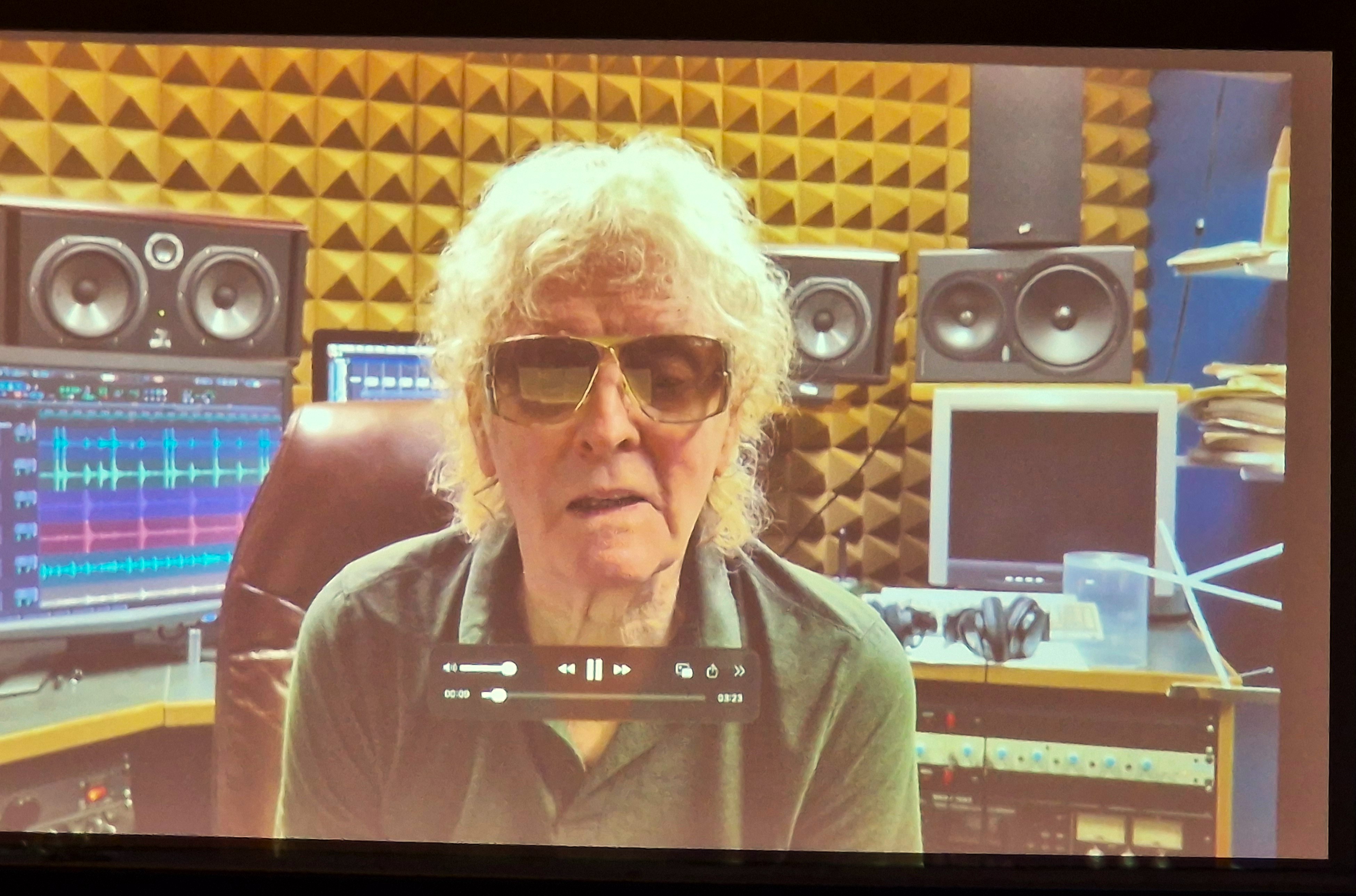
After a panel discussion of Mott fans sharing their early memories of the band with veteran fan club founder and long-time music writer, Kris Needs, there was a similar panel featuring all of the surviving musicians who were present from Mott The Hoople and its Mott and British Lions offshoots (namely Verden Allen, Ariel Bender, Morgan Fisher and John Fiddler), as well as various short film segments, including a video message from Ian Hunter, now the only other surviving member.
Ian Hunter sends a video message to Mott Fest 2025
The afternoon also saw a charity auction for St. Michael’s Hospice and the Alzheimer’s Society. After being outbid for an original gold disc marking sales of the ‘Roll Away The Stone’ single, I ended up splashing out £40 on a band publicity shot signed by Overend Watts and Dale Griffin – the only two Mott The Hoople members who I never got to meet to ask for an autograph in person!
Luther Grosvenor (Ariel Bender)
Then it was over to the live music, with sets from Luther Grosvenor (Ariel Bender) featuring acoustic material from his recent solo albums and accompanied by Morgan Fisher on piano; from British Lions frontman, John Fiddler, accompanied by Dave Bucket Colwell (the man who played alongside and then subsequently replaced none other than Mick Ralphs in Bad Company); and from Morgan Fisher who also took on the role of Musical Director for the weekend.
John Fiddler and Dave ‘Bucket’ Colwell
The highlight of this latter set, and indeed the most moving and poignant moment of the whole weekend, was Fisher’s rendition of ‘Rest In Peace’ accompanied by a video montage featuring images of Dale Griffin (who passed away in 2016), Overend Watts (who passed away the following year) and Mick Ralphs (who died in June this year). Definitely a not-a-dry-eye-in-the-house-moment.
Morgan Fisher
The evening closed with a gloriously ramshackle finale, giving all of us present a chance to yell along to ‘All The Young Dudes’ and ‘Saturday Gigs’ at the top of our voices and featuring on stage Morgan Fisher, Ariel Bender, John Fiddler, Dave ‘Bucket Colwell, Kris Needs, John Otway and Dale Griffin’s brother, Bob, alongside key members of the festival organising team.
The grand finale
Sunday
This wonderful weekend of all things Mott rounded off on the Sunday with family members unveiling a memorial bench dedicated to Dale Griffin and Overend Watts and with the Mayor of Ross on Wye unveiling a blue plaque commemorating the location where the pair performed their first gig. A fitting end to a fantastic weekend.
Overend Watts’ sister Jane and Dale Griffin’s brother Bob at the memorial benchBench plaqueCrowds gather for the unveiling of the blue plaqueThe Mayor of Ross on Wye unveils the plaqueThe Mott The Hoople plaque
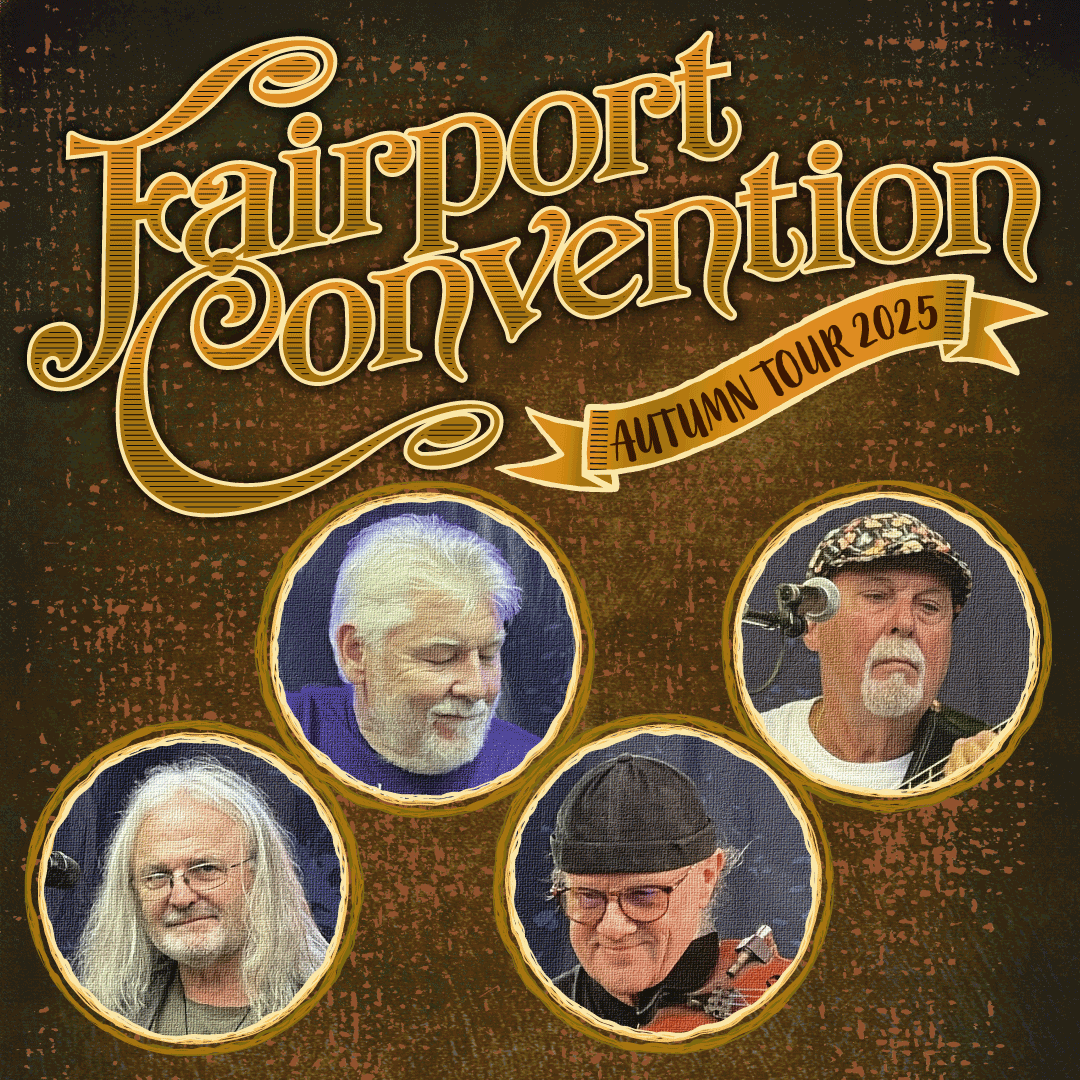
Following a triumphant sold-out Cropredy festival this summer (see my review here), folk rock legends Fairport Convention embark on an Autumn 2025 UK tour.
Playing as a stripped back four-piece, Simon Nicol, Dave Pegg, Ric Sanders and Chris Leslie will take to the road in October with 23 dates across England, Scotland and Wales, rounding things off in Liverpool on November 2nd.
Interviewing Dave Pegg earlier in the year, he emphasised how important playing live still was to the band:
“We still enjoy touring enormously and treading the boards has always been what Fairport is good at. We’ve had more success playing live than we’ve had making albums.”
You can read my full interview with Dave Pegg here.
Dave Pegg at Cropredy- Photo: Simon Putman
2025 marks 40 years since the Gladys’ Leap album – the first of the reunited Fairport Convention, featuring Simon Nicol, Dave Pegg and the first contributions from Ric Sanders.
Interviewing Ric Sanders ahead of this summer’s Cropredy, we discussed the Gladys’ Leap album, and how Sanders thought he was merely being asked to contribute to a Dave Pegg side project when he first got the call:
“Peggy had this offshoot group – a fun outfit it was – and they were called Dave Pegg’s Cocktail Cowboys, of which Chris was a member as well. At this time, around about ‘85, I was just doing jazz gigs around the Midlands. Just going out, playing with different rhythm sections, like jazz musicians used to. And it wasn’t hugely lucrative, but I got by. Peggy sent me this tape and I thought he was asking me to play on a Cocktail Cowboys record because I had no idea that Swarb had decided that he didn’t want to carry on with Fairport. And so when the tape arrived and I listened to it, I thought, hello? Well, that’s Peggy playing the bass, obviously. That’s Dave Mattacks on drums. And that guitar I could tell straight away. And yeah, it turned out to be Gladys’ Leap. And I went along and my first day was just recording those three tracks that I did on the album. The standout track for me, and the one that stayed in the repertoire, is ‘The Hiring Fair’.”
You can read my full interview with Ric Sanders here.
Ric Sanders – Photo Kevin Smith
Fairport Convention’s Autumn Tour runs from 8th October to 2nd November, with some shows already sold out. Tickets are available to purchase now on the links below.
Fairport Convention – Autumn 2025 UK Tour
Wed, 8th Oct 2025 The Green Hotel, Kinross – TICKETS
Thu, 9th Oct 2025 The Green Hotel, Kinross – TICKETS
Fri, 10th Oct 2025 Byre Theatre, St Andrews – SOLD OUT
Formed in Blackwood, South Wales in 2019 the deliciously-named Revolution Rabbit Deluxe are Ant Gingell (vocals/guitar), Max Perera (vocals/guitar), Tim Lawley (bass) and Lee Titterrell (drums). The band-name was inspired by Gingell’s lifelong love of said furry friends with the random thought of one of them appearing on an iconic Che Guevara-style poster coming to him during a car journey discussing potential names one day. The ‘Deluxe’ part was then added to give a bit of extra sparkle.
The Pixies, Smashing Pumpkins and Feeder are all cited as influences, alongside the Beatles and XTC.
As the name might imply, Revolution Rabbit Deluxe are a band that certainly don’t shy away from strident political commentary in their music. The new album Rise addresses such themes as Elon Musk and Jeff Bezoz blowing money on their pet space projects while children die of hunger (‘Chapter 9’); the fashion for cheap, easy virtue-signalling while failing to address fundamental issues of corporate power and economic inequality (‘We’re So Woke – We Haven’t Slept in Years’); and standing up and being counted (‘Rise’).
While there’s certainly anger and angst (and why shouldn’t there be!), there’s also plenty of joy, optimism and bags and bags of catchy melodies to be found on this album. The shared male/female vocals also work extremely well and while Gingell takes the lead vocal on the songs already mentioned, Max Perera provides some light and shade on the album with her lead vocal contributions on tracks like the anthemic ‘Starlight’ and the more mellow, acoustically-driven ‘The Night The Stars Fell’ which closes the album.
With it’s catchy tunes, spiky lyrics and punky attitude, Rise is well worth a listen.
Psychedelic indie alt-rock band, Innocents Abroad, were formed in Liverpool by four students in the 1980s: Martin Malone (guitar), Peter Mills (vocals), Stuart Hilton (drums) and Steve Goodrich (keyboards). After recording two albums (Quaker City in 1986 and Eleven in 1988) the band went their separate ways and, like many other bands of that era that was seemingly the end of the story.
But improbably, they released their third album back in March of this year. Three of the four original members (Hilton, Malone and Mills) are back in the fold, each bringing their different musical perspectives and life experiences. These days, Hilton occupies the drum-stool for the band, Cult Figures, alongside running a degree course in animation; while Malone has pursued a solo career as well as recording with both Eskimo Chains and The Scaremongers and is also an award-winning poet. After spending time in Eastern Europe, meanwhile, Mills returned to the UK to teach music at English universities. Around ten years ago, they started occasionally playing together once again, with Malone and Mills eventually writing songs with one another and the bones of an album beginning to take shape.
With the addition of Jane Breed (bass/vocals) Late Spring weaves together the band’s love of jangly Rickenbacker rock with strands of European pop and folk music, Bossa Nova and cult movie soundtracks. Once memorably hailed by the Guardian as a “home-grown answer to REM”, the new album has picked up plenty of plaudits, with comparisons being made to the US Paisley Underground scene and bands like Hüsker Dü and 10,000 Maniacs. Listening to Late Spring there’s no shortage of home-grown comparisons to make either – and devotees of Merseyside legends like The Las and The Coral will find lots to love here.
With jangling Rickenbacker, soaring melodies and joy-infused, trippy vibes, Innocents Abroad have created a polished and confident album bursting with exquisitely-crafted indie-pop anthems.
When tickets for Cropredy 2025 went on sale, it was announced that there would be some changes to the festival this year, with far fewer tickets available. Interviewing Fairport’s Dave Pegg back in January, he explained the thinking behind the new approach as follows:
“Gareth Williams our CEO came up with several formulas for trying to make it pay. It’s always been such a gamble, the last couple of years especially. Because when you don’t know how many tickets you are going to sell, you can’t budget. You’re guessing about the number of people who are going to turn up. Gareth’s idea – we’re only going to sell 6,500 tickets and we’re only selling three-day tickets. Because we know we’ve got that lump of income and we can budget accordingly without the risk of going bankrupt.“
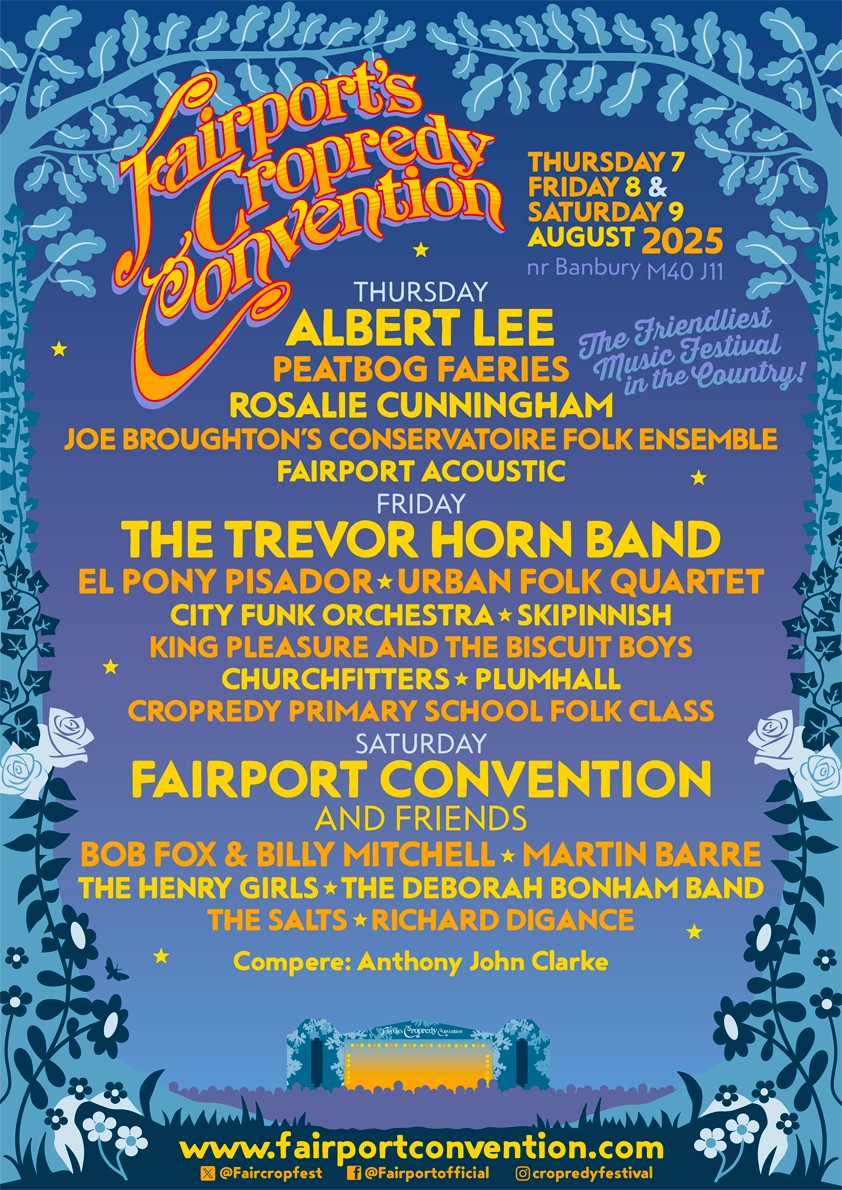
As well as fewer tickets, the festival line-up was to look somewhat different, too. The era of big-name headline acts like Chic and Madness and Alice Cooper, who had previously graced the Cropredy stage in a bid to widen the festival’s appeal and get more bums on (folding) seats, was over. Instead, there would be far more focus on acts that the festival organisers knew and had worked alongside.
The big question, therefore, is did this new formula work? Clearly, there was no problem shifting tickets, with the vast majority being snapped up by February and with the festival selling out well in advance. Arriving at the campsite on the Thursday afternoon, it didn’t feel much different, although a couple of fields previously used for camping had apparently been taken out of use.
The Cropredy crowd (Photo: Simon Putman)
I was also wondering whether the slimmed-down attendance would leave us all rattling around in the main arena field but it didn’t feel like that at all. Walkways had been rejigged, the big screens at either side of the stage had been replaced by a single screen at the back of the stage but overall it very much felt like the same old Cropredy I’d been going to for the past fifteen years.
Richard Digance up on the big screen (Photo: Simon Putman)
So, enough of the festival arrangements, what of the music? I must admit that one of the real attractions for me when I first started going to Cropredy in 2010 was the mix of folk, acoustic and classic rock acts. I loved having Status Quo and Rick Wakeman and Little Feat alongside Thea Gilmore and Breabach and Bellowhead. Unlike some of the diehard Cropredy goers, I was perhaps more worried about the potential for the new ‘Friends of Fairport’ formula to squeeze out some of the rockier elements. That didn’t happen at all though. I got my fix of both folk and classic rock, in some respects more than I could possibly have hoped for.
Joe Broughton’s Conservatoire Folk Ensemble join Fairport Acoustic on stage (Photo: Simon Putman)
On the folky side, obvious highlights for me included Joe Broughton’s Conservatoire Folk Ensemble, whose massed ranks begun their set by joining Fairport Acoustic on stage, for an epic rendition of ‘The Lark In The Morning’ instrumental medley from the Liege & Lief album. Scottish folk band Skipinnish were another highlight for me, with a thrillingly energetic set, my second time seeing them this summer as they also performed at the New Forest Folk Festival. A special mention, too, should go to the kids of Cropredy Primary School Folk Class who kicked things off at the festival. We only made it in time to hear their last couple of songs but what a wonderful idea to link the village and the festival this way and how lovely it was seeing the huge cheer for them as they made their way from the backstage area afterwards to a waiting gaggle of proud parents.
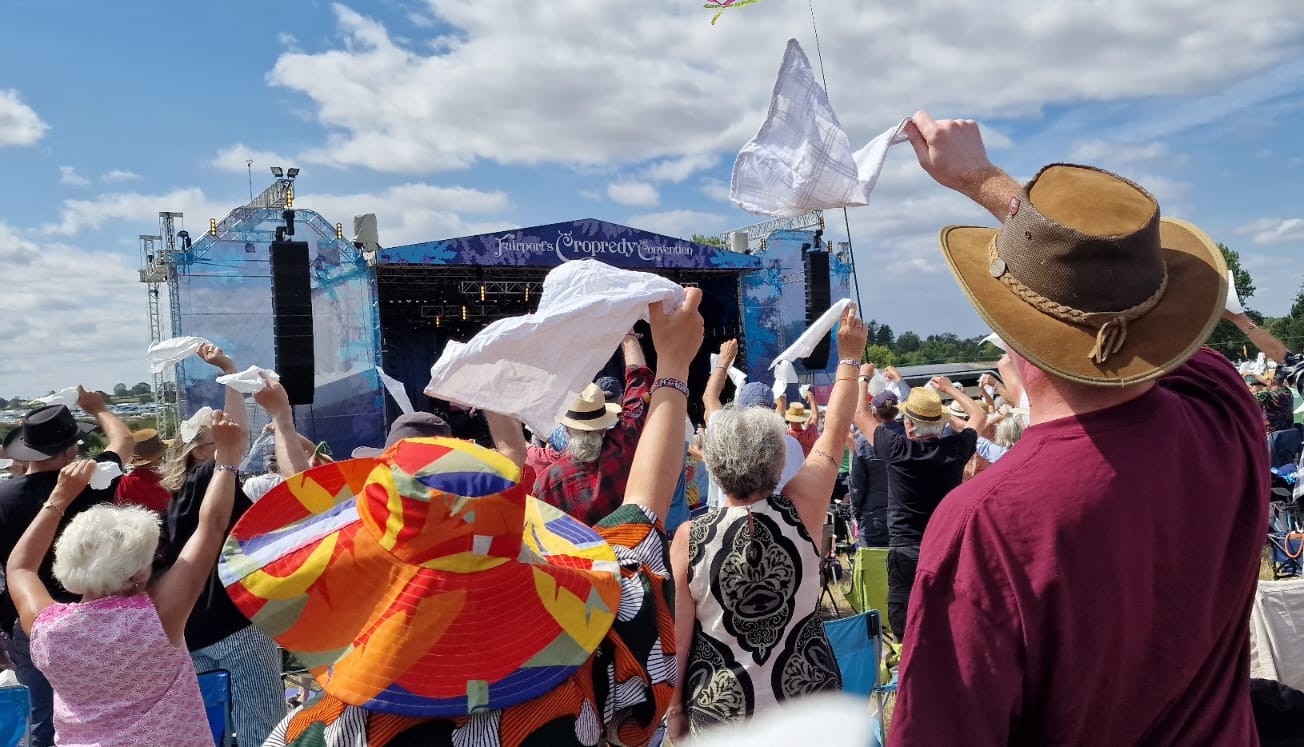
The traditional hanky waving during Richard Digance’s set (Photo: Simon Putman)
On the rock side, the festival organisers demonstrated that you didn’t need to be in the megabucks league to attract some decent classic rock acts. My many years of going to music weekends at Butlins showed me that it’s perfectly possible to line up some talented rock names without bankrupting yourself.
Trevor Horn (Photo: Simon Putman)
The Trevor Horn Band, making their third appearance at Cropredy, were hugely entertaining as ever, blasting out a deluge of hits that Horn had had a hand in, from Frankie Goes To Hollywood, to Buggles to Yes – with the added bonus of Lol Creme of 10CC on guitar and some Godley & Crème/10CC hits thrown in, too! They were originally booked under the old formula for the previous year, however, and had to reschedule because of illness so the situation was slightly different.
Martin Barre (Photo: Simon Pitman)
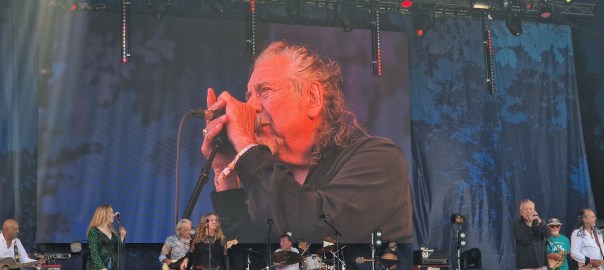
The same cannot be said for Martin Barre (ex-Jethro Tull) and Deborah Bonham (sister of Led Zep drummer, John) whose sets were clear highlights of the weekend, none more so than the latter whose special guest almost certainly provided the highlight of the weekend for many, with none other than Robert Plant stepping on to the stage to perform sizzling versions of ‘Ramble On’ and ‘Thank You’ from Led Zeppelin’s second album. It doesn’t get much better than that at Cropredy.
Robert Plant joins the Deborah Bonham Band on stage (Photo: Darren Johnson)
I didn’t get to see everyone who performed and there were acts (like Bob Fox & Billy Mitchell) I would have liked to have seen but didn’t. However, I’ve never spent the entire day in the field from mid-day to midnight. For me, time spent at the campsite, catching up with friends early in the evening and relaxing ahead of a late night finish, is as much part of the Cropredy experience for me as the music. Plus, in the last few years, our camping group has also chosen to spend a little bit of time at the Cream of the Crop festival in the adjoining field and this time we got there just in time for an explosive set by the excellent Burnt Out Wreck, the band fronted by former Heavy Pettin’ drummer, Gary Moat. No-one can say I didn’t get my fill of hard rock at Cropredy this year!
Burnt Out Wreck at Cream of the Crop next door (Photo: Simon Putman)
Fairport Convention, of course, rounded things off on the Saturday night with their usual mammoth set featuring a mix of familiar old favourites, revisited deep cuts, covers with guest artists (this time Ralph McTell and Danny Bradley) and more recent material penned by the band’s own Chris Leslie. While a couple of our camping group head back to the campsite before the end, missing ‘Matty Groves’ and ‘Meet On The Ledge’ is not something I could ever contemplate so we make our way to the front in time for a rousing ‘Matty’ (with accompanying animated video hilariously interpreting the storyline through the medium of Lego) and an always emotional ‘Meet on the Ledge’.
Ralph McTell is a guest during Fairport’s set (Photo: Simon Putman)
While it was the end of Cropredy for another year, it wasn’t quite the end of our camping trip as we had booked for several days at a lovely campsite ten miles away, just outside Barford St. Michael. The spirit of Cropredy was never far away though. The village of Barford St Michael, itself, was once home to Dave Pegg and the studio he established, Woodworm Studios, where Fairport recorded numerous albums. The studio is still in operation, although no longer owned by Peggy these days.
The Hook Norton Brewery (Photo: Simon Putman)
While camping, we also took a trip to the village of Hook Norton for a tour of the Hook Norton Brewery, who in recent years became the official suppliers for the Cropredy festival bar, taking over from Wadworth. It’s an absolutely fascinating tour of this historic nineteenth century site and our engaging tour-guide was himself a Cropredy regular who had spent many years working at the festival. If you are extending your stay in the Oxfordshire countryside and want to find out how the beer at the Cropredy bar is brewed and learn more about the history of the brewery, it’s well worth a visit!
The Rock and Roll Almanac is a bumper compendium of facts, insights and snapshots in time covering events from the early days of rock and roll in the mid-1950s right up to the present day. Compiled by musician and music writer, Andrew Craneman, the book devotes a page to each day of the year, with every page containing a selection of historical rock snippets drawn from the past seventy years, along with notable births, notable deaths and a recommended single and album released on that same date.
It’s something you’ll dip into, rather than read in a single sitting but choosing a random selection of dates, I certainly got a feel for what the book has to offer.
Firstly, for my birthday (20th May) I’m interested to learn that on this day Bill Haley’s ‘Rock Around the Clock’ was first released in 1954, the Rolling Stones unveiled their forthcoming new single ‘(I Can’t Get No) Satisfaction’ on a US TV show in 1966, Joe Strummer of the Clash is arrested but later cleared following an altercation with an audience member in 1980 and Finish rock band Lordi won the Eurovision Song Contest in 2006.
Turning to today’s date (4th August) I find that the Kinks released ‘You Really Got Me’ on this day in 1964, Pink Floyd released the Piper at the Gates of Dawn album in 1967, Jim Morrisson got arrested for public drunkenness in LA in 1970 and Eagle, Don Henley, reached an out of court settlement with a US Republican candidate after the latter used parody versions of two of his songs without permission in 2010.
Craneman provides just enough background to each historical entry to keep you engaged and informed but the events detailed in the book will often encourage you to explore further, particularly if its something that you were completely unaware of before.
Keep it on your coffee table to look at each day on the relevant day in question. I’m sure I’ll be dipping in and out of it throughout the year.
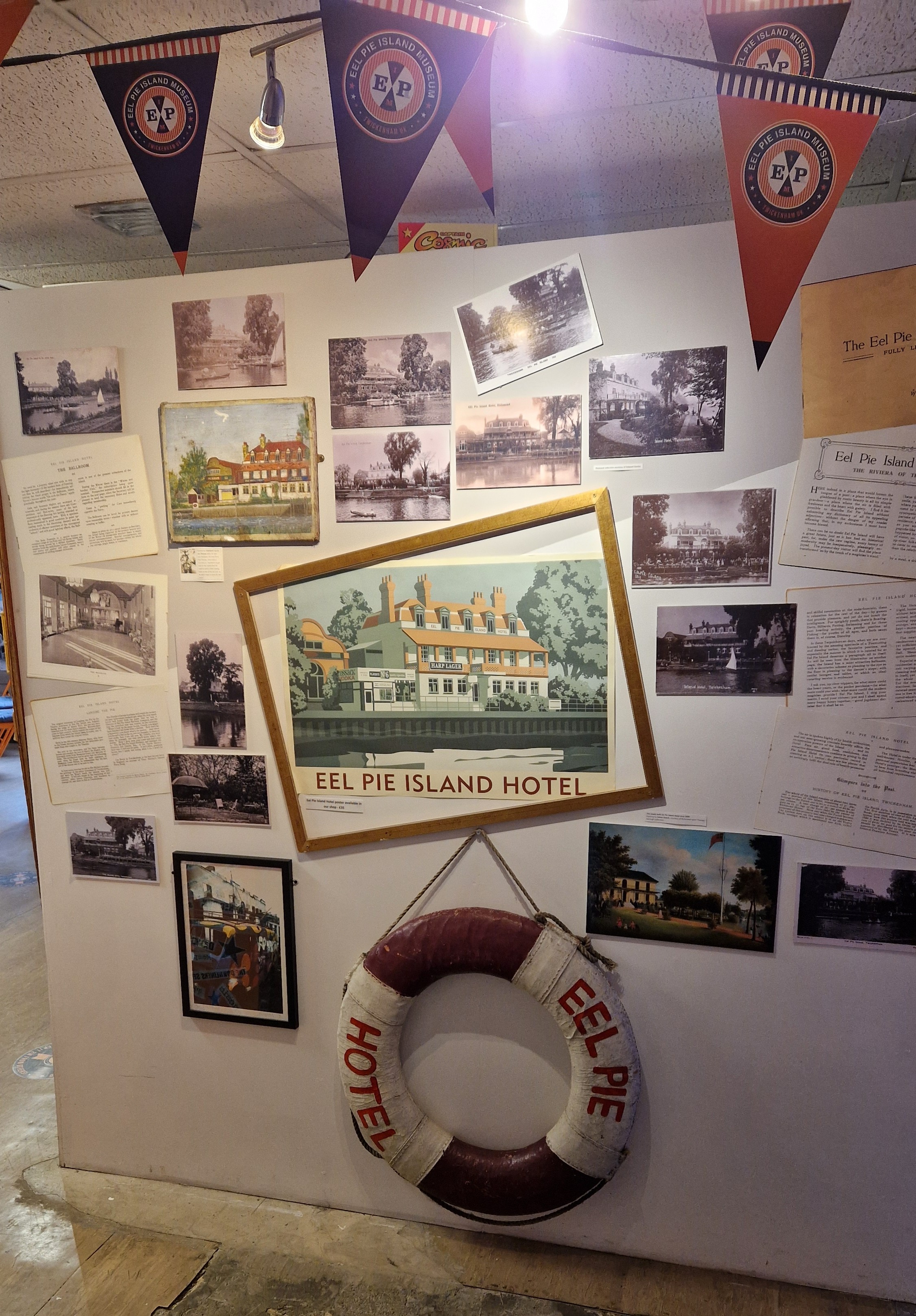
I’ve read so many books over the years documenting the early days of British rock, it’s impossible to ignore what a pivotal role the Eel Pie Island Hotel played in the formative years of the careers of many important UK artists. In the mid-1960s, the Rolling Stones, the Yardbirds, Rod Stewart and David Bowie were all regular performers there. Prior to the rhythm and blues boom, it had also played host to many jazz bands, when the run-down nineteenth century hotel and ballroom became a hugely-influential venue during the 1950s trad jazz boom.
The nineteenth-century Eel Pie Island Hotel
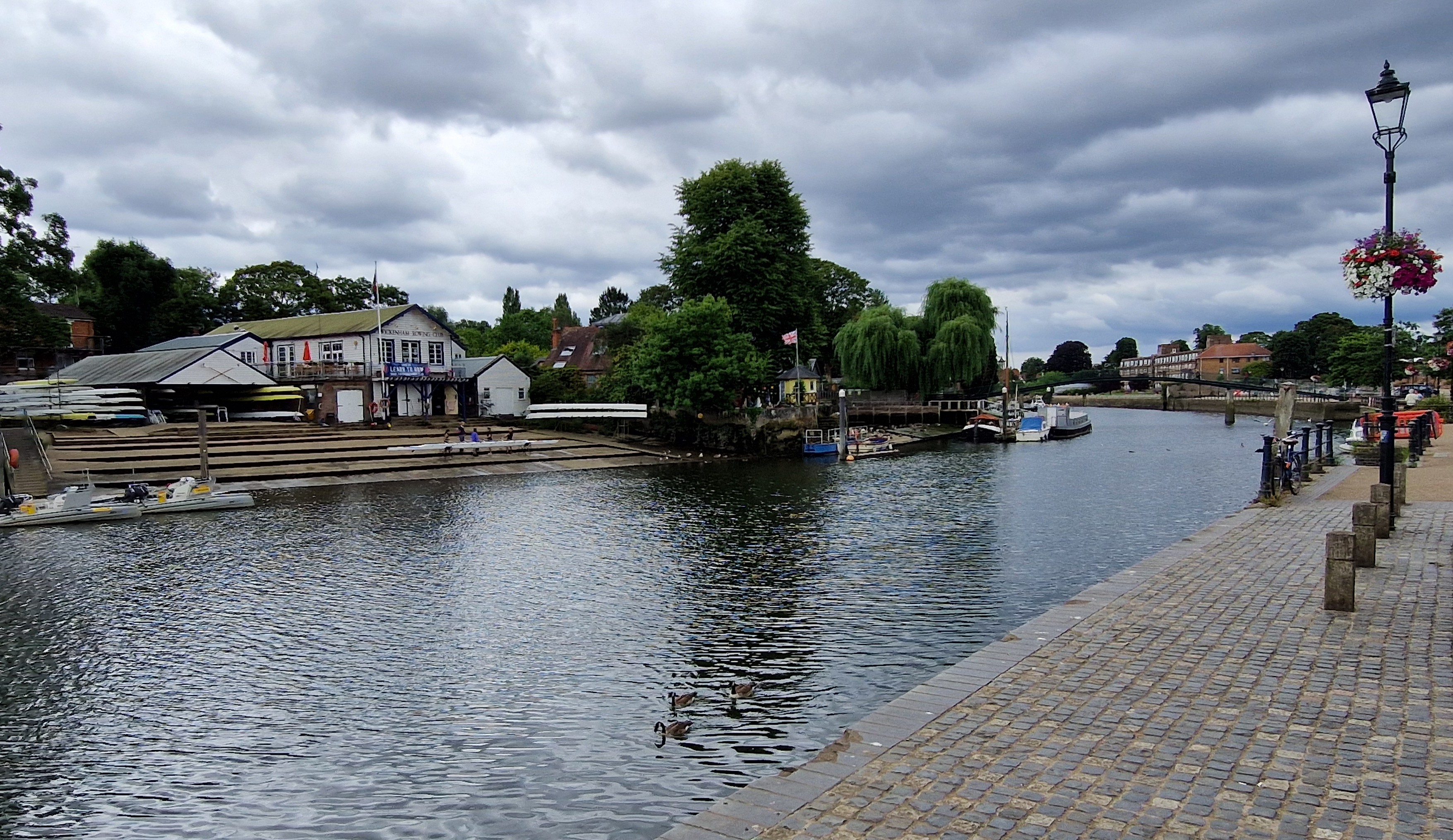
The hotel itself has long been demolished but the Eel Pie Island Museum opened its doors in 2018, celebrating the fascinating musical and boating history of this tiny 8.9 acre island in the River Thames. The museum, itself, isn’t actually on the island but just a short walk away from the banks of the Thames at Twickenham.
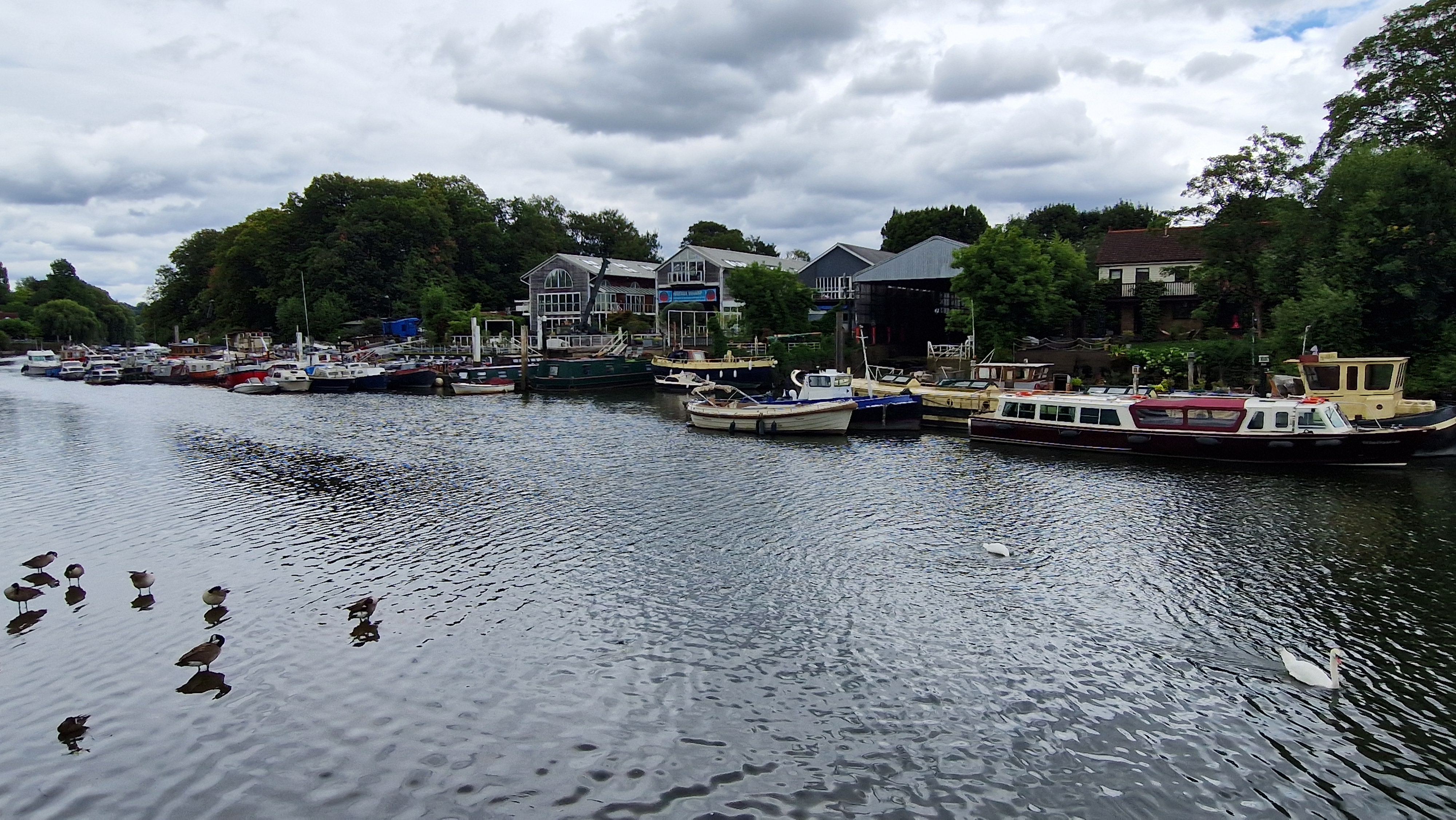
Eel Pie Island today
As I was staying in London overnight for a recent trip to the O2, I thought I would pay a visit to this small museum for the first time. Staffed by volunteers and costing just £5 to enter, it’s well worth a visit for any rock or jazz fan or indeed local history enthusiast.
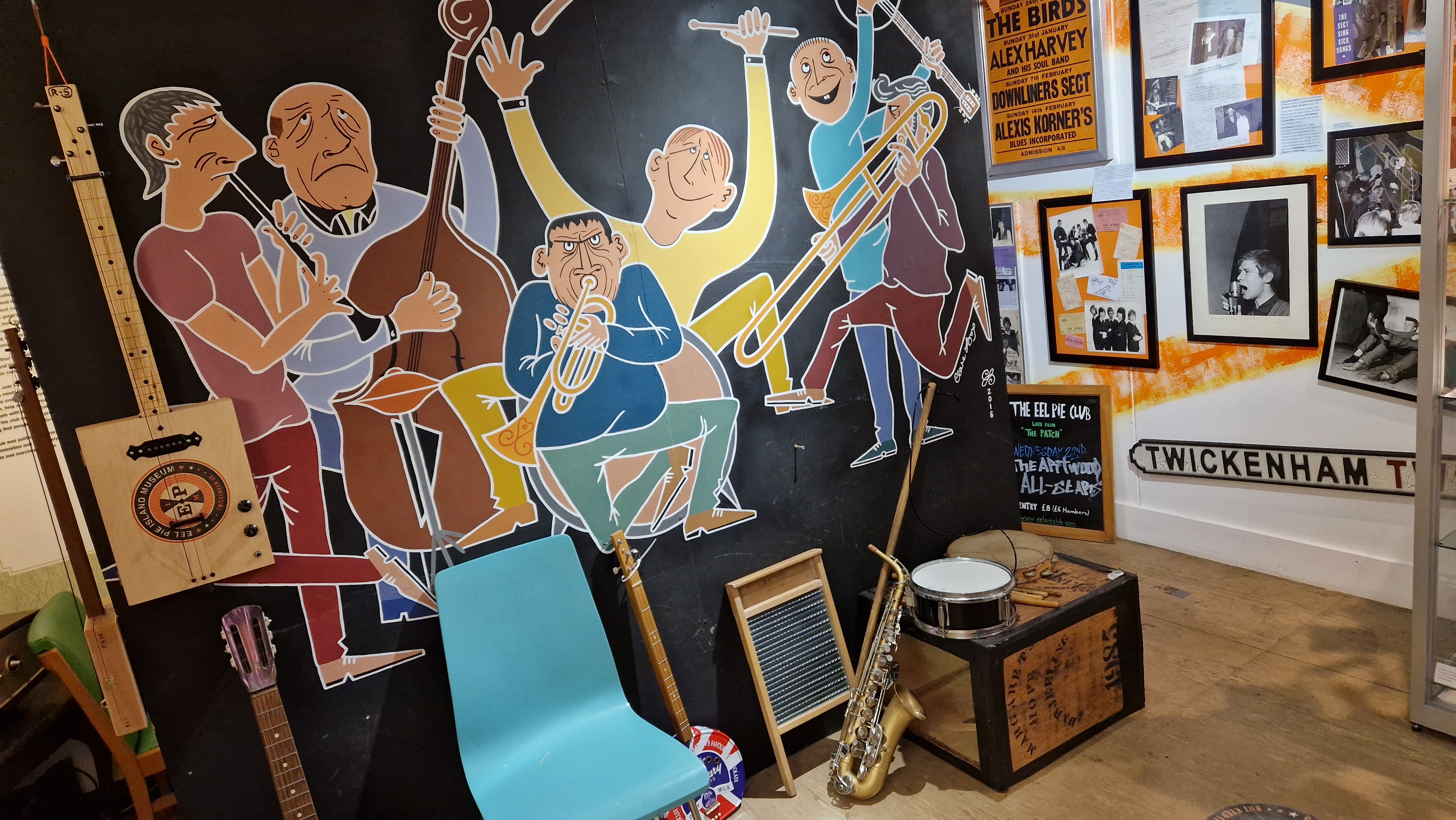
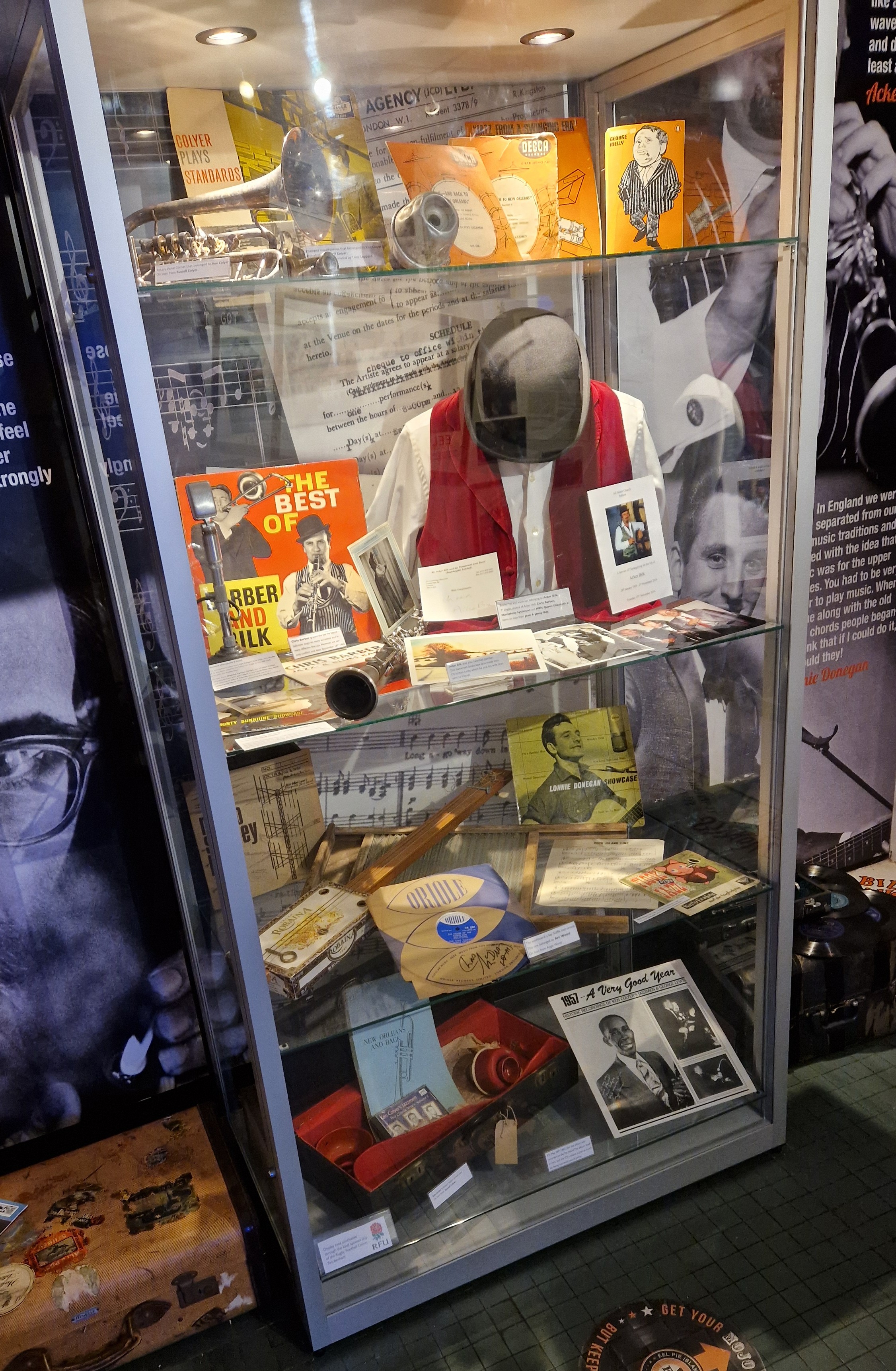
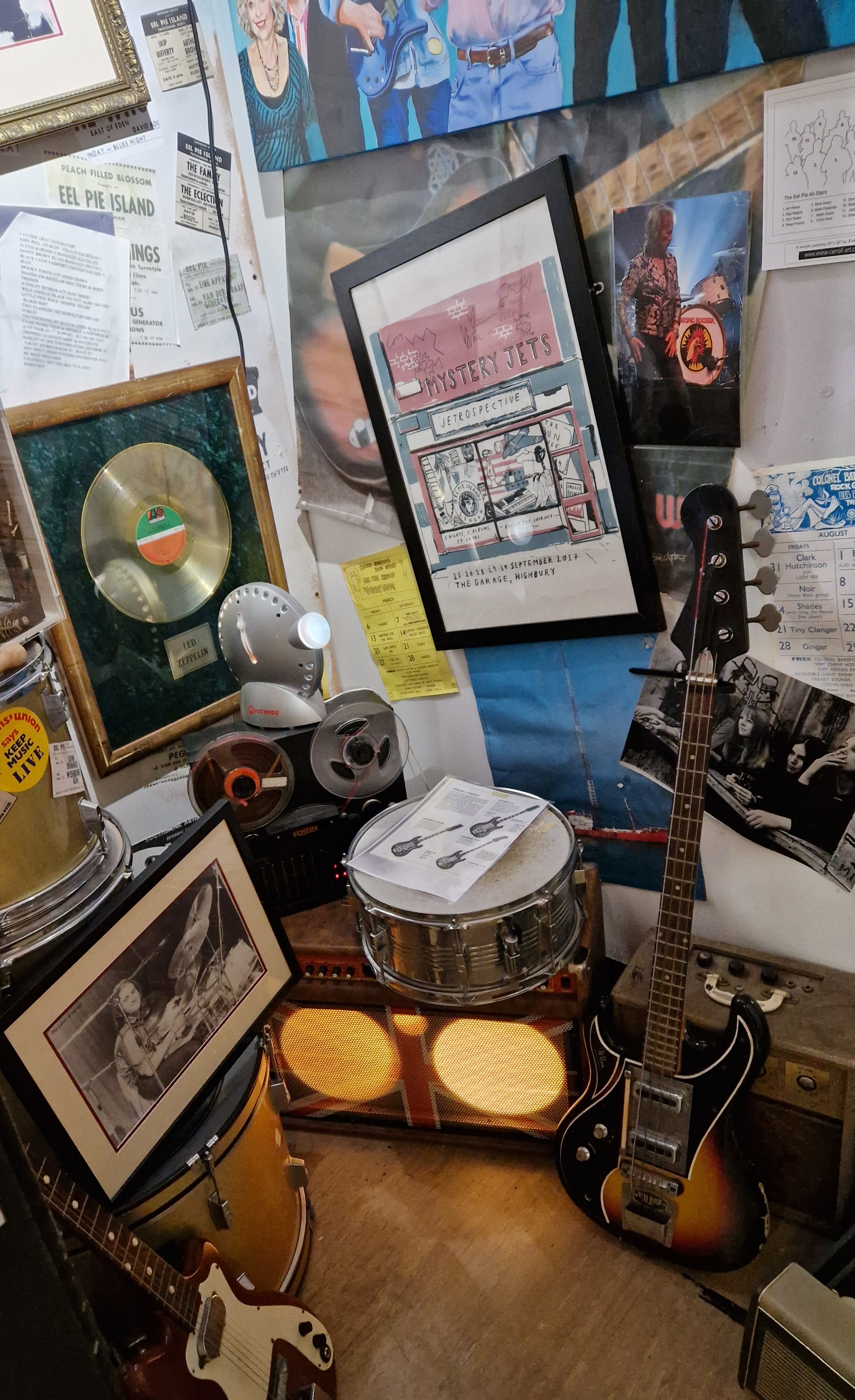
Display on the venue’s past as a jazz clubAcker Bilk’s iconic bowler hat and waistcoat in the jazz displayTrad Jazz gave way to rhythm & blues and rockDisplay of rock instruments and memorabilia at the museumThe Eel Pie Island roll call
There’s fascinating display of musical memorabilia and historical archives, as well as a roll call of all the celebrated artists who played there. It’s not just music either and there are also displays dedicated to the island’s boatyard history and its role as a place for artistic creativity and technical innovation, including being the birthplace of the clockwork radio, invented by the late Trevor Bayliss who had a home on the island.
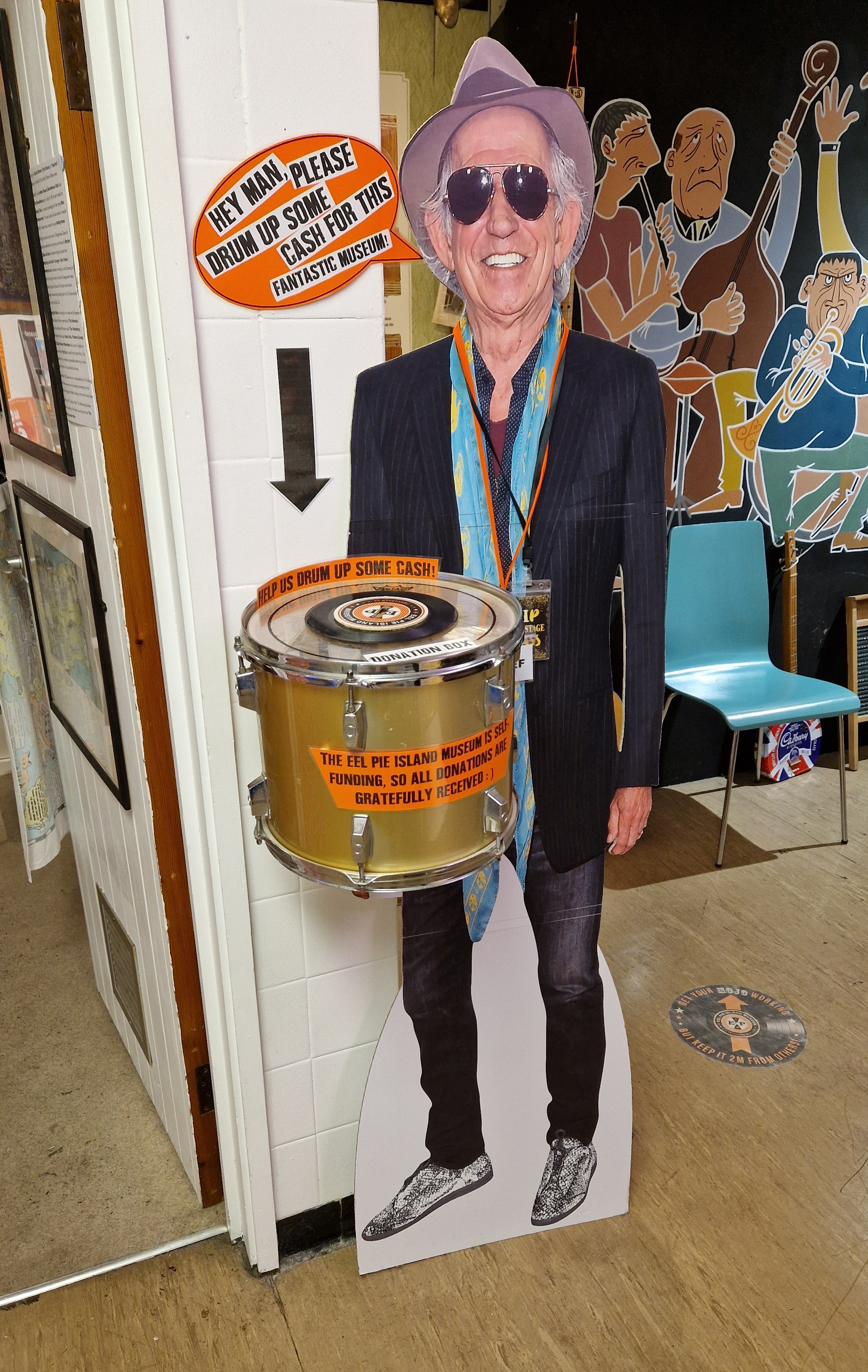
Keith Richards touts for donations for the volunteer-run museum
Given the seismic roll that London has played in the history of popular music, the capital has been behind the curve somewhat in celebrating its world-class musical legacy – particularly in comparison to cities like Liverpool or Memphis. But I’m pleased to say that this is gradually being rectified and the Eel Pie Island Museum is an important addition to the capital’s music tourism scene.
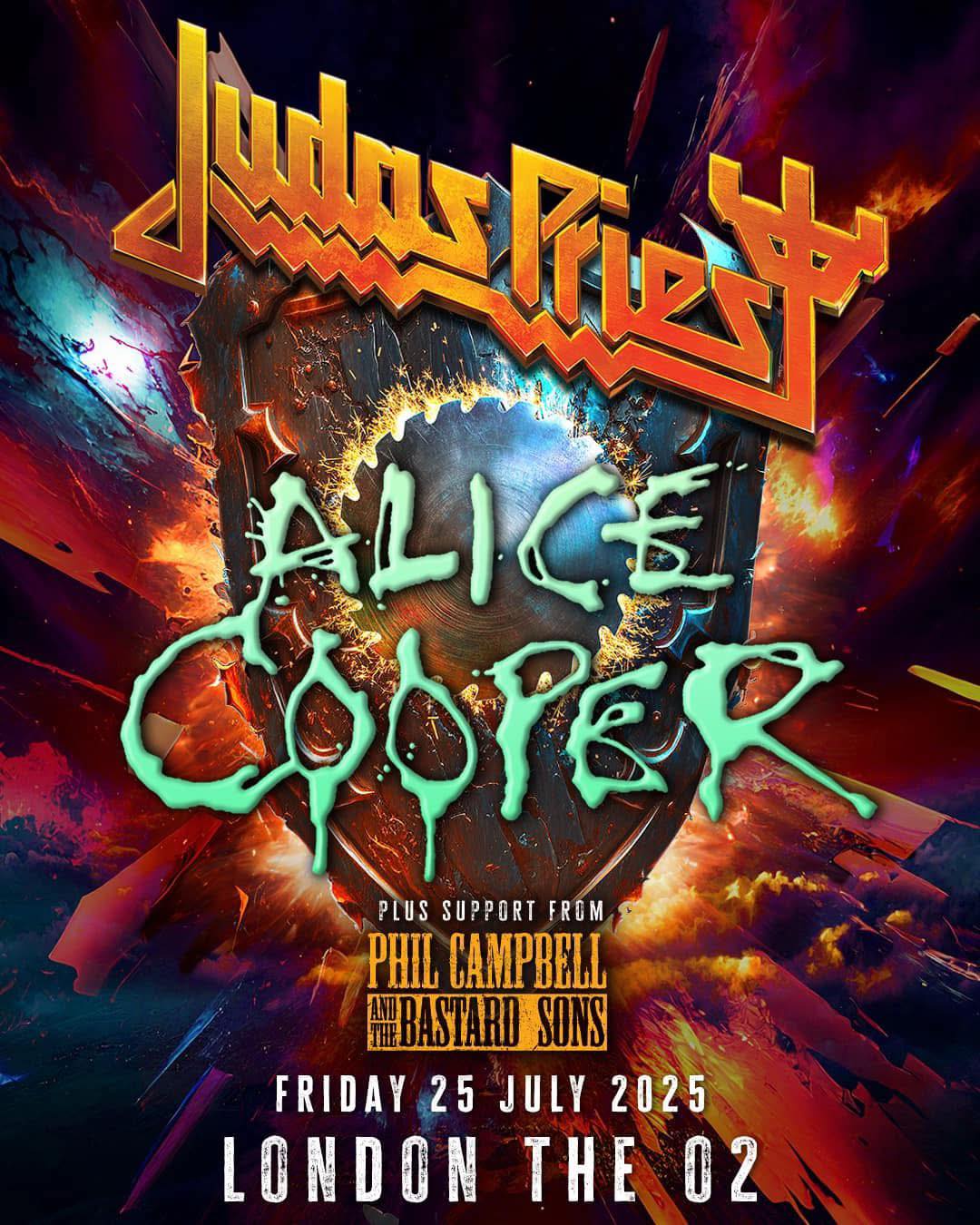
For the second of my O2 gigs this summer it was back ton London for a night of Alice Cooper and Judas Priest. Normally, if I’m heading off to the capital for a big arena gig these days it’s usually for a ‘bucket-list’ artist who I’ve never seen before (like Santana last month, Eagles in 2022 or Iggy Pop in 2023). I’ve seen both Alice and Priest previously so it’s not exactly bucket-list in the strictest sense but a double-headliner bill featuring these two legends proved impossible to resist.
At previous O2 gigs I’ve tended to find myself seated high up in the vertigo-inducing upper tiers right at the very back. Even though I didn’t fork out for a premium-price ticket, tonight I was delighted to find myself right at the front, just five rows from the middle of the stage with a magnificent view of the main action.
First up was a short but incendiary set from Phil Campbell & the Bastard Sons, the band formed by the former Motorhead guitarist following Lemmy’s 2015 death which brought to an end Campbell’s three-decade stint with Motorhead. Not owning any of the Bastard Sons albums I’m not massively familiar with the material, apart from the inclusion of two Motorhead covers. These were ‘Going To Brazil’ from the 1916 album which appeared early on the set and ‘Ace of Spades’ towards the end. The latter inevitably put a big smile on everyone’s faces in anticipation of what was to come. These guys certainly know how to pull off a great warm-up set.
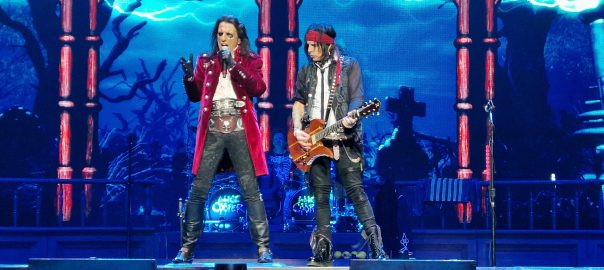
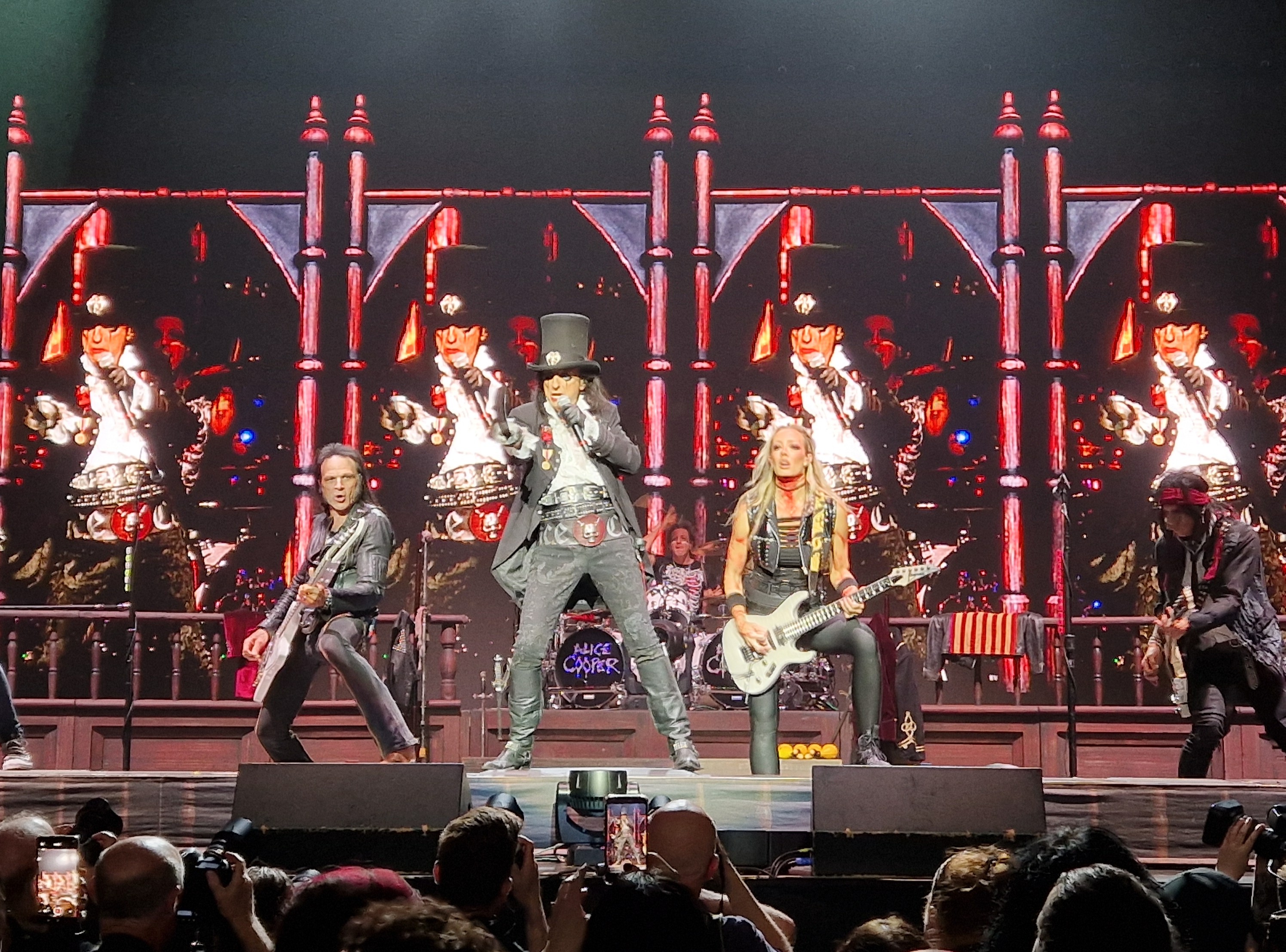
Kicking off with ‘Lock Me Up’, Alice Cooper’s set is as over-the-top and theatrical as ever. An exhilarating combination of blistering hard rock, glam-meets-horror showmanship and that unmistakeable, menacing vocal drawl, the hits come thick and fast – with the likes of ‘No More Mr Nice Guy’, ‘I’m Eighteen’, ‘Hey Stoopid’ and ‘Poison’ fired out one after another.
He may be doing this as a double headliner tour but just like the previous time I saw him (when he was a wonderfully incongruous addition to the line-up at Fairport Convention’s Cropredy festival back in 2013), there’s no skimping on the theatricals. A giant-sized Alice puppet dominates the stage with mock-horror excess during ‘Feed My Frankenstein’, the guillotine comes out for the traditional ritual execution during ‘Killer’ and there’s whippings and slashings galore. It was all huge fun and exactly what you expect from an Alice Cooper gig. But what came later on made everyone gasp.
Lemmy’s legacy may have been very apparent during Phil Campbell’s opening set but for the two headliners, it was very much the spirit of the much more-recently departed Ozzy Osbourne that stole the show. Both would pay tribute to Birmingham’s finest tonight.
Reappearing on stage wearing an Ozzy T-shirt, Alice roared out the lyrics to ‘Paranoid’ as the band blasted out that unmistakeable riff, joined by none other than Hollywood’s Johnny Depp. It was all genuinely surprising, touching and thrilling in equal measure.
There was just time for one more hit after that. And one more set of special guests, as original Alice Coopers members Michael Bruce, Dennis Dunaway and Neal Smith joined the band on stage for ‘Schools Out’. The horror show theatricals give way to a gloriously OTT end-of-term party as giant coloured balloons are hurled across the stage and stabbed by Alice to release explosions of confetti. What a blast!
Alice Cooper setlist:
Lock Me Up Welcome to the Show No More Mr. Nice Guy I’m Eighteen Hey Stoopid He’s Back (The Man Behind the Mask) Feed My Frankenstein Go to Hell Poison Black Widow Jam Ballad of Dwight Fry Killer I Love the Dead Paranoid School’s Out
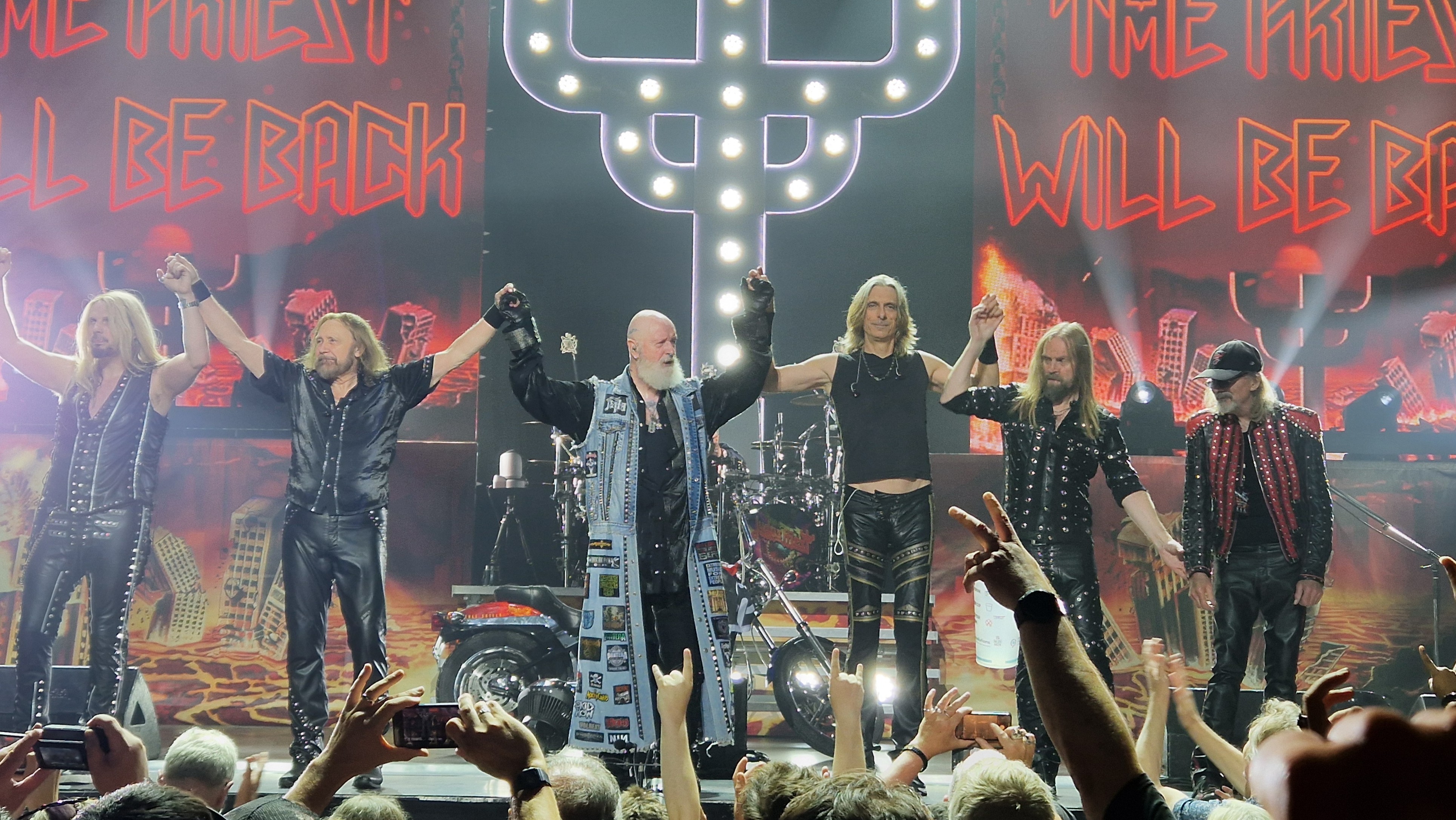
Coming on stage to the strains of Black Sabbath’s ‘War Pigs’, Judas Priest launched straight into ‘All Guns Blazing’ from the Painkiller album. Released 35 years ago, songs from that much-celebrated album feature heavily in tonight’s set. Given it’s one of Priest’s most unrelentingly heavy albums, it gave tonight’s show an unrelentingly heavy edge, with songs like ‘Hell Patrol’, ‘Night Crawler’ and, of course, the title track blasted out at breakneck speed in a demonic-sounding wall of twin guitars, a thunderous rhythm section and Rob Halford’s unmistakeable roar.
The Painkiller album is rightly held in huge affection by many metal fans. My favourite era, however, will always be the Killing Machine/British Steel days because that was my entry point into the band’s music as a young teenager. It was great, therefore, to get a blast of ‘Breaking The Law’ fairly early on – a true shake-your-fists-shout-along-at-the-top-of-your-voices all-time metal classic.
The continuing high quality of Priest albums in more recent years has also been a real cause for celebration. So it was also a treat hearing ‘Gates of Hell’ and ‘Giants in the Sky’ from the excellent 2024 album, Invincible Shield. The latter song, celebrating the continuing legacy of fallen rock legends, is given added poignancy with the death of Ozzy Osbourne earlier in the week and we get a touching video on the big screen – now including images of Osbourne. It’s also provides incontrovertible proof that, over five decades on, this is still a band that can turn out bona fide rock classics.
This is followed by a blistering version of the aforementioned ‘Painkiller’ – a sign that things are beginning to draw to a close. Having such a clear front-section view, I catch a glimpse of polished chrome in the wings and know exactly what’s coming next. Sure enough, Halford rides out on that glistening Harley Davidson to deliver a raucous ‘Hell Bent for Leather’.
Following Alice Cooper welcoming the original surviving band members on stage for ‘Schools Out’, it was an even lovelier moment seeing veteran Priest guitarist, Glenn Tipton, being welcomed on stage for the final song of the evening. Although Parkinson’s has left him visibly frail, Tipton’s delight at being up there rocking with the band for ‘Living After Midnight’ was plain for all to see. A marvellous finale to a brilliant evening of rock and metal.
Judas Priest setlist:
All Guns Blazing Hell Patrol You’ve Got Another Thing Comin’ Freewheel Burning Breaking the Law A Touch of Evil Night Crawler Solar Angels Gates of Hell Between the Hammer and the Anvil Giants in the Sky Painkiller Hell Bent for Leather Living After Midnight