Owen Moore is an Irish-born singer songwriter based in Dorset. Over the past ten years or so he’s put out a staggering ten solo albums of original songs, not to mention a handful live albums too. In fact, my delay in reviewing Fireside Songs since he kindly sent it to me back in the summer has meant he’s had time to put another album since – albeit a compilation of highlights from his previous ten albums.
While Owen tells me he’s had a lifetime of playing countless small gigs behind him, he’s keen to stress that his driving passion in recent years has been his song-writing.
There’s certainly plenty of evidence of quality writing on Fireside Songs. Owen Moore’s lyrics are highly personal, his warm and gentle vocals are consistently engaging and he has a real ear for a catchy melody that will leave you humming along, long after the album has finished.
His style falls into that well-trodden path between folk and Americana, and his songs are captivating and original enough to have plenty of appeal for fans of both. From the Byrds-like ‘Every Once In a While’ to the irresistibly catchy ‘It’s All About You’ to the more traditional big country ballad feel of ‘Diamond Ring’ the album is packed full of songs you want to play again and again. The album ends with ‘The Town of Tralee’, originally released as a single at the back end of 2020,which is the Limerick-born singer’s affectionate paean to the Kerry town of Tralee where he spent time as a young man.
An engaging singer-songwriter and a fine guitarist if you enjoy the folky-ish and the country-ish it’s well worth checking out Owen Moore’s Fireside Songs as well as other albums in his prolific back catalogue.
My review was originally published by Get Ready To Rock here
Fans of the perennial metal gods Judas Priest have been lucky on the albums front in recent years. First we had two killer albums from Priest itself. Both 2014’s Redeemer of Souls (recorded after the departure of founding guitarist K.K. Downing with new boy Richie Faulkner) and its follow-up, 2018’s Firepower, stand up against some of the best of the band’s albums from its classic era. And now we have the debut album from Downing’s own iteration of Priest.
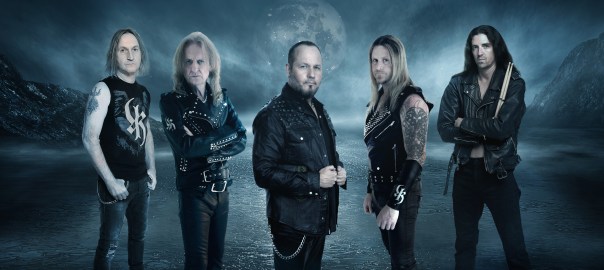
After performing a one-off gig in November 2019 it was announced that three former member of Judas Priest, guitarist K.K. Downing, vocalist Tim ‘Ripper’ Owens and drummer Les Binks, would be working together more permanently under the moniker K.K.’s Priest. Unfortunately, Binks suffered a wrist injury that put him out of action and his place in the studio and planned tour is taken by Sean Elg (Death Riders/Cage). Joining Downing, Owens and Elg are Tony Newton (Voodoo Six) on bass and A.J. Mills (Hostile) on guitar. It is still hoped Binks will make special guest appearances when the band tours.
Having been immediately impressed with the mighty ‘Hellfire Thunderbolt’ when it was first released as a single back in May, I’ve been eagerly anticipating the release of Sermons of the Sinner ever since. I have certainly not been disappointed. Sermons of the Sinner is just utterly, devastatingly, jaw-droppingly brilliant. This is not just some disgruntled ex-member throwing together a pastiche of his former band to hit the classic rock nostalgia circuit. This is a serious metal band with a ton of exciting and inspired new material. Every riff, every yell, every beat, every second of the album encapsulates the spirit of Priest and is executed with power, panache and pure class.
To really pass the Priest test though my question would always be this: are there ready-made metal classics here that I can happily go away and hum along to myself in the shower after only one or two listens? The answer to that is a firm yes. From the uncompromising title track to the aforementioned lead single to the anthemic ‘Raise You Fists’ to the dramatic gothic-inspired splendour of ‘Metal Through and Through’ there’s slice after slice of Priest-inspired metal classics here. The album concludes in dramatic fashion with the nearly nine-minute epic ‘The Return Of The Sentinel’ – presented here as a sequel to the classic track from Judas Priest’s 1984 album Defenders Of The Faith.
How this album will be received in the actual Judas Priest camp is anyone’s guess. The two bands are under no obligation to love one another or even to like each other but we, the fans, can happily love both of them. Neither Judas Priest nor K.K.’s Priest are going to be around forever. Let’s treasure them both while we’ve got them.
Mel Biggs, who has recorded several albums as part of acclaimed trio Moirai, is one of the UK’s leading diatonic accordion players. She releases From Darkness Comes Light her debut solo album on 1st October. Over twelve stunningly inventive instrumental tracks, Mel Biggs takes us on a journey through the seasonal changes, both natural and cultural over the course of the year. Accompanied by fiddle, mandolin, piano accordion, guitar and cittern she invites us to join her on this deeply personal and evocative journey.
I ask Mel how the album came about:
This album has taken over a decade to be made. And when I say that, I’m not talking about the physical album, which took 9-ish months in lockdown, but the mental health journey I’ve been on since my early 20s. The darkness of living with anxiety and depression, a binge eating disorder, and menstrual health issues brought forth the light that is my music and composition. Further to this, and rather poignantly, the album’s completion earlier this year coincided with me being diagnosed with ADHD and Autism. Knowing this has given me the missing pieces on my past diagnoses and, well, literally everything in my life! Especially my sensory crossovers which influence my creativity so much.
The diatonic accordion (or melodeon) became my closest friend and confidante early on when Iwasn’t able to understand and process the difficult emotions I experienced. It gave me a way to escape and meditate on the natural world around me. The healing power of the great outdoors is one of my biggest sources of inspiration. A sunny day in spring watching washing dry on the line brought forth Shivelight In Spring. Being high up in the Norwegian mountains breezed Oppland Upland into my brain. Zoning out of a difficult day whilst viewing winter’s golden light in the garden gave me Silver Linings. Meditating on the heat haze obscuring the view out the back of my house shone Shimmer into my life. Let me travel the world with my accordion and I’d write and write and be very content!
Mel fills us in on the themes that emerged for the album:
When it came to making the album, I looked at what material I had and realised the running theme was light states in nature through the seasons. Each piece relates to a different point in my personal discovery journey. From Darkness Comes Light is a symbiosis of seasons, nature, and light and their combined effect on mood and mental health recovery. It’s also become a statement to myself of never giving up on finding those missing pieces to understanding and accepting yourself for exactly who you are. Feels like a pretty big thing to say about an album of instrumental folk music, but I prefer using sounds to words any day!
From Darkness Comes Light released 1st October 2021 by Talking Cat Recordings
Playing their first gig in April 1985, the band April 16TH were late to the party in terms of the UK’s New Wave Of British Heavy Metal scene. By then many of the bands that had started up in the late 70s and early 80s had either packed up, moved on or dramatically changed their style – bringing in keyboard flourishes and, with an eye on the more lucrative American market, a more commercial sheen. April 16TH resolutely didn’t go down this route, opting for a gutsy raw feel reminiscent of the likes of early Tygers of Pan Tang et al.
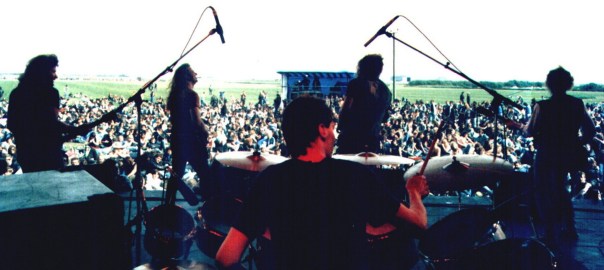
April 16TH at the Marquee
April 16TH were John Fisher (drums), Chris Harris (guitar), Lawrence Mills (lead guitar), Eric Puffett bass) and Dave Russell (vocals) – and unlike many bands of the era their line-up remained stabled throughout their entire tenure 1985-91.
“Musically APRIL 16TH always preferred a raw guitar base sound to that of the cleaner and ‘less real’ sound afforded by keyboards. The bands rough edge was further enhanced by the use of a single vocalist instead of the more traditional backing vocals set up,” states the band’s retrospective biog.
“Philosophically the band truly believed in the power of rock music as a form of expression. Their stage presentation was a totally unpretentious and honest, yet powerful and exciting experience. “APRIL 16TH” despised the use of stage clothing and over-hyped theatrical performances with larger-than-life egos. At gigs you could find and could talk to the band at the bar or the pub next door, not locked away in the dressing room.”
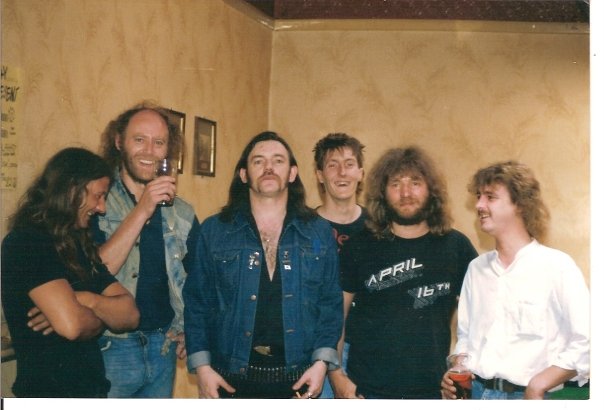
APRIL 16TH meet Lemmy
Gigging extensively around the south east the band’s early recordings began generating interest from regional radio stations and bookings started to come from further afield. An album Sleepwalking followed in January 1989 which led to further exposure for the band. Radio One invited April 16TH to record a session for the Tommy Vance Rock Show and there was also a slot for London Weekend Television. Sadly, however, financial woes put paid to any future success, bankruptcy forced their departure from the music scene and April 16TH played their last ever gig at the Cartoon in Croydon on Saturday 13th July 1991.
The story doesn’t quite end thee however and thirty years later we now have a newly released CD chronicling all of the band’s studio recordings.
Why now? I asked guitarist, Chris Harris, who kindly sent me the CD.
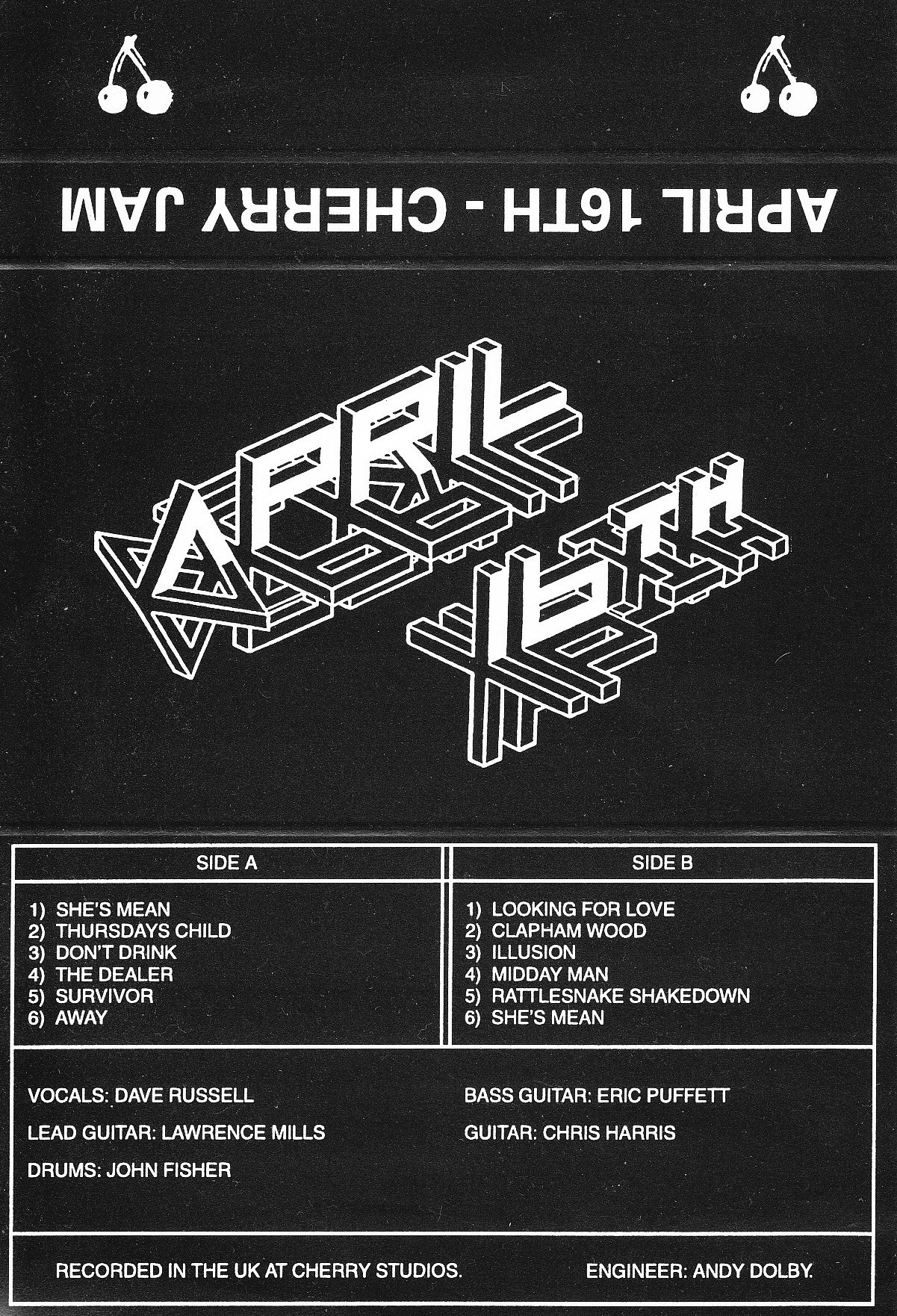
Chris: “During our ‘career’ we produced two audio products. The first was a C60 cassette recorded at Cherry Studios in Croydon that we called the Cherry Jam tape. The second was a vinyl LP also recorded at Cherry Studios entitled Sleepwalking. The Cherry Jam tape was essentially a gig getting Demo tape but the Sleepwalking album was a ‘FOR SALE’ LP released by our record company – High Dragon Records of Paris. After the band went bankrupt it was always my intention to self-release a CD containing all the tracks that appeared on both the C60 and the LP. But this dream did not become a reality until July 2021.”
The Cherry Jam tape cover
“I don’t like the word compilation,” adds Chris. “The title Epitaph was chosen to reflect the sombre memory of our demise and to present all the (recorded) material that the band had available. And so Epitaph was compiled by using the original 1986/87 master tapes. The CD is an exact duplication of the original sound of the band and was not enhanced or re-mixed in any way.”
The Sleepwalking vinyl album
Although not one of the big names of the era Epitaph is a hugely enjoyable compendium of April 16TH’s recorded output and should be of interest to anyone with a love for the NWOBHM scene and in particular those who enjoy those bands who went for the hard, rootsy, gutsy approach and weren’t like the proverbial kids in a sweetshop when they got inside a recording studio but stuck to the basics.
Visit April the band’s Facebook page at April 16TH
Kent-based blues rock band Big River were formed back in 2016 with their debut album Redemption released in 2019. The band took a fair bit of inspiration from that early seventies golden era of blues rock and turned out a nice line in meaty rhythm, soulful vocals, catchy hooks and big fat riffs and lush guitar solos.
Since then there’s been a bit of a shift in personnel with Damo Fawsett (guitar), Ant Wellman (bass) and Joe Martin (drums) now being joined by new boy Adam Barron who takes over from former vocalist Adam Bartholomew. This is almost certainly the best career move a band like Big River could possibly have made.
Barron came to prominence as a contestant on The Voice and then secured the lead vocalist position fronting Mick Ralphs’ solo band. Sadly, that venture came to an end with Ralphs’ debilitating stroke but Barron teaming up with Big River is a stroke of genius. One of the finest blues rock singers around these days, Barron is the perfect fit for Big River and takes the band to new heights.
The new single ‘Don’t Hold Out’ sets an exceptional standard and was released on all platforms for digital download on 20th August. Written by Barron is an old school classic rock song with a summer vibe and a catchy hook with singer’s soulful, emotive, bluesy vocals taking centre-stage.
Barron says: “I love my family, I love my friends and I love life, even with all the complications and shit that comes with it. I really believe we have to grab any and every bit of joy we can every day, because we don’t know what’s going to happen tomorrow, (last couple of years have certainly shown us that!) and that’s what this song is about.”
Big River are currently working on a second album and preparing for tour dates in Summer / Autumn 2021.
With his style being described as “sketchbook pop” the music of singer-songwriter, Robert Gray, combines elements of folk, jazz and blues. Playing in a variety of bands on the London live scene, he released in album in partnership with Australian singer-songwriter, Troy Utz, back in 2003. After a break from music and a subsequent move to Germany with his young family in 2012, Gray was inspired to begin writing and recording again.
Short Stories is his debut solo album. Some ten years in the making the album has been recorded at a number of home studios in Britain and Germany. The songs range from the highly personal: the birth of his son, a love-song to his wife on the theme of growing old together, his feelings as his young daughter lay in hospital for an operation – to the more political: a break-up song about Brexit, a young mother working in a sweatshop and Trump’s election to the White House.
“I think of my songs as little sketches of a scene”, he says “and in those two or three minutes I am trying to paint a picture for the listener.”
“When I look back on the album I have a lot of memories of things that inspired the songs and the places where I wrote or recorded them.”
A multi-instrumentalist who plays all the instruments on the album (bar two guest musicians on one of the track), Gray cites J.J. Cale, Richard Thompson and Chet Atkins as key influences
With an easy-going vocal delivery, some rather lovely guitar flourishes and consistently thought-provoking lyrics, Gray turns out some quality songs which make for a highly listenable album.
Highfield Suite is the debut album from Glasgow singer-songwriter Michael McGovern. At 25 he’s been writing songs since he was a teenager, Highfield Suite being the culmination of his work to date. He says the songs on the album very much reflect this period of his life, focusing on themes such as friendship, love, regret and reconciling with one’s own mistakes. Citing the likes of Leonard Cohen, to Bob Dylan, Paul Simon, Springsteen and Fleet Foxes as key inspirations McGovern traverses that folky, acoustic, Americana-flavoured vibe with confidence and there’s a real maturity to his song-writing, too.
McGovern had begun building a name for himself on the festival circuit but, like many musicians, once the pandemic struck and brought an end to life performances his focus turned to writing and recording. Taking the self-isolation route to its creative limits, McGovern ended up recording much of the album alone in a small wooden cabin in Galway, Ireland with a single microphone.
If that suggests a stark, minimalist feel to the album, then it’s a wrong impression. Dublin-based producer, Bill Shanley, worked alongside McGovern to flesh out the album and a range of additional musicians and backing vocalists were brought in on various tracks to add extra depth and texture. McGovern himself plays guitar, bass, piano and keyboards on the album with co-producer, Shanley, providing additional guitars, bass and vocals alongside assorted guests, including some wonderfully evocative pedal steel guitar from Connor Smith.
The result is a beautifully timeless album with heartfelt lyrics, lush gospel-tinged harmony vocals complementing McGovern’s own emotive voice and some gorgeous guitar. An impressive debut.
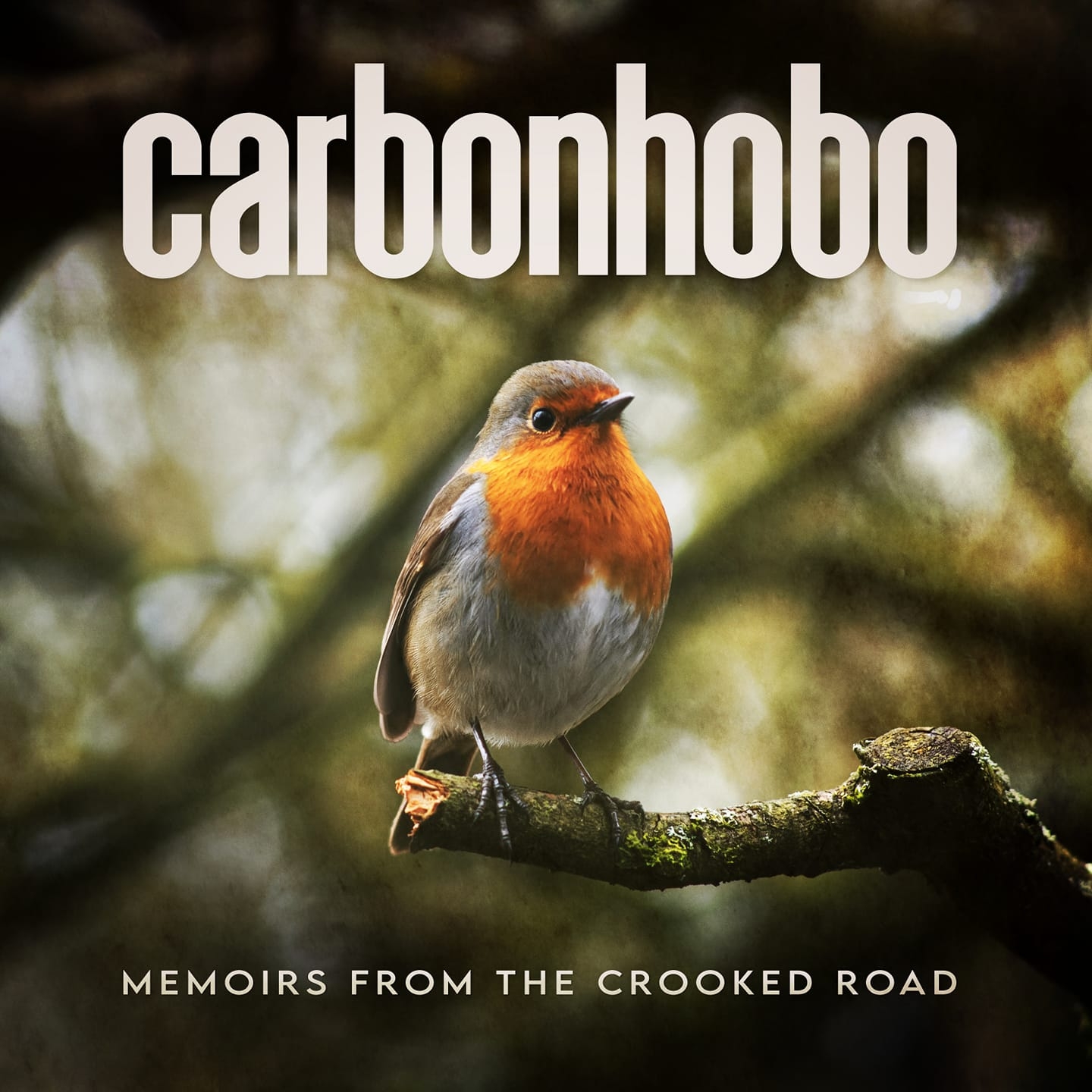
Carbonhobo is the alias for Neil McCartney’s latest solo venture. McCartney (who confirms in the accompanying press release he is actually related to his far more famous name-sake – but only distantly so) will be known to many folk-rock fans as the fiddle player with Merry Hell. Just as we witnessed with the solo album from Merry Hell’s Virginia Kettle last summer, the album is something of a departure from the parent group’s signature sound. In place of amped-up, rousing folk rock anthems we go down a far mellower singer-songwriter road with Carbonhobo.
What is fascinating about the songs on this album is that unlike many musicians who used the enforced down-time during lockdown to put pen to paper and create a whole load of brand-new material, many of the songs on this album go back decades – or at least were started back then.
Described as a “twelve-track wander through over thirty years of songs, written and lived around the world” Memoirs From The Crooked Road include the wistful ‘Seagull’, based on a tune McCartney wrote in his teens in Wigan back in the 1980s, to the infectious ‘Fifteen Miles To Buy Tobacco’ written in a cottage in County Mayo in the early 90s and completed in present day Wigan.
Between his teen years in Wigan and settling down there again later on, McCartney has enjoyed an adventurous life with stints in London, Ireland, the US and Thailand, all of which leave their mark on this album and the songs therein.
McCartney is effortlessly comfortable with the material, has an expressive, emotive voice, is a great storyteller, a fine musician and has an ear for a catchy melody. He takes us on quite a journey with Memoirs From The Crooked Road but it’s well worth joining him.
Having previously lived in south-east London for nearly twenty years I was pretty familiar with the National Maritime Museum in Greenwich and delighted to learn that Joe Danks’ album Seaspeak came about as a result of a collaboration between the museum and the English Folk Dance & Song Society.
Hailing from Nottingham and now residing in Derbyshire, what Danks lacks in terms of bonafide seafaring credentials he certainly makes up for in musicianship, songwriting and ability to source and reinterpret traditional material. Listeners may already be familiar with Danks through his work as part of Anglo-Irish folk outfit Ranagri.
Although shanties suddenly became the height of cool during lockdown, Danks avoided the most obvious musical direction for his material and looks elsewhere for inspiration. Recorded at the Queen’s House in Greenwich close to the Maritime Museum, he’s gone for a mixture of traditional material with some kind of maritime theme – either directly or indirectly, several brand-new compositions and a couple of poems set to music. The album concludes with a new interpretation of Ewan MacColl’s ‘Sweet Thames Flow Softly’.
“I was thrilled to be selected for the residency,” says Danks. “It was a great pleasure and privilege sourcing, writing, and arranging the material. The collection at the museum and its Caird Library is the richest stimulus imaginable for a songwriter and arranger and I was lucky to be supported by some very fine musicians on the project.”
Joining Danks, who plays guitar, bodhran and melodeon as well as singing, are Danny Peddler (accordion/hurdy gurdy), Sarah Matthews (fiddle/viola/vocals) and Jean Kelly (harp). Traditional dancer, Simon Harmer, also contributes his distinctive step dancing on two numbers.
Fresh-sounding, inventive yet steeped in tradition and tapping into a rich vein of history, from the sad tale of Jumbo the Elephant to the battle of Jutland in the First World War to Shackleton’s expedition to name but three, Seaspeak is a very impressive solo debut arising out of a fascinating project.
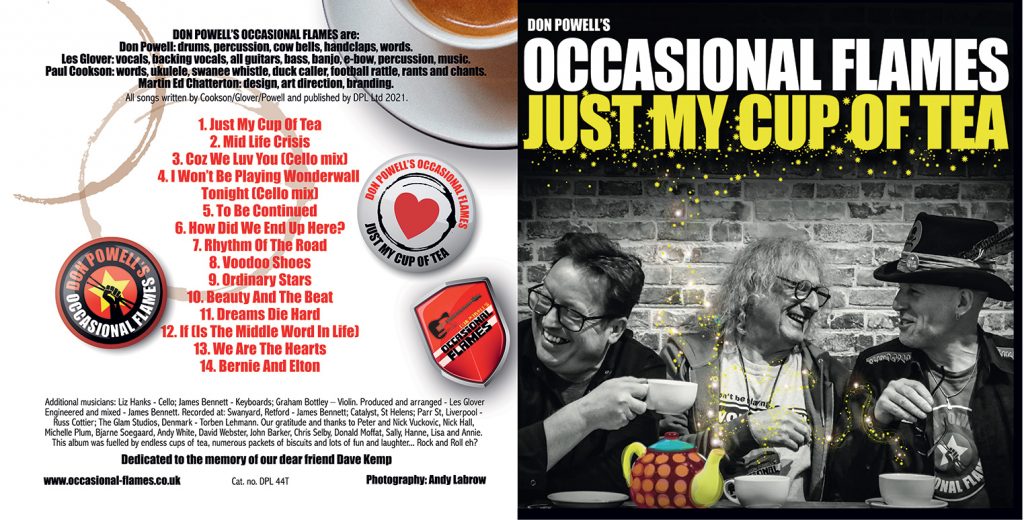
After decades of touring the circuit blasting out the old hits with erstwhile colleague, Dave Hill, in his reconstituted version of Slade, the last few years have been something of a creative renaissance for drummer, Don Powell. There was the enormously well-received album with Suzie Quatro and Sweet’s Andy Scott, there’s been work with his new Don Powell Band and he is also about to release his second album as part of Don Powell’s Occasional Flames. Just My Cup Of Tea sees him, once again, with guitarist/vocalist, Les Glover, and lyricist/poet and ukulele supremo and Slade superfan, Paul Cookson.
Paul Cookson is a brilliantly witty lyricist and poet, indeed publishing an anthology of Slade related poetry ‘Touched By The Band Of Nod’ back in 2007. I have a signed copy! Of course, there are numerous nods to Slade on the album and ‘Coz We Luv You’ is an affectionate tribute to our four heroes from Wolverhampton with a trademark Slade stomp.
The cultural references across the album’s fourteen songs go far beyond Slade and 70s glam, however. ‘I Won’t Be Playing Wonderwall’ is a witty Oasis pastiche, for example, but much of the album gives off something of an early 80s post-punk vibe – choppy, slightly aggressive yet highly tuneful playing, teamed up with sharp, observational semi- spoken-word lyrics. Not the album lacks more sensitive moments, too, like the poignant ‘We Are The Hearts’ or the affectionate ‘Bernie and Elton’ tribute to the bespectacled pianist and his long-time lyricist.
There quality of the musicianship on the album is great, too, both from the trio themselves and their musical guests. Cellist, Liz Hanks, who has played with the likes of Liam Gallagher, Richard Hawley, Paul Heaton and Thea Gilmore is one of the album’s guests for, example, while the group’s own guitarist, Les Glover, has a very impressive musical CV, running from Elvis sideman, James Burton to 10cc’s Graham Gouldman.
Glorious words, great playing and Don Powell out of Slade, too – what’s not to love about the Occasional Flames!