Following my ‘glam rock trilogy’ on Slade, Sweet and Suzi Quatro, my fourth book for Sonicbond Publishing came out in August 2025: Steeleye Span 1970-1989 On Track: Every Album, Every Song. I’ve been really heartened by the enthusiastic responses from readers so far (reaching Number 2 on Amazon’s Music Encyclopaedias Chart) and the many kind words from reviewers.
Darren Johnson
“Both satisfying and engrossing, what should’ve been a simple task to read and comment on, became a series of rabbit holes, as songs and entire albums had to be revisited or indeed investigated. Both for the purposes of research and pure enjoyment, as well as a degree of nostalgia.”Folk North West (read full review here)
“Darren Johnson has done a remarkable job in squeezing the details of fourteen albums into this slim volume” “Johnson’s research is thorough”RnR magazine
“I hadn’t heard some of these records for a very long time, but this deep dive into the band, their music and indeed the history behind some of the traditional songs they performed, caused me to listen again with fresh ears. Check it out if ‘The Span’ or indeed folk rock in general are your thing.” The Afterword (read full review here)
“The book though is very fair in recognizing it’s sources. It brings together a lot of info into a well written book – definitely recommended!” A Celebration of Steeleye Span (read full review here)
Steeleye Span 1970-1989 On Track can be purchased via Amazonhere as well as most other major book-sellers. And via the publisher’s own online shop at Burning Shedhere
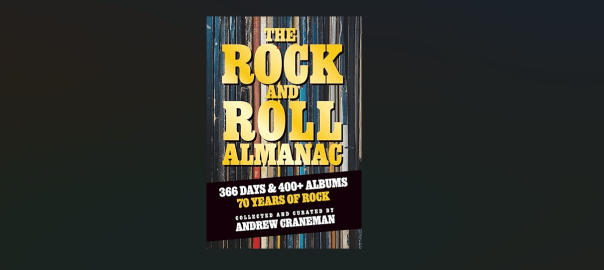
The Rock and Roll Almanac is a bumper compendium of facts, insights and snapshots in time covering events from the early days of rock and roll in the mid-1950s right up to the present day. Compiled by musician and music writer, Andrew Craneman, the book devotes a page to each day of the year, with every page containing a selection of historical rock snippets drawn from the past seventy years, along with notable births, notable deaths and a recommended single and album released on that same date.
It’s something you’ll dip into, rather than read in a single sitting but choosing a random selection of dates, I certainly got a feel for what the book has to offer.
Firstly, for my birthday (20th May) I’m interested to learn that on this day Bill Haley’s ‘Rock Around the Clock’ was first released in 1954, the Rolling Stones unveiled their forthcoming new single ‘(I Can’t Get No) Satisfaction’ on a US TV show in 1966, Joe Strummer of the Clash is arrested but later cleared following an altercation with an audience member in 1980 and Finish rock band Lordi won the Eurovision Song Contest in 2006.
Turning to today’s date (4th August) I find that the Kinks released ‘You Really Got Me’ on this day in 1964, Pink Floyd released the Piper at the Gates of Dawn album in 1967, Jim Morrisson got arrested for public drunkenness in LA in 1970 and Eagle, Don Henley, reached an out of court settlement with a US Republican candidate after the latter used parody versions of two of his songs without permission in 2010.
Craneman provides just enough background to each historical entry to keep you engaged and informed but the events detailed in the book will often encourage you to explore further, particularly if its something that you were completely unaware of before.
Keep it on your coffee table to look at each day on the relevant day in question. I’m sure I’ll be dipping in and out of it throughout the year.
Slade in the 1970s – my third book for Sonicbond Publishing’s Decades series came out in May 2023, following my books on The Sweet (2021) and Suzi Quatro (2022). All three books are available on Amazon and other major retailers as well as the publisher’s own online shop at Burning Shed.
It’s been great seeing the amount of interest in the book, including a joint interview with Don Powell (pictured here with a copy of my book – definitely a proud author moment!)
Here is a round-up of reviews that have come in so far:
“Covering the titular decade, Johnson provides in-depth analysis release by release, relying heavily on contemporary press. It reads well: interesting, informative and with an amiable personal slant.” – Gerry Ranson RnR magazine
“Another ‘must have’ for the casual Slade fan and anyone who loves a bit of glam rock”– Jason Ritchie, Get Ready To Rock (read full review here)
“As a massive glam rock fan, this is a must-have book” – Martin Hutchinson, Eighth Day magazine
“This neat paperback guide to a glittering 70s heyday recalls a momentous run of singles and albums” – Beat magazine
“As well as listing all single and album tracks, with accompanying background notes, all key elements of the Slade story are covered here.” – Jon Marsh, Wired Up fanzine
This week sees the publication of my third book for Sonicbond’s Decades series: ‘Slade In The 1970s’. It follows on from my books on The Sweet in 2021 and Suzi Quatro last year – a glam trilogy if you will!
Here is a round-up of reviews for my previous book on Suzi Quatro. All three books are available on Amazon and other major retailers as well as the publisher’s own online shop at Burning Shed.
“Darren Johnson focuses the same obsessive-compulsive attention to detail that he applied to Sweet in his earlier contribution” – Andrew Darlington, RnR magazine
“An interesting book which should appeal to a wide audience” – John Tucker, Record Collector magazine
“Fascinating read for Suzi Q fans, aging glam rockers and anybody who enjoys a good, informative rock biography.” Jason Ritchie, Get Ready To Rock
Following his two recent books cataloguing the glory years of Top Of The Pops, music wrier, Peter Checksfield, has turned his attention to those perennial rock gods, the Rolling Stones. More accurately, those artists who have chosen at some point in their careers to cover songs by the Rolling Stones. This bumper tome takes an in depth look at five hundred cover versions of Rolling Stones songs recorded by a vastly varied selection of artists.
‘Undercover’ not only includes the obvious Stones standards, like ‘Brown Sugar’ (covered by everyone from Little Richard to Ken Boothe to Thunder); ‘Honky Tonk Women’ (Ike & Tina Turner, Waylon Jennings, Elton John) and ‘Satisfaction’ (Otis Redding, The Supremes, Devo); but the book also covers many lesser-known songs and some lesser-known artists, too. Coventry band, The Mighty Avengers, recorded three (as then) unreleased Jagger-Richards compositions which resulted in some minor, albeit fleeting, chart success.
It could be argued that in these days of ever-expanding Wikipedia entries there’s less of a need for weighty rock encyclopaedias of this type. However, where ‘Undercover’ really comes into its own is in the 130 exclusive interviews that Checksfield carried out with many of those artists recording the cover versions featured in the book. We get fascinating insights from musicians as varied as Justin Sullivan of New Model Army; Bob Bradbury of glam almost-heroes, Hello; Gale Paridjanian of Turin Brakes; Steve ‘Lips’ Kudlow of Anvil; Dick Taylor of The Pretty Things, Marc Almond and Sandie Shaw.
‘Undercover: 500 Rolling Stones Cover Versions That You Must Hear!’ is a fascinating reference work on both the songwriting and the enduring influence of one of the world’s greatest rock and roll bands and will probably be something I’ll keep on dipping into.
Published: November 2022 – visit Peter Checksfield’s website here
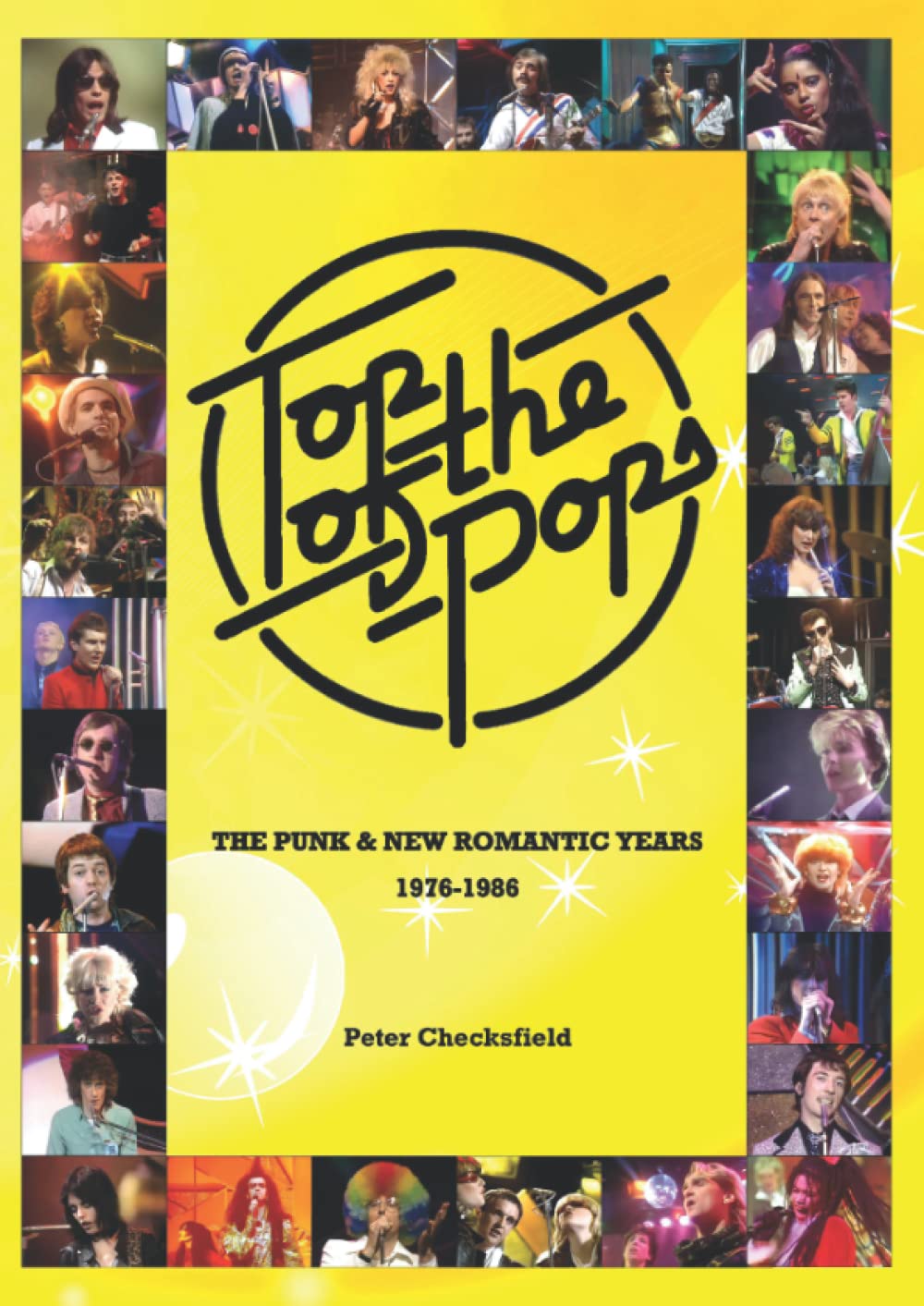
Hot on the heels of Peter Checksfield’sprevious Top Of The Pops book (which covered the show from its inception in 1964 through to 1975) comes this second volume taking us from 1976 through to 1986.
Again, it’s a similar format with a rundown of the acts on each episode and various titbits such as brief pen portraits of each artist, chart history and various reminiscences from some of those who performed on the show. It’s a slightly expanded format this time, including stills from each episode broadcast, resulting in a massive telephone directory -sized tome.
Unlike the first volume, where I was either yet to be born or a very young toddler for a good chunk of the episodes covered, this volume covers the entirety of my teenage years where Top Of The Pops went from something being on in the background to something I avidly watched each week.
I was ten in 1976 and vaguely starting to become aware of changes in the musical landscape. This book, however, is a timely reminder that for all of punk’s year zero rhetoric, change was gradual rather than something that happened overnight. Slade, Sweet, Mud and Gary Glitter were all still regulars at this point (even if their chart positions were somewhat lower than previously) sharing the Top Of The Pops weekly chart run-down with the likes of The Jam, The Stranglers and The Sex Pistols.
I was a bit too young to get caught up in punk and new romantic was never really my cup of tea either. But the early 1980s also saw a real renaissance for hard rock and heavy metal, which had been in the doldrums a bit in the second half of the 1970s. At the start of that new decade, bands like Motorhead, Judas Priest, Iron Maiden and Saxon became regulars on TOTP – not just making the album charts but making a serious mark on the singles charts, too. The period even saw a big commercial revival for Slade. Their appearance on 29th January 1981 as Checksfield notes, being their first TOTP performance in four years. It was a pivotal moment for me, instantly transforming them from being a group I remembered from my childhood that did that Christmas record to being my number one favourite band.
People will have their own particular highlights but this book, as well as being a useful and well-researched reference work, will trigger many affectionate memories, even though the less we dwell on some of the show’s past presenters the better.
My early teen years neatly coincided with the ascendancy of the New Wave Of British Heavy Metal (NWOBHM). I missed the first Monsters of Rock at Donington in 1980 but was there for the second. I went out to get the first issue of Kerrang! (which I still have) and bought (or taped) albums by many of the bands featured in this book. Unlike many other genres or musical movements that I’ve grown to love over the years, this one perfectly aligned with the period when I was seriously getting hooked on music for the first time.
Taking the form of a transcribed oral history, Denim & Leather features contributions from a plethora of figures, from artists to managers to promoters to writers to fans, who were around during the short life of this grassroots phenomenon which gave a much-needed shot in the arm to the world of hard rock at the tail end of the 1970s and the dawn of the 1980s.
Sometimes books of this nature, featuring an endless stream of quotes and half-remembered (and often contradictory) anecdotes but little in the way of context or analysis, can be a bit of an exhausting and not always particularly satisfying read. But Denim & Leather is cleverly done and author, Michael Hann, has skilfully organised it in a way that allows for clear narratives to emerge. The various chapters take us through key events chronologically but also give us an in-depth look at particular aspects of the scene. There’s chapters on the importance of things like The Friday Rock Show, Sounds and later Kerrang! mag as well as the first ever Monsters of Rock Festival but it also looks at some of the less rose-tinted aspects of the scene, like the all too frequent misogyny.
Wisely, the book doesn’t get too hung up on rigid definitions of what is and what isn’t NWOBHM and there is a chapter devoted to the influence the movement had on that trio of post-Purple bands, Rainbow, Whitesnake and Gillan, as well as lots of mentions of Judas Priest, whose members were all making music well before NWOBHM became a thing although they certainly benefited from it.
Given the importance the two bands had in influencing the later sub-genres of thrash metal and black metal respectively, there’s a whole chapter devoted to Diamond Head and another whole chapter devoted to Venom. I never really got the whole extreme metal thing, personally. But at the other end of the spectrum I never really bought into that overproduced very Americanised direction that Def Leppard soon headed in either. That also takes up a considerable chunk of the book and, in the end, is what pretty much did for NWOBHM.
For me, NWOBHM was at its very best when it melded the uncompromising heaviness of the first generation of heavy rock acts with the catchy choruses and three-minute tunes of the early 70s glam rock scene and the DIY ‘get-up-and-do-it’ spirit of the punk era. The bands that most closely adhered to that template were the ones I warmed to the most – and still do.
Denim & Leather is a well-researched and highly readable look at a crucial but often overlooked period in rock and metal history, with many insightful, entertaining, thought-provoking and occasionally downright disturbing contributions from some of the key players in the NWOBHM scene at the time.
Back in 2020 I reviewed Chasing Shadows – Adrian Jarvis’s book about his ultimately fruitless quest to locate original Deep Purple singer, Rod Evans, who vanished in 1980 following a deeply unwise scam involving misuse of his former band’s name and was never heard from again.
Nick Griffiths’ novel DeadStar takes a similar premise albeit the central character, Garth Tyson, never enjoyed anything like the brief taste of fame that Evans had with the first line-up of Deep Purple. Following a minor hit in the mid-80s with his fictional band Speed of Life Tyson disappears after a part utterly disastrous, part weirdly triumphant appearance at Glastonbury. However, outside of his immediate family and former bandmates, public speculation about Tyson’s whereabouts is precisely zero.
What really holds the reader’s imagination, however, is Griffiths’ attention to period detail in documenting the highs and lows of a wannabe rock star and his fellow travellers. From schoolboy misfits inspired by glam-era Bowie and then moving through boisterous teen punk, moody post-punk and chirpier synth-pop, it’s a journey that many bands have taken. Griffiths, himself a former music journalist who worked on the likes of Sounds and Select magazine in the late 80s and early 90s, captures the mood of the times and the shifting musical trends with accuracy, empathy and good humour.
Stuck inside during a period of Covid-induced self-isolation, when I was feeling well enough to read but not well enough to do much else, DeadStar proved both gripping and highly entertaining.
And does Griffiths’ fictional narrator succeed with Garth Tyson where Adrian Jarvis singularly failed with Rod Evans? Does he end up actually tracking him down? That would be telling but, as with the Jarvis book, the journey is definitely as important as the destination.
Published: 25th January 2022 by New Generation Publishing
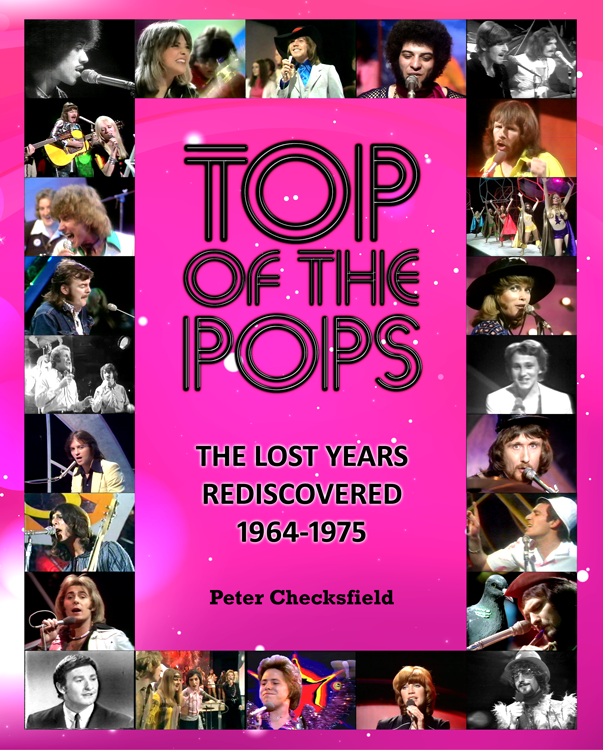
A prolific author and archivist of music history and pop culture, the latest book from Peter Checksfield is a mammoth 650-page tome devoted to the Top of The Pop’s glory days – from its inception in 1964 through until 1975.
As a writer I’d already made use of Checksfield’s own meticulously-researched publication ‘Look Wot They Dun’ which chronicled the TV appearances of all the key figures from the UK’s glam rock scene in the early to mid- 1970s and it’s referenced in my own book‘The Sweet in the 1970s’. Likewise, I’m pretty sure I’ll be making similar use of this latest volume.
It includes a complete episode guide stretching from the first ever show on New Year’s Day 1964 through to the Christmas Top Of The Pops edition that went out on 25th December 1975. Each entry includes a chronological run-down of the acts performing on that show, potted bios and relevant chart positions. This is no mean feat given that many of the episodes from this period no longer survive. Only five complete shows from the 1960s still exist and only two complete shows from 1972 at the height of the glam period survive – although many more clips (the handiwork of early home-taping, sneaky BBC technicians or overseas TV stations) mean the archive isn’t quite as empty as the official figures initially suggest.
While the book is a crucial reference work, what really brings it to life is a succession of anecdotes that Checksfield has garnered from various artists who appeared on the show. Ralph Ellis of the Swinging Blue Jeans recalls a scuffle with Keith Richards in the BBC canteen, surviving members of the Bonzo Dog Doo Dah Band recall their time on the show miming to ‘Urban Spaceman’ and Ray Dorset (Mungo Jerry) recalls arriving late for rehearsals when ‘In The Summertime’ hit the charts as he was still working at the Timex factory and had to ask his boss for time off.
There’s also plenty of little nuggets I learned for the first time. Who knew that for a few months in 1971 Top Of The Pops ran an ‘Album Spot’ where artists would perform three songs from a current album, for example? My own personal recollection from when I really remember looking up and avidly watching an episode of Top Of The Pops (rather than it just being on in the background as I coloured with crayons or whatever) was when that week’s presenter announced a brand-new single from Mud called ‘Tiger Feet’. What 7yo doesn’t love tigers?! On checking the episode guide I find that the episode in question went out on 3rd January 1974.
Thoroughly researched and with some fascinating personal insights together with a comprehensive index of each artist’s appearances on the show ‘Top Of The Pops: The Lost Years Rediscovered 1964-1975’ will appeal to any fan of the show and anyone with an interest in pop culture over that period.
Since my book ‘The Sweet In the 1970s’ was published in the summer, not only have I been bowled over by sales (the first print-run sold out even prior to publication date) I’ve been hugely encouraged by the reviews, too.
Jason Ritchie at Get Ready To Rock was first to review:
“An excellent overview of The Sweet, appraising the band’s 70s output and tracking the band’s ups and downs during that decade. Well researched and referenced too, with the final part of the book giving a whistle stop tour of what the band did from 1980 to the present day.”
You can read the full Get Ready To Rock review here
Then over in the US, Dave Thompson gave the following review in Goldmine magazine:
“Certainly this is not the first Sweet biography to appear in recent years, but it’s sharp, it’s concise, and it doesn’t spend half its time moping around the not-happened-yet sixties and the oh-dear-are-they-still-going beyond. Well, not much. We skip the first ten pages, covering the “early years,” and the last ten detailing “what happened next.” Don’t care. But there’s close to a hundred pages between those bookends that are just non-stop blockbusting, hell raising, teenage rampaging little willying, with every album and single spotlighted for special examination, key quotes highlighted and individual song titles telling their own stories, too. Throughout, author Darrell Johnson (sic) captures the excitement of the great records; can usually find something nice to say about the less great ones, and doesn’t try to kid us that Cut Up Above the Rest was even remotely well-titled. It’s a book for fans, then, but one for the curious, too. Nicely done.”
Dave Thompson produced his own well-written Sweet biography a decade ago, of course, so I was particularly pleased to get his endorsement. I’ll even forgive him getting my name slightly wrong!
Back on to the British magazine racks, Mick Gafney at Powerplay magazine also had some very nice things to say:
“What comes across in spades in this book is the author’s unwavering love and passion for the band, and whilst it might not be the weightiest of tomes, Johnson still manages to fill it with plenty of well-researched facts and insightful opinion.”
You can read the full review here:
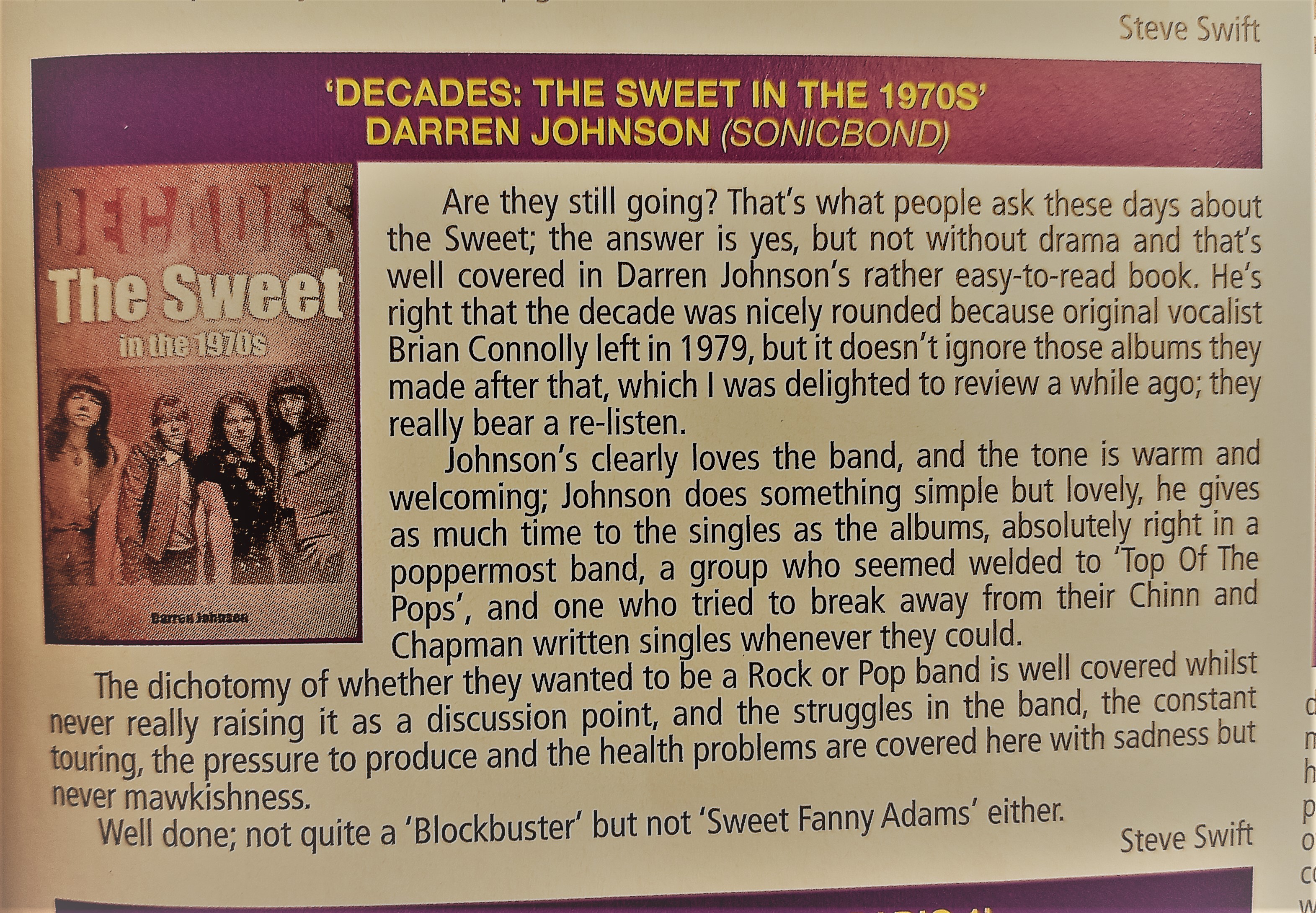
And Steve Swift at Fireworks magazine also gave it the thumbs up:
“Johnson clearly loves the band and the tone is warm and welcoming; Johnson does something simple but lovely…”
You can read the full review here:
Over on Amazon it’s been picking up some very encouraging customer reviews, too:
“The Sweet In The 1970s is an excellent and concise book about rock’s most underrated band who transformed from ‘bubblegum’ to ‘glam rock’ to ‘hard rock’ to something a little more progressive throughout the aforementioned decade. It also reminds the reader how Sweet managed to ‘snatch defeat from the jaws of victory’ on many occasions.”
“Fabulous book. It does what it says on the cover it tells the Sweet story in the 70s. That doesn’t mean that the 60s and 80s are totally ignored.”
“Whether you a big Sweet fan or not this is a really interesting story written and presented very well. I’ve learnt a lot!”
“Draws together from many sources it borders on the academic, yet reads easily. Clearly a fan, our author is not blind to the weaknesses of the band and is never modest on their behalf either. I learnt quite a bit and it’s a great reference book for the material recorded by the band.”
At one point it made it to number three on Amazon’s UK best sellers list for music history and criticism, as well number ten in its popular music books and number fourteen in its rock music books.
When I first began writing the book I never dreamed it would do so well and writing for Sonicbond Publishing had been an extremely positive experience.
You can read how I first came to write the book here
Better, still you can read the book!
‘The Sweet in the 1970s’ is available from the following outlets:
UK
You can order ‘The Sweet in the 1970s’ direct from the publishers via the Burning Shed on line shop here











 Darren's music blog