Having previously lived in south-east London for nearly twenty years I was pretty familiar with the National Maritime Museum in Greenwich and delighted to learn that Joe Danks’ album Seaspeak came about as a result of a collaboration between the museum and the English Folk Dance & Song Society.
Hailing from Nottingham and now residing in Derbyshire, what Danks lacks in terms of bonafide seafaring credentials he certainly makes up for in musicianship, songwriting and ability to source and reinterpret traditional material. Listeners may already be familiar with Danks through his work as part of Anglo-Irish folk outfit Ranagri.
Although shanties suddenly became the height of cool during lockdown, Danks avoided the most obvious musical direction for his material and looks elsewhere for inspiration. Recorded at the Queen’s House in Greenwich close to the Maritime Museum, he’s gone for a mixture of traditional material with some kind of maritime theme – either directly or indirectly, several brand-new compositions and a couple of poems set to music. The album concludes with a new interpretation of Ewan MacColl’s ‘Sweet Thames Flow Softly’.
“I was thrilled to be selected for the residency,” says Danks. “It was a great pleasure and privilege sourcing, writing, and arranging the material. The collection at the museum and its Caird Library is the richest stimulus imaginable for a songwriter and arranger and I was lucky to be supported by some very fine musicians on the project.”
Joining Danks, who plays guitar, bodhran and melodeon as well as singing, are Danny Peddler (accordion/hurdy gurdy), Sarah Matthews (fiddle/viola/vocals) and Jean Kelly (harp). Traditional dancer, Simon Harmer, also contributes his distinctive step dancing on two numbers.
Fresh-sounding, inventive yet steeped in tradition and tapping into a rich vein of history, from the sad tale of Jumbo the Elephant to the battle of Jutland in the First World War to Shackleton’s expedition to name but three, Seaspeak is a very impressive solo debut arising out of a fascinating project.
‘Nightfall in the Labyrinth’ is the new single from Sussex-based progressive duo Across The Sea. Released on 6th August it’s the lead single ahead of the duo’s much-anticipated second album, a nine-track concept piece entitled The Wayfarer Triptychwhich is scheduled for release on 1st October.
Deep amongst the maze-like ruins of a fallen city, a girl is pursued through the night as she flees in a desperate bid for survival. And far in the distance, a great wall of mist rises from the darkness, standing between her and the hope of salvation. What lies beyond? Will she reach the other side? Or will she remain imprisoned in this labyrinth forever?
The fastest track the duo have ever committed to tape, ‘Nightfall in the Labyrinth’ showcases Across The Sea at their most ferociously intense yet strikingly melodic, twisting and turning through a barrage of frenetic guitar riffs, towering vocal hooks and complex rhythmic shifts, as the track spirals towards its soaring and dynamic finale.
Hailing from Worthing on the West Sussex coast in the south of England, Across The Sea sound unlike any act you’ve heard before. Evocative, otherworldly, and utterly captivating, they defy categorisation, inhabiting a place where the boundlessness of the imagination transcends genre limitations and conventions. A breathtaking synthesis of the haunting, siren-like vocals of classically trained soprano Hannah Katy Lewis and the dynamic, unorthodox and experimental guitar style of Pete Ferguson, their mesmerisingly unique sound is wildly eclectic, fiercely inventive and singularly distinctive.
Their critically-acclaimed first album Infinite Worlds was released in December 2018, featuring on HMV Brighton’s recommended list and being lauded by a diverse range of outlets as a startlingly original debut. The June 2019 stand-alone single Behind the Looking Glass gained further recognition for the duo, picking up considerable airplay in the UK and internationally.
Playing over 150 shows since their inception, the pair have earned a reputation as one of the most tirelessly active and genuinely innovative acts on the live circuit, whose immersive and theatrical performances have enchanted audiences at venues throughout the south and – as part of a successful 2019 summer tour – festivals such as Victorious, Wickham and Rhythmtree.
‘Nightfall in the Labyrinth’ will be available from Across The Sea’s online store in a variety of digital formats www.acrosstheseauk.com
Across The Sea – what they say:
“Early Joni Mitchell meets Hawkwind in this Space-Rock-fuelled, Folk fusion journey. Set the controls for a far-flung flight of fantasy to a distant galaxy where Space Rock, Folk and Opera are one. Brimming with complex musical ideas and literary concepts, Across the Sea will challenge you to consider where one genre ends, and another begins.” – Alistair Goodwin, Music Producer & Events Organiser, Wickham Festival
“A unique musical act that is virtually impossible to pigeonhole genre-wise, combining amazing vocals with breath-taking guitar work.” – Ivan Roberts, Riff Taff Music Networking
“Something to get drawn into and swept away with.” – Metal Meyhem Radio
“We love Across the Sea – uncompromising, dark, ethereal beauty. One of the most interesting acoustic artists around. Can’t wait to hear what they’ll do next.”John Fowler of prog duo Dandelion Charm
“Across the Sea are a rare find. The extreme juxtaposition of Hannah’s exquisitely pure vocal and Pete’s deep and intricate guitar playing is extraordinary and compelling.”Clare Fowler, Dandelion Charm
“Combined they’re a 2 piece that sound like a 10 piece.” – Headlights and White Lines
“Hannah Katy Lewis’ vocal is startlingly good, ranging from Kate Bush theatricals to Middle-Eastern chanting…” – Listen With Monger
Nightfall in the Labyrinth – credits:
Vocals – Hannah Katy Lewis
Guitar – Pete Ferguson
Written, recorded & performed by Across The Sea
Recorded at Humber Studios & The Mothership, August – October 2020
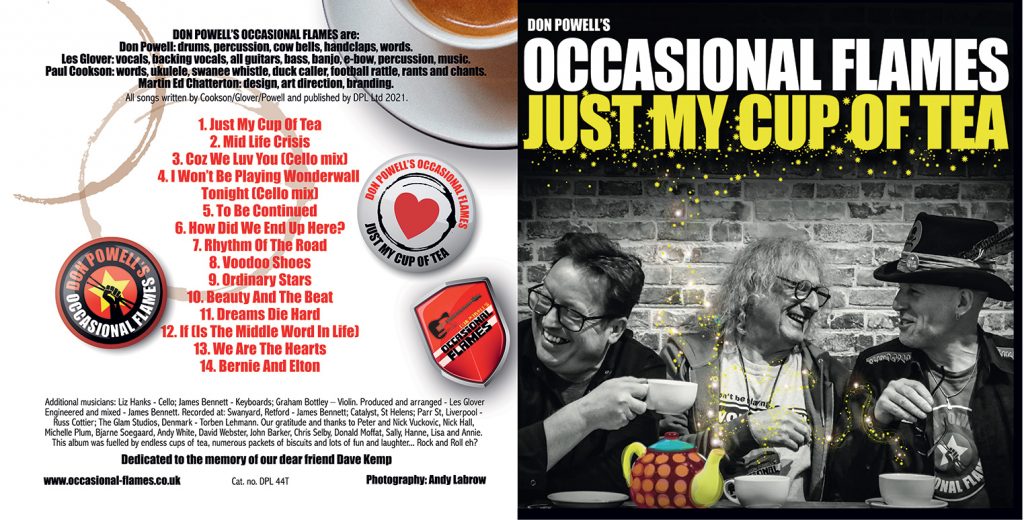
After decades of touring the circuit blasting out the old hits with erstwhile colleague, Dave Hill, in his reconstituted version of Slade, the last few years have been something of a creative renaissance for drummer, Don Powell. There was the enormously well-received album with Suzie Quatro and Sweet’s Andy Scott, there’s been work with his new Don Powell Band and he is also about to release his second album as part of Don Powell’s Occasional Flames. Just My Cup Of Tea sees him, once again, with guitarist/vocalist, Les Glover, and lyricist/poet and ukulele supremo and Slade superfan, Paul Cookson.
Paul Cookson is a brilliantly witty lyricist and poet, indeed publishing an anthology of Slade related poetry ‘Touched By The Band Of Nod’ back in 2007. I have a signed copy! Of course, there are numerous nods to Slade on the album and ‘Coz We Luv You’ is an affectionate tribute to our four heroes from Wolverhampton with a trademark Slade stomp.
The cultural references across the album’s fourteen songs go far beyond Slade and 70s glam, however. ‘I Won’t Be Playing Wonderwall’ is a witty Oasis pastiche, for example, but much of the album gives off something of an early 80s post-punk vibe – choppy, slightly aggressive yet highly tuneful playing, teamed up with sharp, observational semi- spoken-word lyrics. Not the album lacks more sensitive moments, too, like the poignant ‘We Are The Hearts’ or the affectionate ‘Bernie and Elton’ tribute to the bespectacled pianist and his long-time lyricist.
There quality of the musicianship on the album is great, too, both from the trio themselves and their musical guests. Cellist, Liz Hanks, who has played with the likes of Liam Gallagher, Richard Hawley, Paul Heaton and Thea Gilmore is one of the album’s guests for, example, while the group’s own guitarist, Les Glover, has a very impressive musical CV, running from Elvis sideman, James Burton to 10cc’s Graham Gouldman.
Glorious words, great playing and Don Powell out of Slade, too – what’s not to love about the Occasional Flames!
Scarfoot are a three piece hard rock/metal outfit from Merseyside. A video for their latest release ‘Cactus Killer’ was unveiled back in June and has already clocked up an impressive 8,000+ views.
The band are Oliver Carins (guitar and vocals), Phil Eakins (drums and vocals) and Rhys Jones (bass). Formed back in 2018 their line-up has now settled with bass-player Rhys joining the two founder members.
I get the lowdown on the video:
“We were intending to make a more… budgetarily weighty video,” confesses Rhys. “But lockdown after lockdown after lockdown made us just decide – balls to this, we’ll have some cactuses fight and animate them. It isn’t the video we originally intended to make, but in a pandemic you do what you gotta do to keep the ball rolling. We had cactuses, we’re a bit daft, so this is what we made!”
And how would the band describe their sound?
Rhys: “A yet to be defined genre. Probably stoner metal would be the closest I think but we do argue about it.“
“We are two Americans living in Ireland doing original Americana which is folky and rocky at times.”
So stated the charming hand-written note that accompanied the CD and press release announcing Beki Hemingway’s latest album. Folky and rocky Americana does indeed sound just the sort of thing that Darren’s Music Blog should be investigating so I decided to find out more.
Working with her husband and musical partner, Randy Kerkman, since the mid-90s Hemingway has already released half a dozen albums, the last being Whins and Weather which came out in 2017. It was around that time, however, that the pair made some major changes to their lives. Leaving behind Denver, Colorado they emigrated to Ireland in late 2016, settling in Dundalk on Ireland’s east coast.
Channelling the spirit of the likes of Emmylou Harris, John Mellencamp and Hank Williams Earth & Asphalt serves up eleven tracks of gorgeous, sun-kissed, heart-felt Americana. And there is, indeed, some rocky bits. Kerkman is a greatly talented guitarist, whether turning in some achingly poignant guitar licks on the slower tracks like ‘Shape of My Face’ and ‘Hurricane’ or some Stonesy-type riffing on songs like ‘We’re Not Going Anywhere’, not to mention bags of gorgeous-sounding, upbeat Americana on the rest.
Expressive and emotive as a singer and a great story-telling lyricist and melodious song-writer, Hemingway’s vocals are the perfect fit for her husband’s playing. Bass, drums and keyboards from a succession of supporting players round out the sound nicely and it’s extremely well-produced with some rich-sounding harmony vocals.
What you won’t really find is much in the way of Celtic influences, however much they are soaking up the scenery and culture of their new lifestyle.
“It turns out that being here has only made us sound more American,” says Hemingway. I can’t disagree with that! Simply gorgeous.
I was very enthusiastic about Record Store Day when it first started getting off the ground back in the late 00s. Amazon was sweeping all before, independent record stores faced complete obliteration and it was a worthy exercise to show those that were hanging on some love and support. One of my most enjoyable Record Store Day experiences back then was a on a weekend trip to Antwerp, wandering from store to store, catching a variety of live bands playing instore and coming home on the Eurostar with an armful of CDs, both new and second-hand.
These days, however, Record Store Day has become so synonymous with the vinyl revival craze and all the attendant limited edition vinyl releases that go with it that it just doesn’t speak to me at all. As a dedicated CD collector, I don’t bear it any ill-will and I am very happy for stores to cater for their vinyl market in this way, and for the artists and record companies that supply them. But it’s not my day.
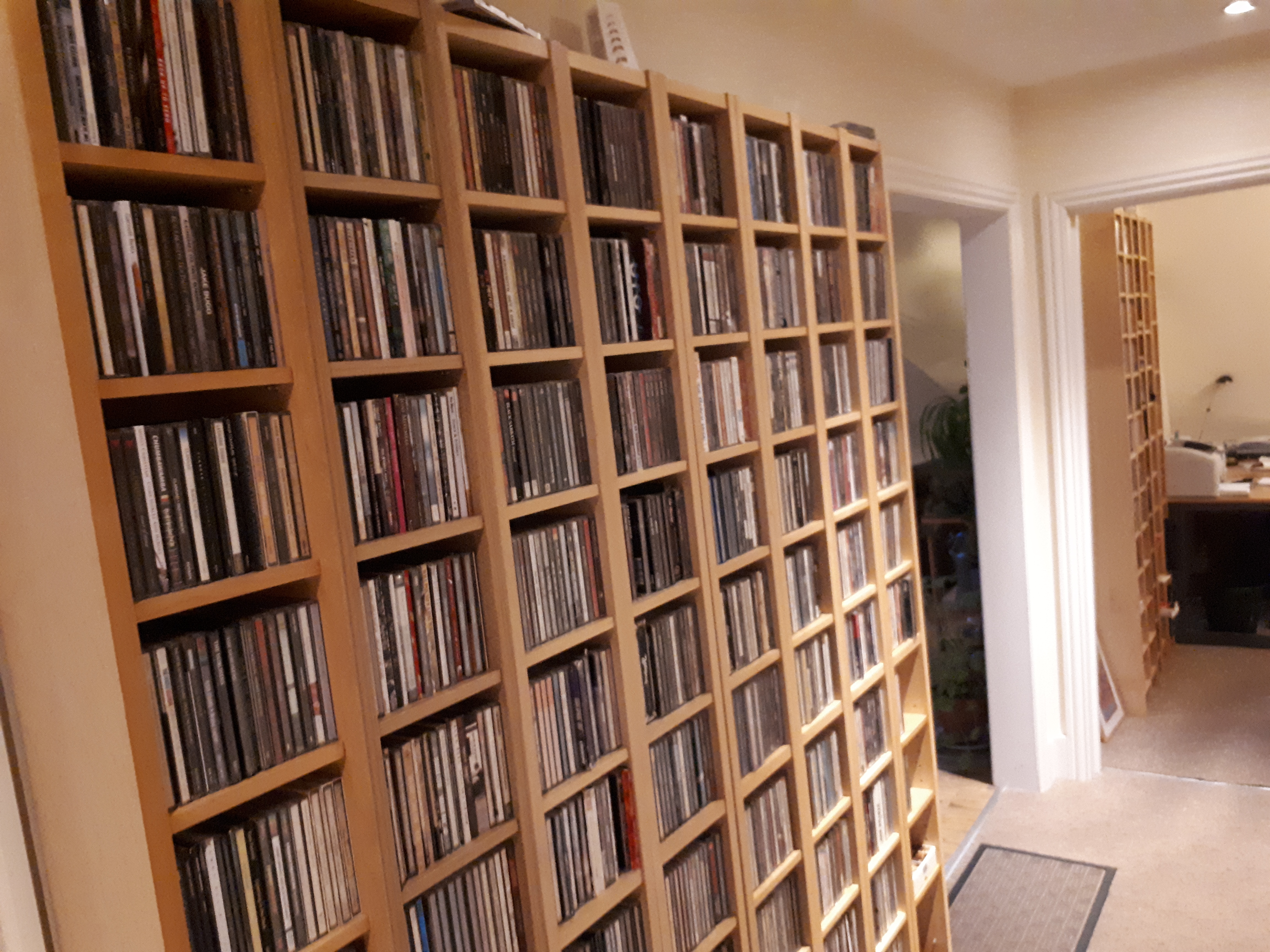
I am a dedicated fan of the CD format and will remain so – and remember there were still 16 million of them sold in the UK last year, bringing in revenue of £115 million. Yes, CD sales are declining but they are far from disappearing and – nor will they!
As this article makes clear CDs are still a great format for musicians:
Why do musicians hate streaming?
– Streaming services reduce sound quality
– Musicians make significantly less money from digital sales and streaming
– This combination of reduced audio quality and income undermine the musician’s work
Easy to produce and cheap to mail out and easy to sell at gigs (unlike lugging huge crates of clunky vinyl around) CDs provide a decent revenue stream for musicians on a quality format for fans.
That is why I now think we need an annual day to celebrate the CD each year, and those who sell them – whether that’s record stores, independent online retailers and the artists themselves. I don’t begrudge vinyl fans their day. There’s loads of cultural events that completely pass me by – from Eurovision to football to royal weddings. And Record Store Day is one of those. Great for those who it means something to but it’s no longer my day.
So let’s have an international Day of the CD each year. Who’s up for it?
In the week of the sixty-seventh anniversary of the recording of Lonnie Donegan’s ‘Rock Island Line’ I talk to Peter Donegan about his father’s legacy, about his viral TV duet with Tom Jones and about his forthcoming album.
DJ: Firstly it’s a huge, huge pleasure to be talking to you. My own dad was a big, big Lonnie Donegan fan and I think he’d be very touched that I was interviewing his son. Growing up in the 1970s the Rolling Stones and Deep Purple and so on were always played a lot in our house but there was still always lots of Lonnie Donegan, too. So it was a big part of my childhood. But if we can start off going back to the very beginning then we’ll look at your more recent career. Elvis Presley recorded ‘That’s Alright’ and your father recorded ‘Rock Island Line’ in the very same month back in July 1954. It’s something Billy Bragg points out in his book on skiffle, and he called them ‘the first tremors of an earthquake that would shake the world’. Did that give you a good feeling seeing it put like that?
PD: Yes, definitely. Billy’s been a huge campaigner for the importance of what has become a kind of forgotten era – the skiffle era. I mean, Billy made another nice analogy which was that it was the nursery for British rock and roll. Because songs like ‘Rock Island Line’ – and that one in particular which changed the British music industry – it gave a new breath of life into what was, you know, a crooners’ market. And I don’t mean any disrespect to any artist up until my dad came out, obviously, but it did. It changed the nature of it. And it made music accessible. It meant that for people like Eric Clapton, for people like Van Morrison, for people like Jimmy Page – all these kind of people realised, ‘Ok, so I don’t have to be – number one – classically trained to play the guitar. I can learn the basic two/three chords – or one sometimes – and the lyrics and go for it.’ And, number two, it meant that you didn’t have to feel self-conscious singing a lot of these old American country and blues songs and feel self-conscious about it – especially a British white person as well. You didn’t feel like you were false either. You could be ‘paying homage’ to, you know, and doing it in your own way. I mean that gave birth to, like the Beatles and the Rolling Stones and Led Zeppelin who all started off in skiffle bands.
DJ: And it was a very British take. It wasn’t a straightforward adoption of an American culture was it?
PD: No, No. You could argue really that while skiffle was Americana music, as we call it now nowadays, it was definitely with a very British tint to it. It didn’t sound the same. They were the same songs, but they weren’t the same way. They were definitely distinct. Which is how ‘Rock Island Line’ went to number 8 in the States, you know – just before Johnny Cash recorded and released it. And the odd thing is, is that my dad had added that part of the tollgate which wasn’t in the Leadbelly original. And then Johnny Cash put out a version afterwards with the tollgate in it again – so you can argue that Johnny was listening to my dad’s version. Because it’s kind of like, he’s just taken dad’s version, slowed it down just a little bit. So there could be something there. There could be something there. You could argue really that the skiffle sessions – all that stuff for that period in time, that six years or whatever it was – was a little bit more British even than when the Stones came out. Because they were doing it much more per original blues… Definitely, much more modernised but it was arguably more towards the original than what Dad was doing.
DJ: In the true folk tradition he actually adapted it and added his own take on it and that’s now become the tradition.
PD: Yes, exactly. You know, it’s been fantastic. And, of course, Dad wrote his own things as well which we all know about. Most notably was the Tom Jones hit ‘I’ll Never Fall In Love Again’. I mean, it wasn’t written for Tom to do. My dad went to release it because he loved the sounds that he was hearing coming from Ray Charles. Great gospel R&B singer, you know, and Dad thought, ‘That’s brilliant. I want to do something like that.’ Wrote ‘Never Fall In Love Again’ and the record label which was Pye at the time – who were trying to be true to their roots and wanting to be jazz, despite the fact of having Lonnie Donegan on the record label who was definitely not jazz anymore despite his origins of coming through with the Ken Colyer Jazzmen and then the Chris Barber Jazz Band – they insisted on there being a jazz version. So they recorded a jazz version and a more gospel version which Dad wanted to do. And insisted on releasing the jazz version – obviously, because that was their plan all along. And nothing happened with it – because it wasn’t what people expected. It wasn’t ‘Dad’ if you know what I mean. So, Tom picked up on it.
DJ: It was a few years gap wasn’t it between your dad releasing it and Tom Jones having a hit with it?
PD: It was early ‘60s for my dad. You’re looking at 62/63 whenever it was – and I think it was 67/68 when Tom released it. And Dad’s gag on stage was always, ‘What’s Tom Jones got that I haven’t got!’ It was always a good laugh. And then, of course, Elvis picked it up in the end because, you know, Elvis was permanently ‘on tour’ doing all the casinos in Vegas. As was Tom, so they were always going to see each other’s set at some point in time. And Elvis picked it up and did it, you know. And I think that was the last track on the last album that Elvis released.
Watch the full interview on YouTube here
DJ: And then, obviously, you had that wonderful emotional moment with Tom Jones on ‘The Voice’ two years ago. That must have been very, very special?
PD: It was! It was a big ‘pinch me’ moment because I was scouted by the show. They’d seen me at a country festival in London and they wanted that – because they knew that the country genre was really booming in the UK. And they wanted me to go and try out – so that was nice. And they said, ‘Don’t worry. It’s not like you’ve got to wait in the queue or anything. You can go straight to the producer so there’s no pressure.’ And that’s more pressure I think! So yeah.. sat there and did some original songs. That’s what they wanted. They said they wanted originals. And went through about another four rounds of auditions and they said, ‘Yep – we want you for the blinds.’ And I just thought well, if nothing else, this is just a bit of PR. You know, get a nice bit of high-quality PR footage [laughs] and have some fun while you’re there. And when it was Tom that turned, you know, it was an emotional relief that somebody turned. I was very nervous. I’d never done anything like that before and it was a very nice moment. And then when, obviously, Tom asked us to do that song and we did it – it was a shock, you know. There’s a video about me – because I did a video on YouTube talking about it which had about two million views.
DJ: Yes, I watched that. I still tear up every time I see the footage. It’s just so incredible!
PD: It was a lovely, lovely evening. It really was. I mean, bittersweet in some ways because obviously you realise it’s a TV show first and foremost before it’s a talent show – and it’s a very good one and I really enjoyed my experience on there. But, as a friend of mine who was there said, ‘That’s going to go viral.’ I said, ‘Do you think? Shit!’ He said, ‘Why?’. I said, ‘I peaked too soon in that case! It probably means I’m out next.’ And I was out next!
DJ: But no-one could take away that moment though.
PD: No! I have no regrets. I had great fun. And not many people get to do three songs in two shows – so it was good!
DJ: Has Tom been in touch since?
PD: No. I’ve tried but not got anything back though.
DJ: Ok. Ok. And just looking back – this week, it’s actually the 67th anniversary of ‘Rock Island Line’ being recorded.
PD: Yep. ‘54 it was recorded. ‘56 it became a hit. It was a track on the Chris Barber Jazz Band album and for whatever reason Decca released it two years later as a single and it was played on – I can’t remember the radio show – Dad didn’t know anything of it. Somebody said to him, ‘You know you’re number one!. He was like, ‘What?’ ‘Yeah check out the papers…’ And the rest is history, as they say.
DJ: And you did a special concert two years ago, to mark the 65th anniversary of it?
PD: We did, yes. We did one in 2018 just at the end because it all started off with Chas Hodges – God rest his soul. It was his initial idea because we were raising money for our son’s therapy for his autism and he said, ‘If you want to do a gig, me and Dave will get up and do something. We’ll do half an hour, you finish the gig off. I was like, well that’s lovely. Mentioned it to a couple of friends as I was talking and they we’re like, well I’ll do something and I’ll do something and someone said, ‘Well we haven’t done a night for your dad in a while. Why don’t we do that?’ So in 2018 we had Billy Bragg, Nora Guthrie, The Jive Aces, Mike Berry, Mike Read, Ralph McTell, Chris Difford from Squeeze, Chas McDevitt, Vince Eager and we did that at the Union Chapel in Islington. And Billy Bragg said, ‘Right, so what are we doing next year?’ And I was like, oh you’re kidding right. But I’d invited Van to do that one and he wasn’t available but then he followed up and said, ‘Are you doing another one?’ I said, ‘Well yes, next year’s the 65th anniversary of the recording of ‘Rock Island Line’. And then Mike Read said, ‘Well we need a blue plaque to commemorate that.’ So we did a blue plaque on the same day, on the morning and then we went and did the gig.
DJ: You obviously grew up with music. Did you always want to be a musician?
Yeah. I did. There was never any other option, you know. And I had a great coach, obviously, in Dad and he always taught me that the best thing to do – the only way to make it in this industry is to write your own songs. And that’s why I’ve always done that. From becoming my dad’s piano player to then becoming the opening act for the set, I always did original material. And then, from then I kept doing it. It was difficult because, you know, every time a label said that we could do an album they would only include a maximum of one of my songs on it. Because they wanted to make easy money and just do another Lonnie Donegan tribute album which was, you know, getting frustrating to say the least. So, I decided to go independent and in 2017 released my ‘Superman’ EP which did quite well for my first independent thing and that’s what got me ‘Country To Country Festival’ which got me noted by the guys at ‘The Voice’ and then on with Tom Jones and then on from there. And then we did the live album after that which was recorded in 2019 in the Decca recording studios. In the same studio that Dad recorded ‘Rock Island Line’ – which now belongs to the English National Opera. But that was nice. It was good fun. And then since then I’ve released ‘Thank You Texas’ which was co-written with two Texans at the Buddy Holly song-writing retreat in Lubbock.
DJ: And that won an award didn’t it?
PD: It yes – at the ‘Texas Sounds Country Music Awards’ last year. Got Best Male Vocalist and Original Song.
‘Thank You Texas’ recorded at North London’s Mill Hill Music Complex
DJ: The Americana/country direction that you’ve taken as you wanted to pursue your own, as you say, independent career – was that a very conscious decision or did you just sort of evolve into that direction, musically?
PD: Well, obviously, when you consider the influences I was surrounded by with Dad’s record collection at home – which had everything, you know, from Fats Waller to Jerry Lee Lewis, Johnny Cash, Willie Nelson, The Highway Men – all that kind of stuff. So I grew up with that plus – I was born in London but only because Dad was doing a West End thing at the time… We were living in California. So you know California, Florida, Spain. I didn’t grow up here, so I was surrounded by American music a lot of the time. And Dad was big into country. And then so was I. I’m a huge Waylon fan, Willie fan and later on, you know, I love now Chris Stapleton and Eric Church and the High Women if you’ve heard them… So it was a natural transition for me because I like to write stories, you know real-life events, that kind of stuff. And country music, Americana music in general really lends itself to that.
DJ: Well story telling is at the heart of those lyrics.
PD: Yeah. So it was a natural transition for me. And when you consider really where I came from musically with Dad, skiffle is what we call Americana now. Because Americana is country, with blues, folk. And it’s just Americana is the umbrella term. And underneath it you’ve got all these different genres.
DJ: So what’s next for you in terms of your solo career? Are you working on new music at the moment?
PD: I am yes. Again, written at the same retreat with a couple of great song-writers in America. With Sean Healen who’s from New Mexico and with Tessy Lou Williams – ‘It’s My Dreams’. We did a lockdown sessions version of it which you can find on YouTube but there will be a single version of it coming out. And it will be included on the new album which is currently being made.
There’ll be a couple more singles to come off that album as well… I think there’s some really cool tunes on there, especially with the new collaborations. Because I do like to co-write… the old adage two heads are better than one is true. Because there’s ideas that you come up with that you wouldn’t come up with unless you were sitting with somebody else. I’m not saying that maybe their idea is in the song, but they say something which sparks an idea in your head again, you know – and the other way around, too.
DJ: That approach to collaboration is very much part of the Americana scene isn’t it, I think?
PD: It is and there’s a feelgood sense within it as well. It’s a case of not quite as much competition as we’re in it together. So it’s more fun to drag these other people that you respect – if you’re not already friends – along with you and have that shared experience rather than try and keep it for yourself. And I like that feel. It’s much more relaxed… It’s a better experience. It’s less uptight.
Thank you so very much to Peter Donegan for talking to me. You can check his forthcoming live dates on his website here:
I’m generally more one for Viz Top Tips than anything approaching self-help literature but when I was offered the chance to review a book entitled ‘How To Think Like David Bowie – Habits of mind for leading a more creative and successful life’ my curiosity was piqued.
By sheer coincidence the book arrived in the post about thirty minutes before I was due to head off on a trip to Essex with former Bowie guitarist, Kevin Armstrong, who had worked with Bowie on Absolute Beginners and Tin Machine and played with him at Live Aid. I hadn’t even had time to open the book before he arrived but I mentioned it to a bemused Kevin on the journey up to Colchester and asked for his thoughts. “I think there’s very few people who ever really knew what David Bowie was thinking,” was Kevin’s response, saying that Bowie was always welcoming and warm-hearted but rarely shared his inner thought processes, concentrating very much on the task in hand and getting the best out of everyone present.
In the book itself, Kevin Armstrong’s own sentiments are very much echoed by an earlier collaborator, Rick Wakeman, whose recollections of recording ‘Space Oddity’ back in 1969 are reproduced in the book:
“He was always incredibly prepared in the studio. He never wrote in the studio; everything was already done. He was always what he called ‘75% prepared’. You’d go in and he’d get the piece that far, and then the studio would take it that extra 25%.”
So does author, Jonathan Tindale, really attempt to get inside the head of Bowie and tell us how to think like him? In truth, although the book references Jung and Myers- Briggs and ‘The Journal of Personality and Social Psychology’, the title is somewhat tongue-in-cheek and it’s more philosophy than psychology. Bowie’s approaches to numerous projects throughout his five-decade career are analysed, dissected and cross-referenced and various life lessons drawn from them. Tindale, whose previous publications have included travel writing and parenting, draws on a wide range of Bowie-related sources to derive a number of key lessons from Bowie’s career.
Arranged across twelve chapters, themes include Bowie’s individuality, his work ethic, his approach to creative collaborations and his attitude to the business side of things. The book is not a long read but it’s well referenced and entertaining and avoids falling into the cult-like demagogic devotion that some of the more hagiographic pieces written after his death have fallen victim to. Moreover, it doesn’t shy away from looking at some of Bowie’s flaws and the odd creative troughs in his career as well as the many peaks. Quirky and thought-provoking How To Think Like David Bowie will be of interest to more than just the most hardened Bowie devotee.
Published: 18th June 2021 and available to orderhere
On her long-awaited debut album entitled Gu Deas (meaning south or southern), Màiri MacMillan presents us with interpretations of eleven traditional Gaelic songs. For MacMillan, Gaelic folksong and the Gaelic language is not merely some recent exploration of Scotland’s rich musical heritage. She lives and breathes it and is very much the genuine article.
From Milton in South Uist, MacMillan was brought up surrounded by Gaelic language, culture, music and song and began singing at an early age. Gaelic is her first language and Gaelic songs, and traditions run deep in her family.
“The songs on this album have been learned from recordings of women, mostly from South Uist, who passed on songs for future generations,” she writes in the sleeve-notes.
MacMillan is blessed with one of these beautiful, clear, pure voices that is just so perfect for this material and her familiarity with and deep love for the songs shines through.
The songs have been given fresh-sounding but sympathetic contemporary arrangements by the musician Mhairi Hall, who arranged and produced the album, learning from past recordings of South Uist tradition bearers. Alongside Hall (harmonium, piano, flute, and whistle), the album features Megan Henderson (fiddle and voice), Ali Hutton (bodhrán, guitar, whistle, great highland bagpipes) and Rachel Newton (clàrsach, electric harp and voice).
The extensive sleeve-notes, in both Gaelic and English, provide full lyrics and additional background information for each of the songs. The themes range from mythical creatures to long lost love to banishment to battle laments. An especially poignant moment is at the end of the first song ‘Wily Margaret’ where a few verses from an original field recording of the song, now in the custody of National Trust for Scotland, are spliced into MacMillan’s own version.
A beautifully-made album that will find a suitable home with anyone who has a love for Gaelic songs and traditions.
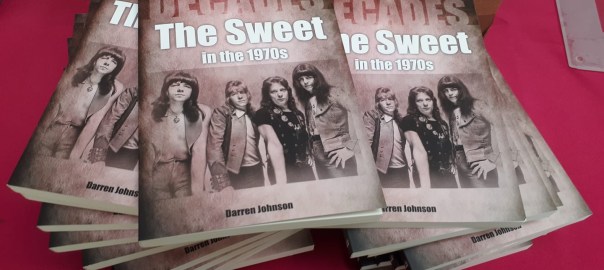
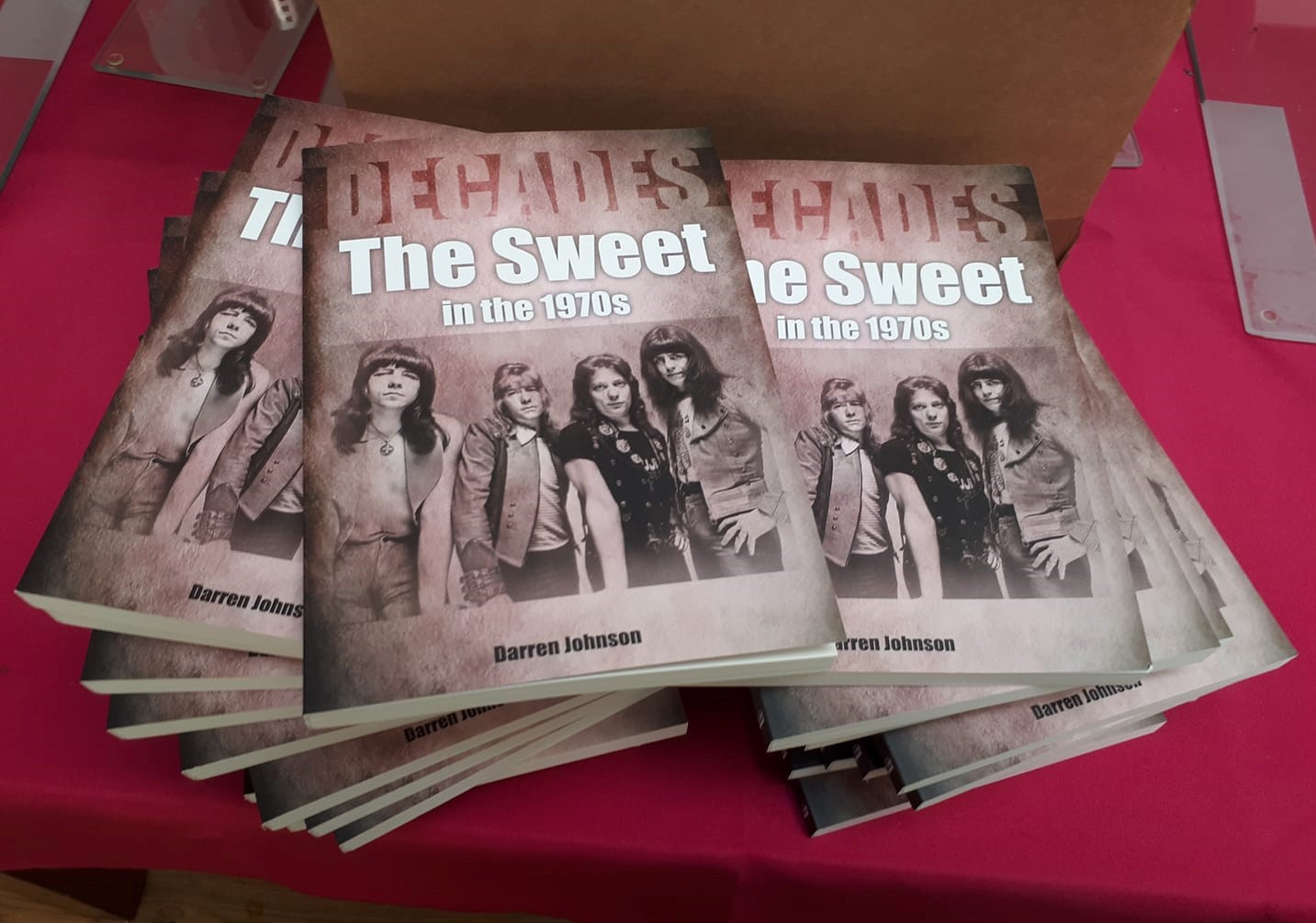
Just over a year ago I had a dream that I had written a book about The Sweet. When I woke up I was more than a little disappointed to release I hadn’t written any such book. But with the idea still fresh in my mind I decided to fire off an email to the publishers Sonicbond to see if they were interested in me writing one. Amazingly they came back and said yes.
Starting work last summer, writing and researching ‘The Sweet in the 1970s’ very much became my lockdown project during the latter part of 2020 and the early part of 2021. I finished it back in February, delivered the manuscript and my mind, which had been so utterly pre-occupied with all things Sweet for several months, pretty much moved on to other things. In recent weeks, however, it’s all started to become very real again. There were proofs to read, images and the cover blurb to check through and so on. And although, it’s not in the shops until July 30th I took delivery of some advance copies this week!
I also did an interview for the excellent Glam-themed fanzine Wired Up – talking about how I came to write the book, how I first became obsessed with The Sweet as a teenager in the early 80s trawling through second-hand albums in Preston’s Action Records – as well as a little bit on what readers can expect from the book. You can find out more about the Wired Up fanzine here.
I’ve dedicated the book to my dad. I know he would have enjoyed reading it.
UK:
You can order ‘The Sweet in the 1970s’ direct from the publishers via the Burning Shed on line shop here










 Darren's music blog