This review was originally published by Get Ready To Rock here
After perhaps rather too many Christmas tours of provincial theatres in recent years and, ahem, a tour supporting the Bay City Rollers last year it was gratifying to have Sweet do a short tour of proper rock venues this year. And I was lucky enough to catch them not once but twice. The renowned Robin 2 venue in Bilston, where the tour culminated, has been something of an annual pilgrimage for hardcore Sweet fans, with people travelling in from all over Europe.
First, however, I caught the band a few nights earlier at Nell’s Jazz & Blues in London. This is a small venue with a tiny stage and it was absolutely rammed but the atmosphere was electric. It was evident that the band were also getting a huge buzz from playing to such a responsive audience, too. This was confirmed by Andy Scott when we chatted briefly after the gig and the Sweet legend is clearly humbled by the reservoir of affection for the band as the Sweet approaches its 50th anniversary in 2018.
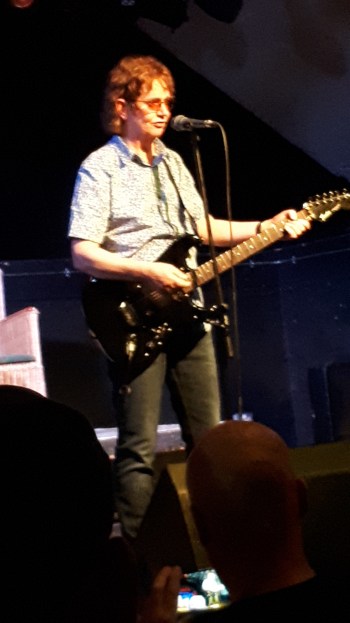
With Brian Connolly and Mick Tucker no longer with us and Steve Priest in the States with his own version of the Sweet it’s been left to Andy Scott to fly the flag for the band’s legacy in the UK and Europe. Consistently exacting in his high standards Andy Scott has never been one to just go through the motions when he goes out under the Sweet name. The current line-up of Pete Lincoln (lead vocals/bass), Tony O’Hora (keyboard/guitars/vocals) and Bruce Bisland (drums) have been together a good few years now (twenty-five in Bisland’s case) and it’s clear just seeing them on stage they work exceedingly well together as a unit. The unforgettable riffs and the trademark harmonies are delivered as powerfully now as they were when the band was at its commercial peak.
Set-wise, for this tour there was a nice mix between pumping versions of the glam-era singles like ‘Hellraiser’ and ‘Teenage Rampage’ and some of the classic harder-edged album tracks like ‘ACDC’ and ‘Set Me Free’ from the ‘Sweet Fanny Adams’ album. In the middle of it all the stools came out for a nice little acoustic set – Andy Scott and Pete Lincoln delivering blinding versions of ‘Lady Starlight’ and ‘Lost Angels’. Tony O’Hora then joined the two for an acoustic run-through of some of the band’s very earliest (pre-glam) bubblegum hits. It’s testimony to the guys’ creativity, not to mention sheer chutzpah, that they can somehow give added meaning to the lyrics of ‘Co-Co’ and ‘Funny Funny’ and get a packed-out rock crowd singing along to every word.
Throw in some majestically symphonic versions of ‘Love Is Like Oxygen’ and ‘Fox On The Run’ and add in a barnstorming encore of ‘Blockbuster’ and ‘Ballroom Blitz’ and on both nights I witnessed very memorable gigs and a very satisfied audiences. Here’s to The Sweet at 50 next year.
Live photo credits: Eileen Handley, Set-list photo: Darren Johnson
Lovers of 70s-era David Bowie have been in for a real treat this year. Not only have we had Tony Visconti and original Spider from Mars, Woody Woodmansey, touring the Ziggy Stardust album in full, we now have virtuoso Bowie pianist, Mike Garson touring the Aladdin Sane album in full.
Joining Garson on this tour are former Bowie guitarist, Kevin Armstrong; award-winning vocalist Gaby Moreno, Terry Edwards (PJ Harvey band) on sax and guitar; along with the current Iggy Pop rhythm section of Ben Ellis and Mat Hector. It’s a stunningly good band. From a fabulously groovy ‘What’s That Man’ through to a poignantly dramatic ‘Lady Grinning Soul’ they bring to life the full Bowie masterpiece in all its glory.
For ‘The Jean Genie’ we get an extra treat. Deep Purple’s Roger Glover (whose talented daughter Gillian Glover is providing backing vocals tonight as well as being the solo support act) is taking a night off from the Purple tour and takes the stage to play bass for this song. Sadly, I never got to see Trevor Bolder doing the bass-line of ‘The Jean Genie’ but seeing Roger Glover doing it has got to be the next best thing. We even get a cheeky snatch of Purple’s ‘Black Night’ at the end!
After a magnificent performance of Aladdin Sane, Garson introduces a second set of other Bowie favourites, kicking off with a stunning Space Oddity. Then it’s on to ‘Life On Mars’.The piano is as prominent on ‘Hunky Dory’ as it is on ‘Aladdin Sane’, albeit in a very different style. But after the jazz-infused piano of ‘Aladdin Sane’ Garson moves on to deliver a truly majestic version of ‘Life On Mars’ that even manages to out-Wakeman Rick Wakeman. An extremely gifted composer and musician it’s nothing less than an absolute pleasure to see the great Mike Garson in action this evening.
Another treat is seeing Steve Harley of Cockney Rebel fame take the stage to guest on vocals for a few numbers, including a superb ‘Changes’ and a wonderfully frenetic ‘Absolute Beginners’ as well as two of Harley’s own songs ‘A Friend For Life’ and ‘Sebastian’.
Like all great art the songs celebrated tonight will live on long after the demise of their original creator. They will undoubtedly carry on being performed many years into the future. Inevitably, there will come a day when no-one who actually performed alongside Bowie is around any more. For now, though, let’s be thankful that people like Mike Garson and Kevin Armstrong are celebrating his legacy and the unmistakable part they played in it.
Set-list:
First Set – Aladdin Sane album in full:
Watch That Man
Aladdin Sane (1913-1938-197?)
Drive-In Saturday
Panic in Detroit
Cracked Actor
Time
The Prettiest Star
Let’s Spend the Night Together
The Jean Genie
Lady Grinning Soul
Second Set – Bowie Favourites:
Space Oddity
Life on Mars?
Changes
A Friend for Life
Absolute Beginners
Sebastian
Rock’n’Roll Suicide
Five Years
Wild Is the Wind
Ziggy Stardust
Under Pressure
Let’s Dance
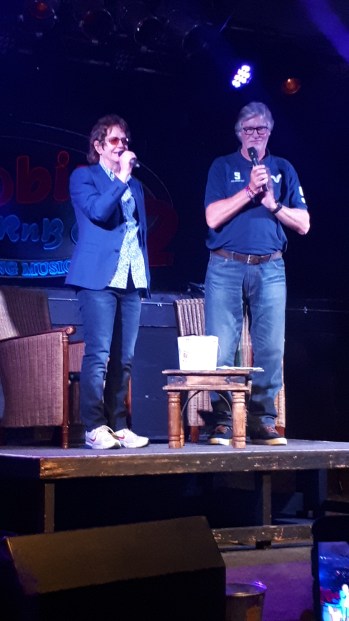
Back in 2002 Slade’s Jim Lea performed a unique one-off solo gig at Bilston’s Robin 2 venue, the only solo gig of his entire career. Now, some fifteen years later, Jim was to take to the stage at the Robin once again for a Q and A session for fans that would immediately follow an official first screening of the new live DVD from that gig.
Today’s event was not going to be a live performance we were all warned when we booked: “Unfortunately due to Jim’s illness he will be unable to perform musically at this event.” That was fine I thought to myself. It will still be something special, a unique Slade event, a chance to hear directly from Jim and, for me, an opportunity to see him up on a stage for the first time since I saw Slade on the My Oh My tour when I was still at sixth form.
The film itself is a nice memento. It’s fan-shot footage from the audience rather than a professional film but the quality is considerably better than the average blurry, wonky you-tube concert video and, coupled with the official CD soundtrack of the concert and some brand new interview segments with Jim as he reflects back on that night, it’s definitely a must-have for fans.
The DVD screening is then followed by a short warm-up from poet, Paul Cookson. Dubbed Slade’s official Poet Laureate by Noddy Holder, Cookson delivers two wonderfully affectionate Slade-themed poems, including one written especially for today. And then it’s time for the main event. Jim Lea takes the stage to warm applause as he begins his Q&A session with local BBC radio presenter, Paul Franks.
While there are many oft-repeated Slade anecdotes that fans, and many chat-show viewers, will have heard many, many times before from his less publicity-shy erstwhile band-mates, Jim delves deep with his recollections today. Fascinating insights emerge: such as his wife Louise being an uncredited co-writer of Slade’s 1974 hit Everyday; about the piano refrain in How Does It Feel being the very first thing he ever composed; about how the violin solo in the band’s first number one Coz I Luv You originally emerged out of his regular dressing room jamming sessions with Noddy Holder when they were channelling the spirit of Django Reinhardt. And for this famously private musician who has studiously eschewed the rock ‘n’ roll lifestyle he also told us a lot about himself today. “Why now?” he was asked. “Well I realised I was no longer shy any more!” he confided. Sharing with the audience that he now understands he is probably autistic (although he’s never had any formal diagnosis) he suggests that this has likely been a key factor in both his levels of creativity and his introspection.
Always the most thoughtful, the most creative and the most fascinating member of Slade, notwithstanding that all four members played an irreplaceable part, Jim Lea was the genuine musical genius of the band. In the DVD he recollects the time he was asked by late manager, Chas Chandler, why he became a bass player when, like Hendrix, he was such an instinctive natural on lead guitar. “I didn’t want to get noticed,” Jim replied.
And so, as the Q&A draws to a close, I start thinking what a special day today has been: getting to pose with Jim’s bass in the morning after much, much queuing, seeing the inaugural screening of Jim’s DVD on the very stage where it was originally filmed, hearing Jim share his fascinating insights into the band and, of course, getting to meet lots of fellow Slade fans.
And then it all started to get ever so slightly odd on stage. Jim went off stage to get something. Something about some notes for the final question host, Paul Franks, said. But then microphone stands start appearing. Surely he can’t be? He can’t be playing for us can he? Oh my God, there he is back on stage with his guitar. Is he really going to do this?
He’d not got a full band he confessed but he had recorded some backing tapes to play along to and he wanted to do something special to finish the session, he said. And he did. Launching into a blistering version of Cum On Feel The Noize, he rocked out on lead guitar and sang for all he was worth in his first public performance since that last Robin gig fifteen years ago. Gudbuy T Jane and We’ll Bring The House Down quickly followed and, with an ecstatic demand for an encore, he finishes by giving the emotional crowd of Slade fans Mamma Weer All Crazee Now.
We had been warned not to expect a live performance. But he certainly gave us one, and not some gentle, reflective, soul-searching, acoustic reinterpretation but a full-on, amped-up, raucous rock performance that so perfectly captured the spirit of Slade.
The man who didn’t want to get noticed certainly got noticed today.
Thank you Jim for what you did for us today. We wish you the best of health in your ongoing treatment and we thank you for all the music you gave us in the greatest rock ‘n’ roll band the world has ever known.
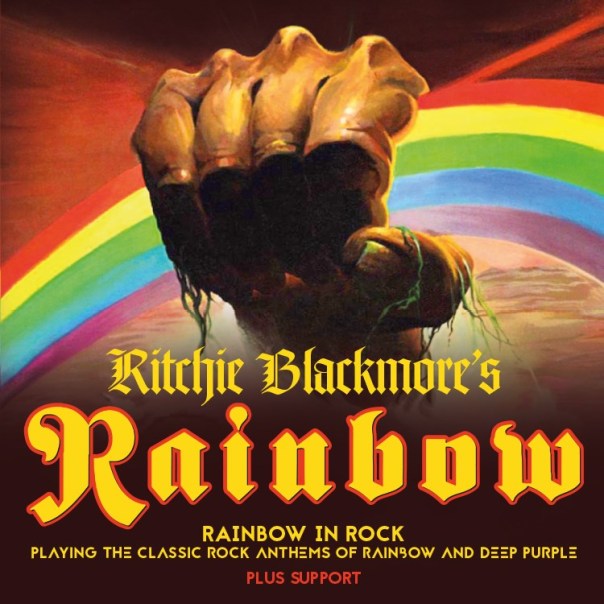
When I was a teenager getting seriously into rock and metal in the early 80s I was lucky enough to see some of the biggest acts around: AC/DC, Sabbath, Quo, Ozzy etc. One band I never got to see, however, was Rainbow and one guitar wizard I never got to see (in any formation) was Ritchie Blackmore. For some inexplicable reason (and I am normally really on the ball with this) I failed to get myself a ticket when Blackmore revived the Rainbow name and announced a tentative return to rock ‘ n’ roll last year. So when a further tour was announced this year I made absolutely sure I was going to be there this time.
The evening was going to be made even more special when I found out the support act would be Sweet, who I have been following for as long as I’ve been following Rainbow. Unlike Rainbow, I have seen The Sweet many times before over the past twenty-odd years – but usually in small rock venues or provincial theatres, never in an arena with a 15,000 strong crowd. In some ways, both Rainbow and The Sweet summed up the music of the mid 70s: the albums-based rock was brilliant and the singles-based pop was brilliant, too. Perfection!
Tonight would give Andy Scott and co the chance to rekindle their relationship with many older rock fans as well as hopefully winning over some newer fans, too. ‘Hellraiser’, ‘Teenage Rampage’, ‘Blockbuster’, ‘Ballroom Blitz’ et al all go down an absolute storm. My only complaint was that the set was heavily weighted towards the old hits, with little time for the harder-edged album-oriented rock of which the band have an impressive, if less well-known, back catalogue. However, we did get stunning versions of ‘Set Me Free’ and ‘Love Is Like Oxygen’ and hopefully Andy Scott’s continuing version of The Sweet has a good few more fans after tonight.
“I’m playing all the right notes, but not necessarily in the right order,” Eric Morecambe once famously said. No-one in their right mind could ever accuse guitar god, Ritchie Blackmore, of that. But funnily enough I was reminded of the old Morecambe & Wise gag when I was thinking about Ritchie Blackmore’s set-list at Birmingham tonight. Pretty much all of the songs that I very much hoped he’d play were in there – but the set order seemed to be in random shuffle mode with little attempt at any sort of thematic approach. We jumped from the polished commercial rock of Joe Lynn Turner-era Rainbow, to Coverdale-era Deep Purple, to the infectious pop-rock of Graham Bonnet, to the heavy prog-tinged majesty of Dio-era Rainbow and so on and so on. I suppose the main message was: “I have been involved with creating some amazing music in different bands with different vocalists and different styles – and whichever order you put them in they are all amazing…” Which is true!
After years away from doing gigs of this type and making albums like this Blackmore’s stunning guitar skills have not dimmed. Never guilty of being flashy for the sake of being flashy or of putting technical prowess ahead of creating beautiful melody, there is an elegance about his playing that is a joy to see live. Ronnie Romero, too, I thought was a good choice of vocalist. Of all the iconic vocalists Blackmore has worked with over the years, Romero probably sounds closest to Joe Lynn Turner in style, but he handled all of the material well from Gillan through to Coverdale, Dio, Bonnet and Turner. Towards the end a keyboard solo seemed to go on forever but that is a minor quibble. At the age of 51, the teenage rock fan in me has finally got see Ritchie Blackmore live on stage and has finally got to attend a Rainbow gig. He is happy.
Set-list – Sweet:
Action
Hellraiser
The Six Teens
Set Me Free
Teenage Rampage
Wig Wam Bam / Little Willy
Love Is Like Oxygen
Fox On The Run
Blockbuster
Ballroom Blitz
Spotlight Kid
I Surrender
Mistreated
Since You Been Gone
Man on the Silver Mountain
Soldier of Fortune
Perfect Strangers
Difficult to Cure
All Night Long
Child in Time
Stargazer
Long Live Rock ‘n’ Roll
Lazy
Catch the Rainbow
Black Night
Carry On… Jon
Burn
Smoke on the Water
My review was originally published on the Get Ready To Rock website here
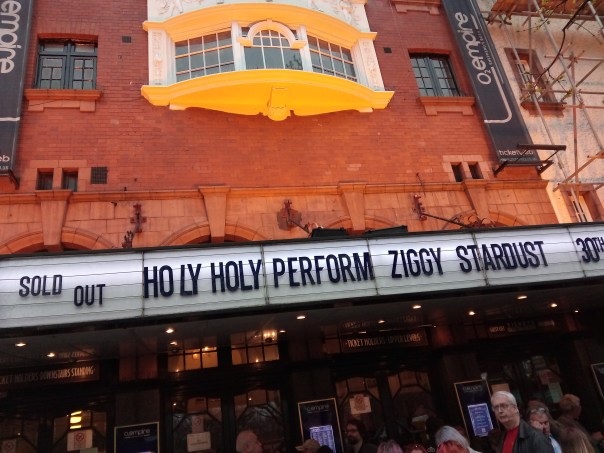
“He’s fucking sacked us,” Spiders bass player, Trevor Bolder, was seen to mouth when David Bowie announced at the Hammersmith Odeon in October 1973 that it would be the final Ziggy show ever. Tragically, like Bowie, Bolder and his former Spiders colleague Mick Ronson are no longer with us. However, three years ago Spiders drummer, Woody Woodmansey, teamed up with long-term Bowie collaborator, Tony Visconti, to tour The Man Who Sold The World, an album that both played on. Now their Holy Holy outfit have done the seemingly impossible and resurrected Ziggy and the Spiders, forty-odd years after Bowie declared it would be the last show they would ever do.
Would they pull it off? I was certainly keen find out. Much as I wholeheartedly agreed with all of the tributes last year about what a truly unique, talented and infuential presence Bowie was throughout his entire career, for me it was always the early 70s glam rock period of Bowie’s work that I was truly, unequivocally a 100% fan of.
Starting out with The Width Of A Circle from The Man Who Sold The World, the seven-piece band go on to perform the Ziggy Stardust album in full, treating the crowd to blinding versions of Starman, Ziggy, Suffragette City and all the other gems from that iconic album. Once the final song of the album Rock n Roll Suicide plays out they give us to a spectacular run-through of other Bowie classics including Changes, Life On Mars and Space Oddity.
Heaven 17’s Glenn Gregory delivers superb Bowie-esque vocals with the familiar phrasing that we all know and love from the records, while at the same time avoiding descending into a “Tonight Matthew I’m going to be…” pastiche. Post-punk icon James Stevenson absolutely nails the Ronson guitar licks in what is a talented band of world-class musicians. And, of course, it goes without saying that Woody Woodmansey is still an exceptionally talented drummer. The outpouring of affection for him throughout the night is thoroughly deserved.
The capacity crowd sing along to every word and the whole thing is joyful and celebratory. As we inevitably lose more and more of our twentieth century rock icons it becomes more and more apparent that we continue to have a tremendous yearning to still hear the music they made being performed live. We are no more going to forget Life On Mars in fifty years time than we have forgotten A Wonderful World almost fifty years after the death of Louis Armstrong. The challenge is to find an appropriate way of continuing to celebrate such music in a live setting. Holy Holy perhaps provides the template. They don’t claim to be the original band, although they’ve got a living, breathing direct link to it in the form of Woodmansey. They are not a tribute act, in that they avoid the role-playing and dressing up which can risk turning contemporary live performances into the musical equivalents of historical re-enactment societies. They do, however, pay tribute to the music in a way that is accurate and authentic and which delivers the songs with great love, care and affection.
In short, Holy Holy shows a way forward as to how we can continue to enjoy some of the greatest music of the twentieth century well into the twenty-first. A genuinely and truly impressive gig.
Setlist:
The Width of a Circle
The Rise and Fall of Ziggy Stardust and the Spiders from Mars
Five Year
Soul Love
Moonage Daydream
Starman
It Ain’t Easy
Lady Stardust
Star
Hang On to Yourself
Ziggy Stardust
Suffragette City
Rock ‘n’ Roll Suicide
Wild Eyed Boy From Freecloud
All the Young Dudes
Oh! You Pretty Things
Changes
Life on Mars?
Space Oddity
The Supermen
Black Country Rock
The Man Who Sold the World
Watch That Man
Time
Heroes
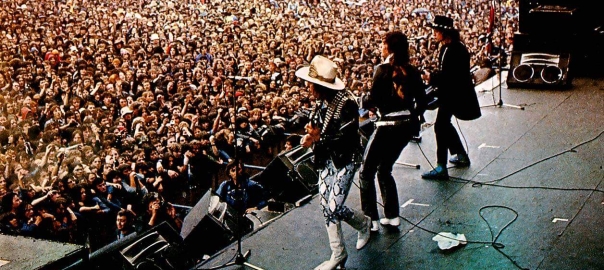
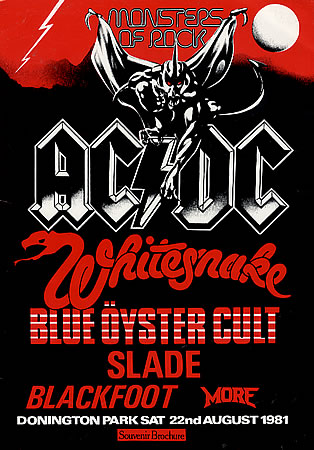
When I went to Monsters of Rock at Donington, aged 15, in 1981 it was not only my first ever festival but also my first ever live rock gig of any type. It still remains my favourite gig of all time, in particular the set by Slade that afternoon.
We arrived at Donington a little late and by the time we had parked and got into the arena the band More were most of the way through their set. The next band on were Blackfoot who I have no real recollection of at all. What I do remember is the anticipation of waiting for Slade to come on. After several years in the doldrums Slade had burst back into the charts a few months earlier with ‘We’ll Bring The House Down’. Their storming performance at Reading Festival the previous year (when the band replaced Ozzy Osbourne at the last minute) had already become legendary and this all meant that in the space of a few months Slade went from being a band that sang about Christmas that I vaguely recalled from my childhood to being my number one favourite band in the whole world. And that was even before I witnessed what would become (and still remains) the most remarkable live performance I’ve ever seen. Loud guitar-driven rock, commanding showmanship, unforgettable songs and sheer over- the-top-eccentricity, it was an absolute master-class in compelling live performance.
On the back of the previous year’s Reading appearance, the early 80s heavy metal crowd had really taken Slade to heart. Looking at the setlist from Donington now the songs basically fit into three categories. Firstly, there were, unsurprisingly, the 70s hits like ‘Gudbuy T’ Jane’ and ‘Cum On Feel The Noize’. Secondly, there was newer material like ‘We’ll Bring The House Down’ and a sneak preview of their soon-to-be-released new single ‘Lock Up Your Daughters’. Thirdly, there were the old 50s rock ’n’ roll covers, which Slade had begun inserting in their set in their wilderness years in the late 70s but had kept in as they began to be embraced by the heavy metal crowd. Although the look couldn’t have been more different, this latter group of songs demonstrates how much late 50s rock ’n’ roll and early 70s glam rock had in common in terms of song structure, lyrical themes and instantly memorable choruses.
It was Noddy Holder’s masterful ability to connect with the 65,000-strong crowd, however, that was perhaps even more memorable than the songs. Witty, irreverent and on a mission to entertain no matter what, in spite of the non-stop rain, Holder was able to strike an instant rapport with a huge festival audience in a way that few can. And that’s before we even get on to discussing the surreal sea of moving objects that danced above the heads of the crowd throughout the entire set. Although ever-more hostile missile throwing was to mar a number of festivals around that time, with Slade it was turned on its head and rather than being fuelled by aggressive machismo, chucking stuff about became a life-affirming celebration of communal craziness. White plastic beer bottles full of beer, bundles of hay that had been laid on the ground in an attempt to soak up the mud, packed lunches, burger buns – everything that could be thrown in the air was thrown in the air . The band, of course, joined in with one toilet roll after being another lobbed out into the crowd during Mama Weer All Crazee Now. When the crowd called for Merry Christmas at the end of the set Holder told us all that if we wanted it we would have to sing it ourselves, which is precisely what everyone did…
After Slade finished, and soaking wet from rain, beer and mud and covered head to foot in hay we made our way further towards the back of the crowd to catch our breath and I wondered whether I would ever see anything on stage quite so magnificent ever again. There were more fantastic performances to come that day – with memorable sets from both Whitesnake and AC/DC (once a completely underwhelming performance from Blue Oyster Cult was out of the way). However, even though I’ve seen many exceptional performances from many exceptional bands over the years, nothing has ever quite matched the intensity of seeing Slade at Donington.
Setlist:
Dizzy Mamma
When I’m Dancin’ I Ain’t Fightin’
Take Me Bak ‘Ome
Lock Up Your Daughters
Everyday
Somethin’ Else
Pistol Packin’ Mama
Gudbuy T’Jane
We’ll Bring the House Down
Get Down and Get With It
Mama Weer All Crazee Now
Cum On Feel the Noize
Born to Be Wild
Merry Xmas Everybody
Happy New Year and thanks to everyone who visited this blog during 2016. Here were the ten posts with the biggest number of hits this year:
Sweet at Bilston – December: “The band produced some excellent hard rock back in the day and it’s nice to see that side of the band being properly celebrated, in addition to the more obvious but still equally wonderful glam rock side” – full review here
AC/DC at the Olympic Stadium – June: “as I’m listening to Axl Rose belting out the likes of Hell Ain’t A Bad Place To Be, Dirty Deeds Done Dirt Cheap and High Voltage I can’t help feeling he’s absolutely nailing those old Bon Scott tunes – full review here
John Cooper Clark & Hugh Cornwell at Kentish Town – November: “It’s a veritable celebration of late 50s/early 60s pop culture and it is, my gig companion for the evening whispers to me, the most surreal gig I’ve ever been to.” – full review here
Saxon / Fastway / Girlschool at Shepherd’s Bush – November: “Saxon in 2016 deliver the old material as good as they ever did, produce truly stunning new material and perform with a confidence and authority as befits one of British rock’s truly great bands.” Full review here
Ian Hunter at Shepherd’s Bush – November: “The Rant Band are on great form, as ever. Ian Hunter continues to be both a great rock and roll performer, as ever, and a thought-provoking singer-songwriter, as ever. Let’s hope there’s a good few more tours in him yet.” Full review here
Ian Hunter at Minehead – January :(yes – clearly a lot of Ian Hunter fans visit my blog!) “not only is Hunter still going strong, still singing and still performing but that he is still a major creative force, writing songs and making albums as consistently original and wonderfully compelling as the ones he made over four decades ago.” Full review here
Mott The Hoople Fan Convention at Hereford – June: “Forty-two years after their original demise Mott The Hoople is still a band that’s loved, celebrated and cherished by its many fans – and rightly so.” Full review here
Mick Ralphs Blues Band at Minehead – January: Sadly, the band have now called it a day following Mick Ralphs’ stroke this year. Let’s hope Mick has a full recovery and let’s hope it’s not the last we have heard of lead singer Adam Barron “he is, in my mind, fast establishing himself of one of the finest blues rock vocalists of his generation.” Full review here
Me! – yes my own biography at number 9. You read the blog, you want to find out a bit more about who is behind it so here I am. Full details here
Slade UK and Pouk Hill Prophetz at Wolverhampton – March: Another fan convention – Slade this time and a chance to see the Pouk Hill Prophetz. “Where the band really excel, particularly in the later set, is in the delivery of pre-glam era “before they were famous” Slade songs – stunningly authentic versions of songs like Know Who You Are and Dapple Rose.” Full details here
Thanks to visiting everyone and here’s to 2017. Although it’s now inevitable that a number of music icons from the 60s and 70s are passing away let’s hope the rock obituary writers are not kept anywhere near as busy in 2017.
Darren
Sweet at Bilston -our number 1 for 2016 (Photo credit: Eileen Handley)
While this time of year often provides opportunities to see The Sweet at various provincial theatres around the country it is always nice to see the band at a proper dedicated rock venue. And the Robin in Bilston, near Wolverhampton, is packed out with Sweet fans from across the UK and further afield.
Tonight the band are going to “heavy it up” declares Andy Scott, following a deluge of requests from fans in the run-up to the gig. What this means, therefore, is that as well as those unforgettable Sweet hits, the audience also get a taste of the band’s brilliant 1974 rock album Sweet Fanny Adams, with ‘Set Me Free’ and ‘Into The Night’ from that album making a welcome appearance on the setlist, alongside ‘AC-DC’. The band produced some excellent hard rock back in the day and it’s nice to see that side of the band being properly celebrated, in addition to the more obvious but still equally wonderful glam rock side. It certainly hits the spot as far as the audience are concerned.
Of course, before The Sweet even began churning out those glam anthems, they had a run of ridiculously cheesy but inanely catchy bubblegum, hits penned for them by songwriting due Nicky Chinn and Mike Chapman. For many years, the policy of Messrs Scott and co was to forget these even existed but in recent years they’ve made their way back into the setlist. But now the ephemera of the bubblegum era is completely stripped back and they are re-invented as chilled-out, folky, acoustic sing-alongs. Surprisingly, it works – and the audience lap these up, too.
Of course, no Sweet gig would be complete without those glam mega-hits: whether it’s the Chinn-Chapman covers like ‘Hellraiser’, ‘The Six Teens’ and ‘Wig-Wam Bam’ or the self-penned hits like ‘Action’ and ‘Fox on the Run’. Add in some majestic versions of ‘Lost Angels’ and ‘Love is Like Oxygen’ and the inevitable ‘Blockbuster!’ and ‘Ballroom Blitz’ for an encore and it’s a perfect Sweet mix.
There are numerous 70s pop-rock bands ploughing the 70s circuit, many of them continuing to offer a night of nostalgia and guaranteed fun; even if, like Sweet, you will only find one or two original members these days. But few, if any, offer the degree of perfection, professionalism and top class musicianship as Andy Scott and his colleagues, Pete Lincoln, Tony O’Hora and Bruce Bisland do.
Sadly, I never got to see the classic irreplaceable Sweet line-up of the 70s. But I’ve seen numerous line-ups over the past quarter of a century and this is undoubtedly the strongest since then.
Glam rock and hard perfection. Keep at it boys
Setlist:
Action
New York Groove
Hellraiser
The Six Teens
Set Me Free
Into The Night
AC-DC
Lady Starlight
Lost Angels
Co-Co / Funny Funny / Poppa Joe
Teenage Rampage
Wig-Wam Bam / Little Willy
Love Is Like Oxygen
Fox On The Run
Blockbuster!
The Ballroom Blitz
Brash, colourful, over the top, glittery – 1970s glam rock and Christmas seemed made for each other. Yet glam had been in ascendancy for some two years before anyone contemplated putting the two together. And more than anyone else, we can thank Slade for that. From the familiar pounding on the harmonium in the opening bars to the final “It’s Christmaaaas!” Slade’s Merry Xmas Everybody remains one of the most well-known and most popular Christmas records of all time. Released in December 1973, the Performing Rights Society once calculated that it is the world’s most listened-to song, heard by an estimated 42% of the global population.
“My mother-in-law the year before had said why don’t we write a song like “White Christmas”, something that can be played every year.” Jim Lea, Slade (Uncut Magazine)
Recorded in New York in the summer of 1973, Noddy Holder told Uncut magazine that he wanted the lyrics to convey a mood of optimism. The song certainly does that. But at the time of recording it, the band would have little clue as to how grim things were going to get in Britain that particular winter. Conservative Prime Minister Ted Heath’s increasingly fractious battle with the miners took a dramatic turn. Mineworkers, like all public employees at the time were suffering the effects of below-inflation pay increases at a time of hyper inflation, and were pursuing industrial action for higher pay. Regular domestic power cuts became a fact of life.
Merry Xmas Everybody was released on 7th December 1973. On 12th December Heath announced that in order to conserve coal stocks, as from midnight on 31st December the Government would be enforcing a three-day week. Companies were to be permitted to consume electricity only on three consecutive days per week, additional working hours were to be banned and TV companies were required to cease broadcasting at 10.30pm each night.
“We shall have a harder Christmas than we have known since the War.” Edward Heath
This was the Christmas in which Slade’s Merry Christmas was first unleashed on to the public.
It’s a ground-breaking Christmas song in a number of ways. Unlike the treacly nostalgia of previous Christmas classics, Holder and Lea managed to capture the essence of a working class family Christmas:
Are you waiting for the family to arrive Are you sure you’ve got the room to spare inside Does your granny always tell you That the old songs are the best Then she’s up and rock ‘n’ rolling with the rest
That was combined with a genuine spirit of bright, breezy optimism:
So here it is Merry Christmas, everybody’s having fun Look to the future now, it’s only just begun
There is a freshness about the way that line is delivered that still sounds fresh even today. “In terms of comfort we shall have a harder Christmas than we have known since the war,” Heath declared ominously. But while it might be argued that anything Slade recorded at that particular time in pop history was destined for the Number 1 slot anyway, there was something marvellously subversive about Slade’s Christmas single being the best selling record at the time. People singing along to a chorus that celebrates having fun and looking to the future during the middle of a heated political stand-off, a major breakdown in industrial relations, a draconian response from government and a very bleak-looking New Year indeed.
The three-day week came into force on New Years Day 1974. The Christmas song that was the antidote to it remained at Number 1 until well into the middle of January. In fact, it was February before it dropped out of the charts. As the chorus makes clear, the song is very much a song for the New Year – looking ahead to the future – and not simply one about Christmas.
The Government’s battle with the miners continued to intensify and, refusing to back down, Heath called an election in February 1974. “Who governs Britain?” demanded Heath. “Not you!” the voters told him. He lost the election and embarked on what became known as the longest sulk in British political history. The National Union of Mineworkers secured their pay rise, returned to work and lived to fight another day. But they would be brutally smashed by the Thatcher Government a decade later and Britain’s pit communities decimated. Whatever the battles of the past, the challenge of climate change, of course, means that the only sensible coal policy today is to leave the rest of it in the ground.
Yet Slade’s Merry Xmas Everybody lives on, outliving the three-day week, Ted Heath, the miners and (in its original formation) even the band itself. That celebration of working class life in the festive season and the bright sunny optimism for a better future ahead still makes it the greatest Christmas song ever recorded.
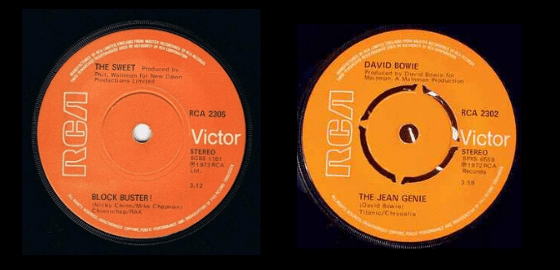
In January 1973 at the height of the glam rock craze, two singles with instantly memorable but remarkably similar riffs were both enjoying chart success: The Sweet’s ‘Blockbuster!’ and David Bowie’s ‘The Jean Genie’, each released by RCA records. Which came first? Were they both dreamt up independently? Did one copy off the other? Or did they both draw on influences from somewhere else?
In the folk world songs have always been adapted, evolved and passed on. In the rock world that sort of behaviour is more likely to get you involved in lengthy court cases and costly lawsuits. But in folk there has been over a century of legitimate and rigorous study looking into the often murky origins of traditional songs and tunes. A simple question therefore is: can the principles of studying folk in determining song origins also be applied to glam rock?
We start with the song ‘Blockbuster!’ written by The Sweet’s then songwriting team of Mike Chapman and Nicky Chinn, recorded on 1st November 1972 in London and released in January 1973. In Dave Thompson’s Sweet biography ‘Block Buster’, The Sweet’s Steve Priest recalls Chapman playing his idea for a new song on an acoustic guitar while they were backstage at the BBC waiting to go on Top Of The Pops to perform ‘Wig Wam Bam’ (most likely their appearance on 14th September 1972).
The riff was remarkably similar to David Bowie’s ‘The Jean Genie’ recorded on 6th October 1972, released in November 1972 and in the charts at the same time. “While en route to Tennessee, ‘The Jean Genie’ was developed from an impromptu tour bus jam,” in September 1972 recounts the Mick Ronson biography, ‘The Spider With The Platinum Hair’ by Weird & Gilly. This would have been just prior to the band’s gig in Memphis which is recorded as taking place on 24th September 1972, several days after Mike Chapman strummed the riff for Blockbuster to Steve Priest on the other side of the Atlantic.
Both sides have always denied copying one another and given both ‘Blockbuster’ and ‘The Jean Genie’ were recorded and released around the same time it seems unlikely that either would have had time to secretly copy the other, then get it recorded and released, all within the confines of the same record company, RCA.
What is far more likely is that they were both influenced by the Yardbirds’ 1965 hit ‘I’m a Man’.
Alwyn Turner’s website Glitter Suits & Platform Bootsquotes The Sweet’s Andy Scott as follows: “And then, you wouldn’t believe this, before our release we were in the office of the guy who was our contact at RCA and he played us the new David Bowie record, he played us ‘Jean Genie’. And I went, ‘That’s the same guitar riff,’ and he went, ‘Is it?’ This is a record company guy and I’m saying, ‘Haven’t you noticed?’ And he went, ‘No.’ I was horrified, I was thinking: that’s coming out first, and we’re coming out a week behind it, on the same label, it’s got the same guitar riff. I said: well, we don’t stand a chance of being #1. That was my thought. And within three weeks we were #1 and he was #2. I’ve since spoken to Trevor Bolder, the bass-player, and he said, ‘Remember “I’m A Man”?”
Here is that Yardbirds’ version of ‘I’m A Man’.
Interestingly, Iggy Pop and The Stooges also recorded a version of ‘I’m A Man’ during the sessions for the Raw Power album in early 1972. Bowie was involved in remixing this album and although ‘I’m A Man’ doesn’t appear on the album, he would certainly have been familiar with the Stooges cover version. Could this have had an influence on Bowie’s ‘The Jean Genie’ later that year?
We can hear Iggy & The Stooges version of ‘I’m A Man’ here.
Both recordings are, of course, cover versions of a 1955 original version of ‘I’m A Man’ by Bo Didley.
Bo Didley’s song is itself influenced by a song Willie Dixon wrote for Muddy Waters‘Hoochie Coochie Man’ recorded in 1954
The blues of Bo Didley, Muddy Waters et al can be traced back through the early electric blues of the 1940s to the acoustic blues of the 1920s, through the slave trade, plantations and back to African origins, where a number of the elements that would come to define key features of the blues could be traced back to.
But it’s worth specifically going back to that Bo Didley tune. The riff in ‘I’m a Man’ is significantly changed from that played by Muddy Waters in Dixon’s ‘I’m A Man’. Didley has adapted the tune as a simple repetitive four note riff repeated throughout the entire song, making it notably different.
So although it was influenced by an earlier blues song I think we can safely say that the riff that appears in ‘Blockbuster!’ and ‘Jean Genie’ first emerged in a Bo Didley song in 1955.
Thanks also to Michael Duthie for pointing me towards the Mickie Most video (below) and to Josh Beeson for pointing me to the Iggy & The Stooges version of ‘I’m A Man’.
Another fascinating release from the 60s that could have played an influential role in the later 70s glam releases was Mickie Most’s 1964 version of ‘Money Honey’.
Unlike earlier versions of Money Honey by Elvis and previously The Drifters, the Mickie Most version utilises that same Bo Didley riff. Most would go on to be a towering figure in glam rock as mentor and producer for Suzi Quatro and as RAK Records boss, home to the likes of Quatro and Mud. He knew Mike Chapman very well and could have helped plant some of the creative seeds for that Blockbuster riff, further strengthening those glam rock links back to blues history.








 Darren's music blog