Category Archives: Folk music

folk performers and music

Iain Matthews in Etchingham 18/11/16

This review was also published in The Stinger here

“Just on the off-chance there’s a spare place do you fancy seeing Iain Matthews do a private gig in someone’s front room in Etchingham tonight.”

“Of course I’m interested! Let me know.”

“Yes, there’s a place for you. The guy who’s organising it says he knows you from years back.”

So went a series of texts between myself and a friend. And why I found myself in the house of an old acquaintance I hadn’t seen for around twenty years to witness a performance by former Fairport Convention/Matthews Southern Comfort/Plainsong singer, Ian Matthews.

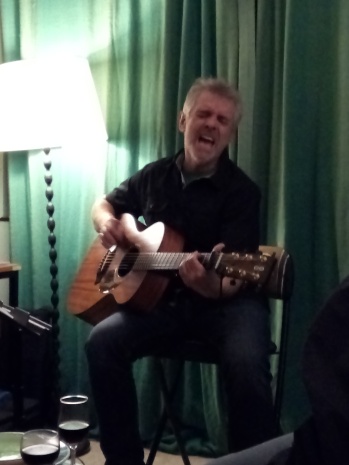
It’s a really intimate affair: just twenty-odd people crowded into a room, Matthews and his guitar. But his material and manner is just perfect for a gathering like this. A few songs in he confesses he very rarely performs solo, normally performing either in a band or as a duo. This really surprises me because not only is he a superb singer-songwriter-performer he’s also got that knack of instant engagement and rapport with an audience, however small. He’s got some fascinating stories to share, reflecting on both his long career and the songs he performs.

2016-11-18-22-11-12

Material-wise, we get some great material from throughout his career, both covers and originals. Highlights include Matthews’ own ‘Ballad of Gruene Hall’; a beautifully laid-back cover of Van Morrison’s ‘Brown Eyed Girl’; a song from Gene Clark’s magnificent solo album No Other; and some lovely Richard Farina covers from the newly-revived Plainsong’s 2015 album Re-inventing Richard.

That golden voice that sang along with Sandy Denny on the original version of ‘Meet on the Ledge’ will probably always be the thing I associate most with Matthews, however. And at the end of the set it can be heard singing out that song, once more, as a final encore for this small but enthusiastic gathering. A perfect end to the evening.

At one point in his set Matthews talks about his giving up completely as performer, assuming his career had run it’s course by the early 80s. But then he recalls a few years later an emotional Robert Plant grabbing him backstage at Fairport’s Cropredy festival and lecturing him about the importance of getting back out there on the road. “You owe it to your fans,” urges Plant. “What fans?” asks Matthews. “Get out there and you’ll find they are out there,” Plant responds. Indeed they are. Keep on playing Iain…

http://www.iainmatthews.nl/news.html

2016-11-18-23-27-27

Folk: album review – Hamish Napier ‘The River’

My review was originally published by Bright Young Folk here

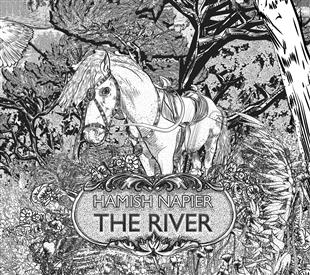
Hamish Napier is an in-demand folk musician who has collaborated with a number of key acts on the Scottish folk scene. The River, however, is the debut solo album from this Strathspey-born composer and multi-instrumentalist, and is very much inspired by a childhood spent growing up on the banks of the Spey. “The River brings to the surface vivid sonic images of occurrences, past and present, along the mile-long stretch of the Spey that flows past my childhood home,” Napier tells us in the extensive sleeve notes.

The album includes a stellar cast of renowned Scottish folk musicians, including Sarah Hayes (Admiral Fallow) on flute, James Lindsay (Breabach) on double bass, Martin O’Neil (Duncan Chisholm) on bodhran, as well as Callum MacCrimmon singing Canntaireach, the ancient chanting language of the bagpipes.

Perhaps symbolic of the constantly changing flow of any river, there is a breadth of sounds and moods explored on this album. Opening track Mayfly puts one in mind of some early 70s prog rock passages, a folky Tubular Bells if you will. It’s perhaps an unusual start but provides a captivating experimental feel which immediately encourages the listener to want to explore further.

The Whirlpool meanwhile is a lovely tune with flute and whistle. It has been written as a round – in celebration of the whirlpool that constantly spins and spins just a few hundred yards from the Old Spey Bridge.which captures the frenetic natural cycle of the river as an ever-changing dance. The mood changes considerably with The Dance, beginning with gentle, sombre piano.

Of course, no aquatic-inspired folk, be it river or sea, is complete without harrowing tales of tragedy and death, and the beautiful but mournful Drowning of the Silver Brothers is inspired by the fate of two local boys who mysteriously drowned in the 1930s. Clearly not forgotten locally, this piece serves as a haunting but fitting tribute to the boys and the mystery that surrounds them.

Another memorable track is Floating, which has a funky electronic feel to it demonstrating just how far Napier is prepared to cast his musical net in order to capture the range of moods and emotions he feels moved to express in this album. The two-part The Spey Cast closes the album. The first part is a thought-provoking gentle piece inspired by the death of an old fly fisherman while the second part is a fast and furious musical romp which reflects the mixture of chaos and hilarity that is the town’s annual raft race.

For those with a love of Scottish folk, particularly those with a keen interest in experimentation and innovation within the Celtic world and who love to hear the sound of boundaries being pushed, this is an album well worth exploring.

Released January 2016

http://www.hamishnapier.com/

the-river-hamish-napier


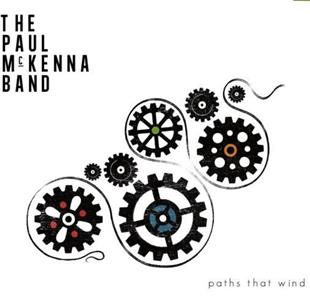
Folk: album review -Paul McKenna Band ‘Paths That Wind’

My review was originally published by Bright Young Folk here

Now celebrating their tenth anniversary, The Paul McKenna Band release their fourth album and continue to cement their reputation as one of Scotland’s premier folk bands. Indeed, “the best folk band to come out of Scotland in the last twenty years,” as the New York Times would have it.

Although no-one would claim they offer a wholesale re-invention of Scottish folk music there is, nevertheless, a fresh and contemporary feel to the band’s sound. Guitar, bouzouki, fiddle, flute and whistles combine to produce a sound that’s accessible, interesting and highly listenable.

This is in no small part assisted by McKenna’s warm and engaging vocals which add a depth and sincerity to the material. As well as regular band members, Paul McKenna, Sean Gray, Ewan Baird and Conor Markey there are also guest slots from a number of notable musicians on the Scottish music scene, like John McCusker (who also produces the album), Rod Patterson, Mike Vass and James Lindsay.

The album comprises eight songs and two tunes, combining original material with some traditional songs as well as some well-chosen covers. Of the self-penned material, highlights include opening track Long Days, which reflects on the age old theme of homesickness: “the grass is always green until we tried to walk it” and here we have some lovely guitar and mandolin that complements McKenna’s lyrics perfectly.

As well as some highly personal lyrics, the band are not afraid to tackle controversial themes either: The Dream is a song written by McKenna about Freddie Gray who died at the hands of the Baltimore Police at the time the band were based in the USA. It’s a thoughtful song reflecting on a brutal episode and evoking the spirit of Martin Luther King: “What happened to the dream, we shall overcome, and walk hand in hand together to the setting of the sun.” Beautiful music, powerful lyrics and warm and very human vocals make this a definite stand-out on the album.

Of the non-original material noteworthy tracks include a lovely version of the traditional Irish song, The Banks of The Moy as well as a heartfelt cover of Peggy Seeger’s anti-fascist anthem, Song of Choice.

Paths That Wind is a strong album that will help consolidate The Paul McKenna Band’s fan-base and, hopefully, win them many new ones. Engaging vocals, thoughtful songs and high standards of musicianship make this an album to be highly recommended.

Released April 2016

Home

paths-that-wind-the-paul-mckenna-band


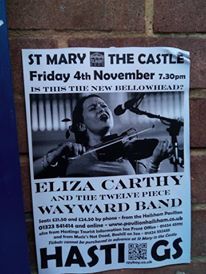
Eliza Carthy at St Mary in the Castle, Hastings 4/11/16

My review was originally published on The Stinger independent music website here

We see it in other musical genres, but with this one perhaps even more so, and second and third generation offspring of the 50s/60s folk revival have been making a significant impact on the contemporary folk scene.

This is unsurprising in a way, given that folk in its original sense was always about songs being passed down through generations.And there aren’t many singers with more impeccable credentials than Eliza Carthy, daughter of folk mainstay, Martin Carthy, and Norma Waterson, of the renowned Waterson singers.First up tonight, however, and keeping it within that illustrious family, is none other than Eliza’s cousin, Marry Waterson, performing with guitarist, David A Jaycock, with whom she’s just released an album.A warm, earthy and passionate singer she’s a good choice for support act, singing a mixture of songs from the duo’s album and from her family’s incredible back catalogue.

Although there are some similarities in the voices of both Eliza and Marry, the contrast between the opening act and the main act couldn’t be greater.

Where the first is stripped back, intimate and reflective the second is big, bold and theatrical. Eliza Carthy and the other eleven members of her latest venture, The Wayward Band, make an instant and lasting impact the minute they hit the stage.

It’s been called a folk supergroup and includes musicians from the likes of Bellowhead, Mawkin, Edward II and Peatbog Fairies.

It’s a very full sound (fiddles, cello, bass, guitar, keyboards, accordion, drums, percussion, brass section) and it’s possible that other folk singers could get a bit drowned out by such backing.

Not Eliza Carthy, though, who has both the strength of voice and the charismatic stage presence to never risk being overwhelmed.

Furthermore, they’ve put together a great selection of songs, too.

There will be a full album out in February but tonight those who wanted to hear more of The Wayward Band had to settle for buying the band’s EP.

Definite highlights from tonight’s set included a gloriously rumbustious ‘Good Morning Mr Walker’ and Carthy’s thoughtful reflection on the refugee crisis: ‘You Know Me’.

Introducing the song she said she felt moved to speak up for the long-standing and ancient tradition of offering hospitality to strangers.

Throughout the night the band were rewarded with a great reception from the crowd.

“Is this the new Bellowhead?” asks the poster advertising tonight’s gig. There are obvious similarities.

But there are obvious differences, too. Although there’s brass it’s not as dominant in the overall sound mix as it is in Bellowhead and in The Wayward Band there’s also an emphasis on Carthy’s own material as well as interpretations of traditional songs.

However, for those on the look-out for a big band that fills the stage and a big sound that fills the auditorium and an act that keeps folk music well and truly in the 21st century, Eliza Carthy and The  Wayward Band is definitely one to look out for.

Marry Waterson website: http://marrywaterson.com/

Eliza Carthy website http://www.eliza-carthy.com/
14947717_10154639273511449_7828087072667150063_n

Rock/folk: album review – Ashley Hutchings ‘Twangin’ ‘n’ a-Traddin’ Revisited’

My review was originally published by Bright Young Folk here

Twangin’ ’n’ a-Traddin’ Revisited is a celebration of the music that first captured Ashley Hutchings’ imagination. Not English folk but rather the instrumentals of the pre-Beatles era from the likes of The Shadows, The Tornadoes and Duane Eddy.

Hutchings has reissued the album, originally released in 1994, and added three new tracks in what he hopes will lead to a reappraisal of what he calls this “misunderstood and undervalued work.”

Officially credited to The Ashley Hutchings Big Beat Combo, the juxtaposition of musical styles is evident, not only in the choice of material, but in the cast of supporting musicians too. Joining Hutchings are Simon Nicol, Simon Care and Richard Thompson from the folk rock world, but also original Tornadoes drummer and legendary session man, Clem Cattini, along with Georgie Flame and the Blue Flames guitarist, Colin Green.

It’s certainly not going to appeal to every folkie but, this being Ashley Hutchings, the folk influence is never that far away. The Tornadoes’ Telstar is radically reimagined as a gentle traditional-flavoured somewhat pastoral tune, with Simon Care on melodeon and Richard Thompson on penny whistle. In a nod to the heritage of the original, though, Clem Cattini, again takes up the drum kit, just as he did when it was a number 1 hit for the Tornadoes back in 1962.

Versions of other classic instrumentals of the era, such as F.B.I. by the Shadows and Walk Don’t Run by the Ventures, whilst staying more faithful to the originals, are still fascinating to hear because of the choice of instrumentation and unexpected mix of musical sounds.

Meanwhile, other tracks like Horsin’ Around and Spinnin’ Jenny/Soldiers’ Spree are traditional tunes that have been given the drum patterns and instantly recognisable twanging guitar sounds of one of those early ’60s instrumentals. Think Hank Marvin giving a helping hand at a morris gig…

Besides the 1960s cover versions and the traditional tunes there are also a number of self-penned tracks from Hutchings himself, which again draw on both folk influences and the rock ’n’ roll instrumentals of the era.

This is not a simple reissue, however, and three new songs have been added to what was originally an album of instrumentals. Two of these have vocals from the Velveteens, a young female singing trio whose vocal delivery along with the evocative period lyrics perfectly capture teenagerdom in late ’50s/early ’60s Britain. The third of the new recordings, and the final track of the album, is Welcome to The World, Hutchings’ very personal reflection on growing up in that era.

For those wanting an introduction to Ashley Hutchings’ considerable back catalogue, this is certainly not the album to start with. Unlike some of Hutchings’ most notable output, it’s always going to be an interesting curiosity rather than a genre-defining classic. But a re-release is long overdue. It’s simply fascinating to hear the sounds that first inspired the teenage Hutchings to want to be a professional musician, melded with the folk influences that have been the mainstay of his long and celebrated career.

Released April 2015

http://ashleyhutchings.com/

twangin-n-a-traddin-revisited-ashley-hutching

Related review:
Ashley Hutchings – From Psychedelia to Sonnetts

Rock/folk: album review – Richard Thompson ‘Acoustic Classics’

My review was originally published by Bright Young Folk here

Richard Thompson is rightly ranked as one of the world’s greatest guitarists and is also recognised as an outstanding songwriter. There is no mystery behind the title of his latest CD. Acoustic Classics does exactly what it says on the tin, offering acoustic recordings of classic Thompson tracks. The question is does anyone with even a passing interest in Richard Thompson really need re-recorded versions of I Want To See the Bright Lights Tonight and 1952 Vincent Black Lightning?

Surprising though it may seem, however, there is no product out there that properly represents Thompson’s latter-day acoustic shows. “I really wanted to have something that would reflect the acoustic shows,” he explains, “But we didn’t really have anything like that. Just some old, slightly scratchy recordings of solo sets that I wasn’t really happy with.”

Listeners will come across a number of re-recorded versions of songs made famous by the renowned Richard & Linda Thompson albums of the 1970s, songs like Walking on a Wire, Down Where the Drunkards Roll and Shoot Out the Lights. Wonderful though those original Richard and Linda recordings are, with their full instrumentation and lush vocals, it is also good to hear those songs stripped back to Thompson’s stunning guitar and mournful voice.

Other songs on the album come from Thompson’s later solo career but, again, stripped back to the very basics in a way that shows off the beauty of the songs and Thompson’s guitar work, although the aforementioned 1952 Vincent Black Lightening differs little from the un-improvable original. It wouldn’t have been right to have missed out such a classic, however. Some particular personal favourites have been missed out, of course, but it was never going to be possible to get everyone’s favourite Richard Thompson songs on to a 14-track CD.

For anyone catching one of his excellent acoustic shows this summer, who comes away wanting a more permanent reminder, this album is ideal; and for those less familiar with Thompson’s voluminous back catalogue this is a pretty good introduction.

Released July 2014

http://www.richardthompson-music.com/

acoustic-classics-richard-thompson

Related reviews:

Richard Thompson live at Folk by the Oak

Richard Thompson at Royal Festival Hall

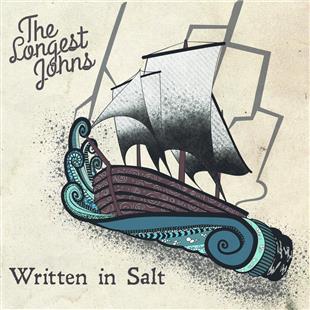
Folk: album review -The Longest Johns ‘Written in Salt’

My review was originally published on the Bright Young Folk website here

The Bristol-based five-piece are an a capella folk band with a particular emphasis on performing sea shanties. Although they have produced a couple of well-received EPs before, Written in Salt is The Longest Johns’ debut album.

As the album title suggests, a passion for maritime songs is very much at the heart of what The Longest Johns and this album are about. Consisting of thirteen tracks, all are sung a capella, save for a lone instrumental and a spoken-word narrative on the album.

Although the group originally began as a four-piece they expanded to a five-piece in 2015, which allows them to showcase a magnificent vocal range and some wonderful harmonies.

There are some well-chosen traditional shanties on the album including Old Maui, a traditional whaling song; Randy Dandy-O and, rounding off the album is Drunken Sailor, nowadays by far one of the best-known shanties in the entire repertoire, but the group give it a fresh, lively and compelling interpretation.

The Grey Funnel Line sticks with the maritime theme, but rather than being another raucous work song, it gives the band the chance to demonstrate their more mournful side with a song that captures the homesickness and longing for a true love that accompany a life at sea.

This is not just a band that sticks to interpretations of traditional songs and covers, though. The album also features a number of self-penned shanties. Barge Ballad, penned by the band’s Josh Bower, opens the album and in its writing, melody and delivery there is an authenticity about it that gives the song a natural and completely uncontrived flavour.

Written in Salt is a fine debut album from five guys who are able to apply their considerable vocal and creative talents to both revisiting traditional shanties and contributing new ones to the genre.

Released June 2016

http://www.thelongestjohns.com/

written-in-salt-the-longest-johns


The Levellers on Hastings Pier 19/9/16

My review was published in The Hastings Independent 14/10/16

Many big-name musical acts played Hastings Pier in the 60s and 70s and it’s great to see that spirit being evoked as the revived and refurbished pier plays host to bands like The Levellers. The big difference nowadays is that lacking a concert pavilion today’s events are more like mini-festivals, replete with wristbands, an outdoor stage, beer marquees and portable loos. But the pier is a fantastic open space and makes for a brilliant setting for a small but perfectly-formed festival.

Prior to the headliners taking the stage supporting acts are local band Matilda’s Scoundrels; the very Levellers-esque sounding folk-punk band Ferocious Dog; and Turin Brakes, who had some chart success in the early noughties and put me in mind of bands like Travis.

The Levellers are clearly the band that everyone has come to see, though, and the crowd has swelled significantly by the time they take the stage. It’s twenty five years since their seminal album Levelling The Land was released. It took the band from niche performers on the festival and protest circuit to the Top 20 and the main stage at Glastonbury. Tonight, and in a subsequent Autumn tour, they are performing the album in full. As on the album the set starts with ‘One Way’ (“there’s only one way of life and that’s your own, your own your own..”) When it came out, at a time of road protests, demonisation of travellers and a growing authoritarianism in policing and criminal justice, it instantly became the anthem for anyone who didn’t want to conform. And judging by the way it’s received tonight those words still mean an awful lot to people.

Levelling The Land is not only the band’s most famous album, it’s a good showcase for the different sounds and influences that have defined the Levellers; bringing together their reflective folky side (with acoustic ballads like ‘The Boatman’) and their more raucous punky side (with tracks like ‘Liberty Song’), mixed in with some perfectly crafted slices of early 90s indie pop (like ‘Sell Out’). After performing the album in full the band rattle through a number of other musical highlights from the Levellers career, eventually encoring with a glorious ‘What a Beautiful Day’.

Musically, the band are still in very good shape. Lyrically, there’s even more in the world to get angry about than there was twenty five years ago. So a Levellers show today: still artistically and politically relevant in post-Brexit, austerity Britain or nostalgia for great songs in troubled but simpler times? In all truth it’s probably a mixture of both but there’s no harm in that.

http://www.levellers.co.uk/

2016-09-18-20-06-46

2016-10-26-14-29-48

Folk: album review – Kaela Rowan ‘The Fruited Thorn’

My review was originally published on the Bright Young Folk website here

Scottish singer Kaela Rowan sang with Mouth Music, recording four albums with them in the 1990s, and more recently has been touring and recording as part of the acclaimed Shooglenifty and their unique fusion of traditional Scottish music and modern dance beats. The Fruited Thorn is Rowan’s second solo album, following Menagerie which was released in 2014.

An album of eleven traditional ballads (seven sung in English, four in Gaelic), The Fruited Thorn is, in Rowan’s own words, “a homage to all the amazing ballads and ballad singers past and present. Those great singers who bring songs to life and helped awaken the young singer in me.”

The whole album has a nice relaxed tempo about it and some beautiful songs, both familiar and less familiar. However, some really interesting musical collaborations do make it particularly stand out from many similar releases in this field.

Rowan has put together a band composed of Shooglenifty personnel James Mackintosh (percussion, guitars, keyboards, vocals) and Ewan MacPherson (guitars, mandolin, jaw harp) for the entire album, but throughout they are joined by a fascinating line-up of additional guests.

Second track ‘Eilan Fhianain’ is one of the most interesting and unexpected collaborations on the album. Rowan’s traditional Gaelic singing is accompanied by traditional Indian singer Dayam Khan Manganiyar who sings the songs of the Rajasthani desert lands, and the two sets of vocals provide for an absolutely compelling cultural mix that actually works. He also provides vocals on another track, ‘Griogal Chridhe’, another traditional Gaelic song.

Elsewhere, more familiar territory is covered and the album gives us lovely new interpretations of traditional standards like ‘Now Westlin Winds’, ‘Lord Gregory’ and ‘As I Roved Out’. Rowan’s soft but persuasive vocals and the gentle but innovative instrumentation provide a fresh take on well known songs. The Uillean pipes on ‘As I Roved Out’ are particularly lovely – played by Jarlaith Henderson who also provides backing vocals to the same track.

While percussion on most of the tracks eschews the folk fusion dance beats for which Shooglenifty is renowned for, it would be surprising if such influences were to be completely absent from the album and sixth track ‘Mary and the Gallant Soldiers’ is where the so-called “Acid Croft” influences of Shooglenifty are most apparent.

An album that takes a fresh look at some traditional ballads, with fine vocals, superb instrumentation and innovative collaborations, The Fruited Thorn skilfully bridges the gap between the experimental and the familiar.

Released August 2016

http://www.kaelarowan.net/

the-fruited-thorn-kaela-rowan

Ryley Walker at St Mary in the Castle, Hastings 5/8/16

My review originally appeared in the Hastings Independent 18/8/16

Although originally billed as a collaboration with legendary folk-rock double bass supremo, Danny Thompson, Thompson has had to pull out of this short tour due to illness. However, this did not prevent the young guitarist and singer-songwriter, Ryley Walker, from delivering a spellbinding performance at St Mary in the Castle. As the promotional blurb for the gig put it, someone who “plays guitar like Bert Jansch and sings like Tim Buckley” should not struggle to draw a supportive audience; and so it proved. 27 year-old Walker, from Illinois, is an exceptional acoustic guitarist, very much influenced by 60s/70s artists like the aforementioned Jansch and Buckley as well as the likes of Davey Graham and John Martyn.

The audience (absolutely typical for a folk/acoustic style gig of this type) is composed overwhelmingly of sixty-something baby-boomers and twenty-something millennials. Those of us in our forties and early fifties, like myself, are mainly notable by our absence. We are truly the lost generation as far as music like this goes. This is our collective loss I suppose; but it’s encouraging that the generation below us are picking up the baton, both as audiences and as performers, as the supremely talented Mr Walker exemplifies. A powerful songwriter and a talented musician with a distinctive voice, he’s not afraid to work across genres and thus brings a range of musical influences into his performance, from indie folk, to jazz to blues through to rock and psychedelia.

It is arguable that the acoustics in this cavernous, iconic former church, and perhaps the atmosphere itself, tend to make it work better for folk acts than for rock bands. This gig is far from a gentle, relaxed strum-along though. It’s an incendiary performance with his two band-mates providing throbbing electric bass and wonderfully atmospheric, powerful drumming that throbbed, crashed and reverberated throughout the venue all night. They complement the guitarist perfectly and it makes for a more intense interpretation of his songs in comparison to his two excellent and well-received solo albums, but that’s all part of the excitement of live performance. There is light and shade and definite changes of tempo during the course of the evening, however. The Davey Graham/Bert Jansch guitar influence particularly shines through on the gentler, more laid-back tunes, where Walker is able to simultaneously coax hypnotic rhythms and beautiful intricate melodies out of his instrument.

“Wow. That was very intense, bordering on psychedelic,” concluded the two women sitting next to me when I asked them what they thought at the end of the night. I wouldn’t disagree at all. Two albums into his career, Ryley Walker is showing exceptional promise.

[Note: since this review Ryley’s third album has now been released. More details on his website below]

http://ryleywalker.com/

2016-08-20 12.46.40