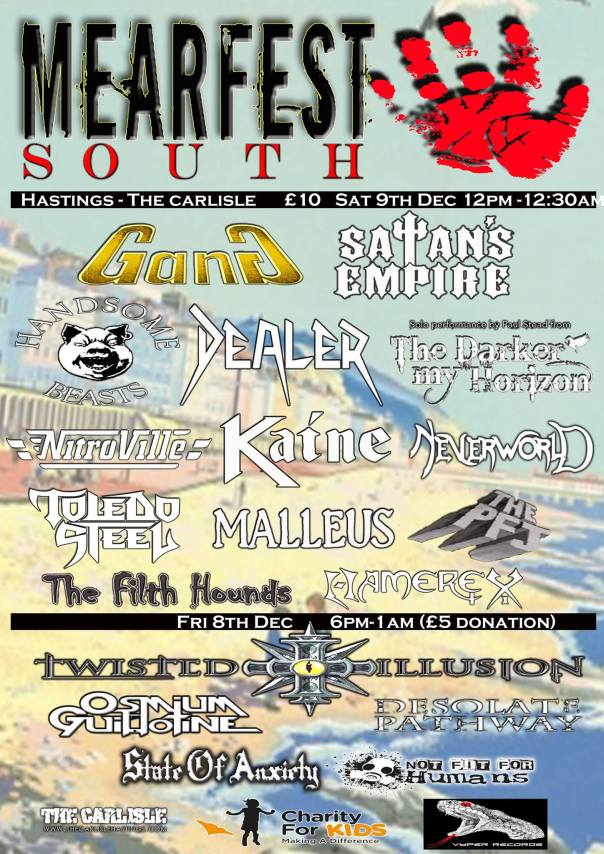
Saturday saw Hastings’ legendary rock pub, The Carlisle, host Mearfest. Inspired by personal tragedy Claire and Brian Mear have been running their rock and metal charity events for several years now, with funds going to The Willows stillbirth charity and other local causes.
Comprising a dozen bands and one solo acoustic set, all performing original material – no tribute acts or covers bands – what struck me throughout the day was the sheer quality of the acts taking the stage.
Particular standouts for me were Southampton five-piece, Toledo Steel; ‘Now Wave Of British Heavy Metal’ act, Kaine; and NWOBHM veterans Satan’s Empire, reformed after three decades.
Powerfully majestic but hard and heavy Toledo Steel put me in mind of classic-era Dio and Rich Rutter’s vocals and Tom Potter’s and Josh Haysom’s guitars are the perfect combination for this brand of hard-hitting melodic rock metal. Toledo Steel are definitely on my list to see and hear more of and I am certainly enjoying their excellent six-track EP ‘Zero Hour’.
Kaine is a four-piece formed in 2009 and musically inspired by the late 70s/early 80s New Wave Of British Heavy Metal boom. Powerful well-written songs and powerful delivery, you can hear the influences from their musical heroes like Iron Maiden in their performance. I took a copy of their excellent album ‘The Waystone’ away which confirms why they are getting so many plaudits on the contemporary metal scene.
Satan’s Empire had a breakthrough of sorts in 1981 when their excellent single ‘Soldiers Of War’ appeared on a Neat Records compilation. Sadly, they disappeared from view but now, with the original line-up still intact, they have reformed. Their performance oozed class, stage presence and memorable songs and it’s great to see them get a second bite of the cherry. They deserve it.
I’ve just pulled three acts out here that particularly inspired but in truth the quality didn’t let up throughout the day. It’s clear that organisers Brian and Claire Mear love what they are doing and, importantly, know what they are doing.
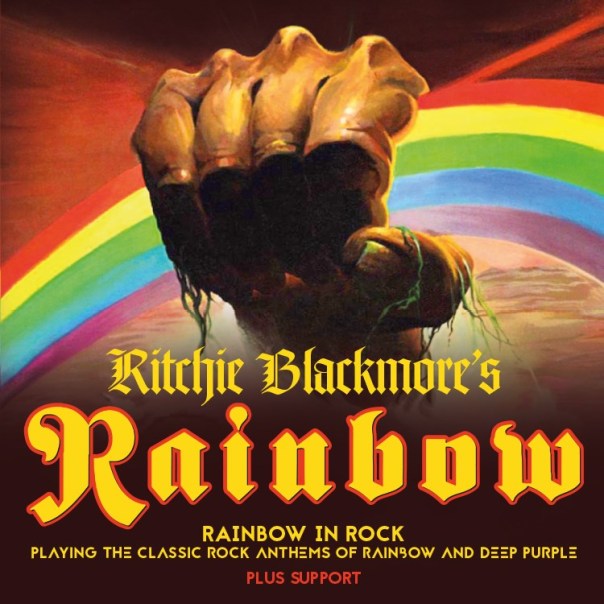
When I was a teenager getting seriously into rock and metal in the early 80s I was lucky enough to see some of the biggest acts around: AC/DC, Sabbath, Quo, Ozzy etc. One band I never got to see, however, was Rainbow and one guitar wizard I never got to see (in any formation) was Ritchie Blackmore. For some inexplicable reason (and I am normally really on the ball with this) I failed to get myself a ticket when Blackmore revived the Rainbow name and announced a tentative return to rock ‘ n’ roll last year. So when a further tour was announced this year I made absolutely sure I was going to be there this time.
The evening was going to be made even more special when I found out the support act would be Sweet, who I have been following for as long as I’ve been following Rainbow. Unlike Rainbow, I have seen The Sweet many times before over the past twenty-odd years – but usually in small rock venues or provincial theatres, never in an arena with a 15,000 strong crowd. In some ways, both Rainbow and The Sweet summed up the music of the mid 70s: the albums-based rock was brilliant and the singles-based pop was brilliant, too. Perfection!
Tonight would give Andy Scott and co the chance to rekindle their relationship with many older rock fans as well as hopefully winning over some newer fans, too. ‘Hellraiser’, ‘Teenage Rampage’, ‘Blockbuster’, ‘Ballroom Blitz’ et al all go down an absolute storm. My only complaint was that the set was heavily weighted towards the old hits, with little time for the harder-edged album-oriented rock of which the band have an impressive, if less well-known, back catalogue. However, we did get stunning versions of ‘Set Me Free’ and ‘Love Is Like Oxygen’ and hopefully Andy Scott’s continuing version of The Sweet has a good few more fans after tonight.
“I’m playing all the right notes, but not necessarily in the right order,” Eric Morecambe once famously said. No-one in their right mind could ever accuse guitar god, Ritchie Blackmore, of that. But funnily enough I was reminded of the old Morecambe & Wise gag when I was thinking about Ritchie Blackmore’s set-list at Birmingham tonight. Pretty much all of the songs that I very much hoped he’d play were in there – but the set order seemed to be in random shuffle mode with little attempt at any sort of thematic approach. We jumped from the polished commercial rock of Joe Lynn Turner-era Rainbow, to Coverdale-era Deep Purple, to the infectious pop-rock of Graham Bonnet, to the heavy prog-tinged majesty of Dio-era Rainbow and so on and so on. I suppose the main message was: “I have been involved with creating some amazing music in different bands with different vocalists and different styles – and whichever order you put them in they are all amazing…” Which is true!
After years away from doing gigs of this type and making albums like this Blackmore’s stunning guitar skills have not dimmed. Never guilty of being flashy for the sake of being flashy or of putting technical prowess ahead of creating beautiful melody, there is an elegance about his playing that is a joy to see live. Ronnie Romero, too, I thought was a good choice of vocalist. Of all the iconic vocalists Blackmore has worked with over the years, Romero probably sounds closest to Joe Lynn Turner in style, but he handled all of the material well from Gillan through to Coverdale, Dio, Bonnet and Turner. Towards the end a keyboard solo seemed to go on forever but that is a minor quibble. At the age of 51, the teenage rock fan in me has finally got see Ritchie Blackmore live on stage and has finally got to attend a Rainbow gig. He is happy.
Set-list – Sweet:
Action
Hellraiser
The Six Teens
Set Me Free
Teenage Rampage
Wig Wam Bam / Little Willy
Love Is Like Oxygen
Fox On The Run
Blockbuster
Ballroom Blitz
Spotlight Kid
I Surrender
Mistreated
Since You Been Gone
Man on the Silver Mountain
Soldier of Fortune
Perfect Strangers
Difficult to Cure
All Night Long
Child in Time
Stargazer
Long Live Rock ‘n’ Roll
Lazy
Catch the Rainbow
Black Night
Carry On… Jon
Burn
Smoke on the Water
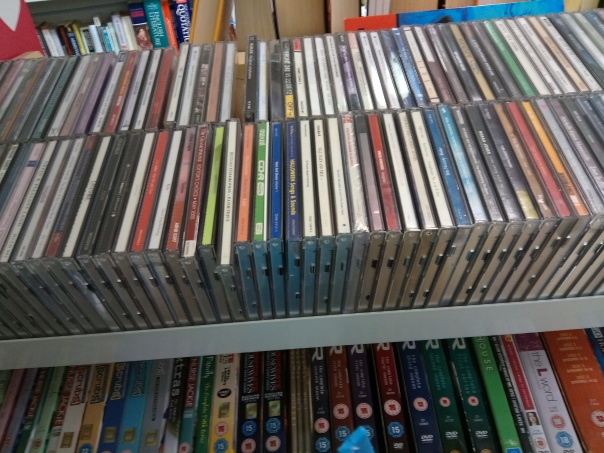
I’ve rarely been able to go past a charity shop without having a quick browse through their second-hand CDs. To be fair this usually doesn’t take long. Shops usually have a shelf or two with around 100-150 CDs for sale and usually the majority of them hold no interest for me at all as they fall into two categories:
1. Old-time easy listening – the likes of James Last, Vera Lynn, Max Bygraves, Harry Secombe and so on. You get tons of these in most charity shops. My guess is that they belonged to people in their late 70s/80s who have either died or gone into nursing homes and their CDs have been passed on to the charity shop by their families.
2. 90s/00s chart pop – the likes of Take That, Spice Girls, Ronan Keating and numerous X Factor winners. Again, you see tons of these in charity shops and my guess is they belonged to 30-somethings or early forty-somethings who have offloaded them, either because of changing musical tastes or because they don’t want to have anything as desperately uncool as CDs in the house and have switched to downloads. Occasionally, you see some Britpop-era CDs amongst these and (particularly as I wasn’t able to afford to buy too many CDs back in the 90s) I’ve been able to pick up numerous second-hand bargains by the likes of Blur, Cast, The Boo Radleys, Ocean Colour Scene, The Levellers and so on to add to my collection.
However, what was very rarely seen, until recently, was the kind of classic rock albums that are the mainstay of my CD collection. This is starting to change it would appear and in the past year I’ve picked up numerous CDs for 50p or a pound by the likes of Ray Davies, Lou Reed, Brian Wilson, Fleetwood Mac, Meatloaf, Iron Maiden, Judas Priest, Deep Purple and Thin Lizzy.
It could be that these are the result of people either switching to digital (or switching back to vinyl) and disposing of their CDs in the process. But I doubt that accounts for the bulk of them somehow. My guess is that just as we have seen a dramatic increase in the number of rock star deaths – guys in their 60s and early 70s being tragically taken away from us, we are probably also witnessing a similar trend amongst rock fans as well. A tragedy for their families, certainly, as I know only too well. But good news,perhaps, for the quality of the CD shelves in charity shops.
The baby-boomer generation may have unwittingly cast a huge question mark over their grand-children’s futures by voting for Brexit in such overwhelming numbers but at least their impeccable good taste in music is available for the benefit of future generations and can now be snapped up at bargain prices at a charity shop near you.
OK, so Black Sabbath may have played its last ever tour, we have seen one devastating rock star death after another and a number of acts are no more. But, in spite of all that, have we been witnessing a real renaissance for some of our classic rock and metal bands in recent years? I would contend we have.
After some difficult years in the late eighties and nineties for many of our much loved rock giants, one band after another have been releasing albums that stand up really well against their early classics. The aforementioned Black Sabbath released the brilliant 13 album in 2013, which in my view can happily sit alongside the first four Sabbath albums as a genuine bona fide classic. Uriah Heep’sOutsider released in 2014 can unashamedly sit alongside the David Byron-era material in terms of Heep’s unmistakable brand of melodic hard rock. Girlschool’sGuilty As Sin is every bit as good as their era-defining early albums, with lead track Come The Revolution a match for any of their well-known classic tunes. Saxon’sBattering Ram from 2015 and Judas Priest’sRedeemer Of Soulsfrom 2014, each reviewed elsewhere here, both stand up well and offer everything you’d want to hear in a new album from either band. Even The Stones have got in on the act with their critically-acclaimed back-to-basics Lonesome & Blue album celebrating their R&B roots.
My theory is that all of these bands have reached a stage in their musical careers where, unlike some often painful attempts a decade or two ago, they have more than proved themselves. They now no longer feel obliged to sound contemporary or try to keep up with modern trends but can simply concentrate on sounding like themselves and producing the kind of music and the kind of albums that brought them to the public’s attention in the first place.
Of course, it doesn’t mean we shouldn’t be championing newer rock acts and none of the bands I’m talking about here are going to be around forever. However, I think we could still be seeing a few more classic releases yet from some of our favourite rock veterans over the next few years.
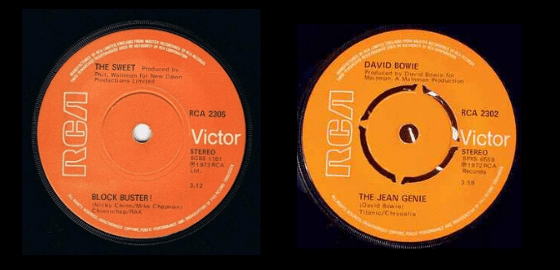
In January 1973 at the height of the glam rock craze, two singles with instantly memorable but remarkably similar riffs were both enjoying chart success: The Sweet’s ‘Blockbuster!’ and David Bowie’s ‘The Jean Genie’, each released by RCA records. Which came first? Were they both dreamt up independently? Did one copy off the other? Or did they both draw on influences from somewhere else?
In the folk world songs have always been adapted, evolved and passed on. In the rock world that sort of behaviour is more likely to get you involved in lengthy court cases and costly lawsuits. But in folk there has been over a century of legitimate and rigorous study looking into the often murky origins of traditional songs and tunes. A simple question therefore is: can the principles of studying folk in determining song origins also be applied to glam rock?
We start with the song ‘Blockbuster!’ written by The Sweet’s then songwriting team of Mike Chapman and Nicky Chinn, recorded on 1st November 1972 in London and released in January 1973. In Dave Thompson’s Sweet biography ‘Block Buster’, The Sweet’s Steve Priest recalls Chapman playing his idea for a new song on an acoustic guitar while they were backstage at the BBC waiting to go on Top Of The Pops to perform ‘Wig Wam Bam’ (most likely their appearance on 14th September 1972).
The riff was remarkably similar to David Bowie’s ‘The Jean Genie’ recorded on 6th October 1972, released in November 1972 and in the charts at the same time. “While en route to Tennessee, ‘The Jean Genie’ was developed from an impromptu tour bus jam,” in September 1972 recounts the Mick Ronson biography, ‘The Spider With The Platinum Hair’ by Weird & Gilly. This would have been just prior to the band’s gig in Memphis which is recorded as taking place on 24th September 1972, several days after Mike Chapman strummed the riff for Blockbuster to Steve Priest on the other side of the Atlantic.
Both sides have always denied copying one another and given both ‘Blockbuster’ and ‘The Jean Genie’ were recorded and released around the same time it seems unlikely that either would have had time to secretly copy the other, then get it recorded and released, all within the confines of the same record company, RCA.
What is far more likely is that they were both influenced by the Yardbirds’ 1965 hit ‘I’m a Man’.
Alwyn Turner’s website Glitter Suits & Platform Bootsquotes The Sweet’s Andy Scott as follows: “And then, you wouldn’t believe this, before our release we were in the office of the guy who was our contact at RCA and he played us the new David Bowie record, he played us ‘Jean Genie’. And I went, ‘That’s the same guitar riff,’ and he went, ‘Is it?’ This is a record company guy and I’m saying, ‘Haven’t you noticed?’ And he went, ‘No.’ I was horrified, I was thinking: that’s coming out first, and we’re coming out a week behind it, on the same label, it’s got the same guitar riff. I said: well, we don’t stand a chance of being #1. That was my thought. And within three weeks we were #1 and he was #2. I’ve since spoken to Trevor Bolder, the bass-player, and he said, ‘Remember “I’m A Man”?”
Here is that Yardbirds’ version of ‘I’m A Man’.
Interestingly, Iggy Pop and The Stooges also recorded a version of ‘I’m A Man’ during the sessions for the Raw Power album in early 1972. Bowie was involved in remixing this album and although ‘I’m A Man’ doesn’t appear on the album, he would certainly have been familiar with the Stooges cover version. Could this have had an influence on Bowie’s ‘The Jean Genie’ later that year?
We can hear Iggy & The Stooges version of ‘I’m A Man’ here.
Both recordings are, of course, cover versions of a 1955 original version of ‘I’m A Man’ by Bo Didley.
Bo Didley’s song is itself influenced by a song Willie Dixon wrote for Muddy Waters‘Hoochie Coochie Man’ recorded in 1954
The blues of Bo Didley, Muddy Waters et al can be traced back through the early electric blues of the 1940s to the acoustic blues of the 1920s, through the slave trade, plantations and back to African origins, where a number of the elements that would come to define key features of the blues could be traced back to.
But it’s worth specifically going back to that Bo Didley tune. The riff in ‘I’m a Man’ is significantly changed from that played by Muddy Waters in Dixon’s ‘I’m A Man’. Didley has adapted the tune as a simple repetitive four note riff repeated throughout the entire song, making it notably different.
So although it was influenced by an earlier blues song I think we can safely say that the riff that appears in ‘Blockbuster!’ and ‘Jean Genie’ first emerged in a Bo Didley song in 1955.
Thanks also to Michael Duthie for pointing me towards the Mickie Most video (below) and to Josh Beeson for pointing me to the Iggy & The Stooges version of ‘I’m A Man’.
Another fascinating release from the 60s that could have played an influential role in the later 70s glam releases was Mickie Most’s 1964 version of ‘Money Honey’.
Unlike earlier versions of Money Honey by Elvis and previously The Drifters, the Mickie Most version utilises that same Bo Didley riff. Most would go on to be a towering figure in glam rock as mentor and producer for Suzi Quatro and as RAK Records boss, home to the likes of Quatro and Mud. He knew Mike Chapman very well and could have helped plant some of the creative seeds for that Blockbuster riff, further strengthening those glam rock links back to blues history.




 Darren's music blog