One of the things that makes the early 1970s my absolute favourite era for music is not only were there so many classic releases coming out of the album-oriented rock acts at the time, like Deep Purple and Pink Floyd, but the singles charts, and what was considered mere pop, were packed with brilliant releases from acts like Slade and the Glitter Band and Suzi Quatro, too.
It wasn’t a completely straightforward division, of course. Bands like Deep Purple would get into the singles charts now and again (‘Black Night’ and ‘Strange Kind of Woman’ both made the Top Ten, for example) and Slade enjoyed three No. 1 albums on top of all of their singles sales. And in reality, the distance between bands like Purple and bands like Slade was not as great as we might imagine – with both bands delivering their own particular brand of loud, guitar-based hard rock.
Where we might perceive the gap to be much more unbridgeable, of course, is when we start considering prog and glam. The classical influences, musical complexity and long solos associated with the world of prog seem a long way away from the handclaps, glitterbeats and chanted choruses from the world of glam.
There were crossovers, however. Only few years after releasing ‘Blockbuster’ and ‘Teenage Rampage’, the Sweet moved into progressive territory with their 1978 Level Headed album. But an early crossover contender must surely be Barclay James Harvest’s 1972 dalliance with glam.
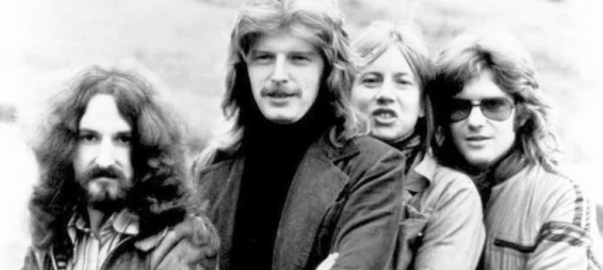
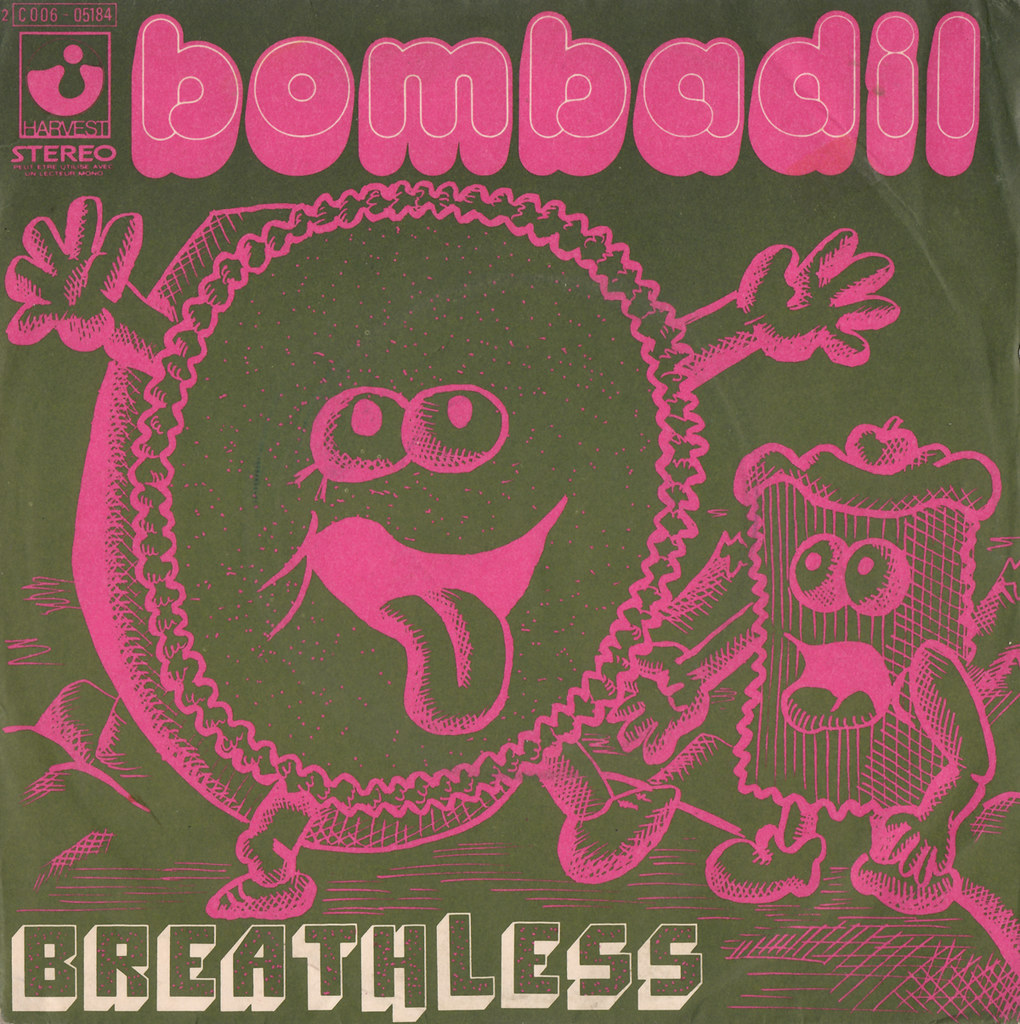
Admittedly, it was released under a pseudonym but the 1972 single ‘Breathless’ (credited to Bombadil and supposedly written by ‘Terry Bull’) was none other than Barclay James Harvest, which saw the Oldham-based prog foursome attempting to make a bid for chart success by playing the likes of Gary Glitter and Chicory Tip at their own game.
Where on earth did the pseudonym Bombadil come from though? According to the Barclay James Harvest website it was inspired by Tom Bombadil, a character in Tolkien’s Lord Of The Rings. Hmmm that is all starting to sound a bit prog and not very glam at all. Perhaps it was the name that let them down in the end then. Sadly, the single failed to make any impact on the charts but since the early 2000s the track (and its B-side ‘When The City Sleeps’) has been made available as bonus tracks on the Baby James Harvest album, leaving us with a wonderful slice of prog/glam crossover.
As most rock fans know, Deep Purple’s most famous song ‘Smoke On The Water’ was based on an actual real life event. In December 1971 the band were planning to record their forthcoming album Machine Head at the Montreux Casino in Switzerland. Used for live concerts throughout the year, Frank Zappa’s performance on 4th December was to be the last of the season, after which Deep Purple would be able to have the run of the place to themselves and the Rolling Stones Mobile Studio would be parked up outside to capture everything on tape.
Unfortunately, as we all know, it didn’t quite work out that way. As the song goes:
Frank Zappa and the Mothers Were at the best place around But some stupid with a flare gun Burned the place to the ground
But who was the “Stupid with a flare gun” who burned the place to the ground?
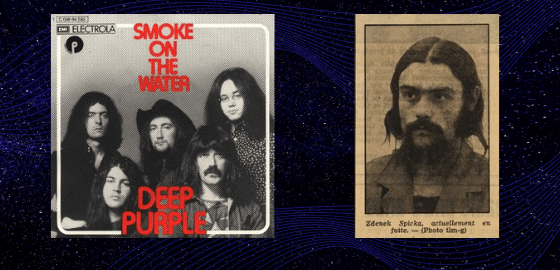
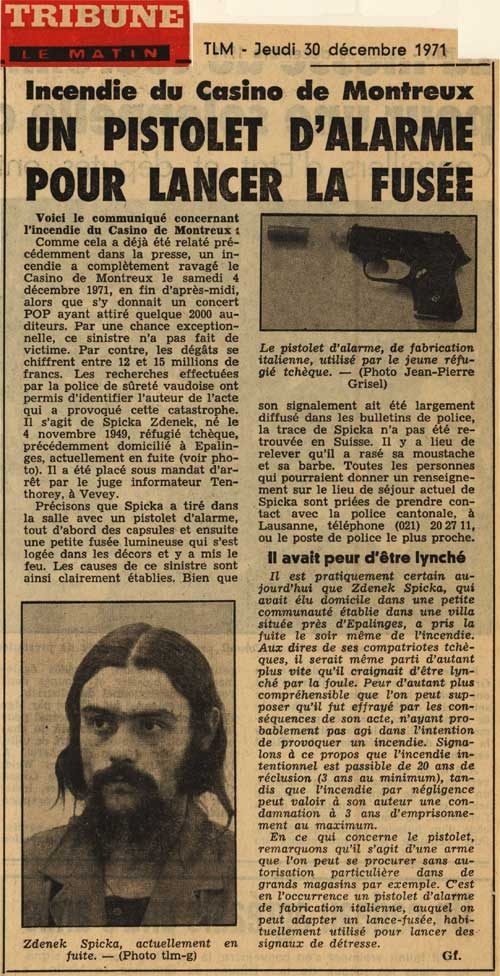
Step forward one Zdenek Spicka, a Czechoslovakian national living in Switzerland at the time. According to a local newspaper article published later that month Spicka is alleged to have fired some capsules and then a small flare into the ceiling of the venue which then started the fire that caused the entire place to burn down. Spicka fled the scene immediately afterwards and although a police ‘Wanted’ operation was mounted he was never located.
The above cutting was tracked down and posted to a Spanish Deep Purple blog back in 2009.
It was subsequently translated into English by another Deep Purple fan as follows:
“Here is the release concerning the Montreux Casino fire. As previously already stated in the press, a fire completely ravaged the Montreux Casino on Saturday, 4 December, 1971, at the end of the afternoon where a pop concert had attracted some 2000 listeners. By exceptional luck, this accident did not claim a victim. On the other hand, the damage in numbers was between 12 and 15 million francs. The investigation performed by the police can identify the perpetrator of the act that caused this catastrophe. It was one Spicka Zdenek, born 4 November 1949, Czech refugee, previously of Epalinages, currently on the run (see photo). He was placed under arrest by the [local judge] in Vevey.
The matter is that Spicka fired a flare gun in the [concert] hall, first some [capsules] and then a small flare that lodged into the ceiling which set it on fire. The cause of the accident is therefore clearly established. Although his details had been widely circulated in police bulletins, no trace of Spicka has been found in Switzerland. It has been suggested that he shaved off his beard and mustache. Anyone who can give information regarding Spicka should contact the police…
It is practically certain today that Zdenek Spicka, who had elected to live in a small commune established in a villa located near Epalignes, took flight the same night of the fire. According to his Czech compatriots, he left as soon as possible because he was afraid of being lynched by the crowd–understandably afraid of the consequences of his actions–even if he had not had the intention of starting the fire. Intentional fire can bring 20 years confinement with a minimum of three years, whereas fire due to negligence can bring a maximum of three years.
Regarding the pistol, it is a firearm that one can obtain without authorization in large stores, for example. It was an Italian-made device which could be adapted to flares used to signal distress.“
What happened next…
Such an incredibly dangerous, foolhardy and unbelievably selfish thing to do at a packed gig, it was a miracle that no-one was killed.
However, the incident did, at least, leave the world with an unforgettable song and an immortal riff.
‘July Morning’ is a 1971 song by English hard rock band Uriah Heep. Written by the band’s keyboard player, Ken Hensley, and vocalist David Byron with its distinctive organ sounds it has remained a significant highlight of the band’s live set.
Introducing the song on Uriah Heep’s 2019 UK tour, Mick Box recalled the time the band were in the studio working on theLook At Yourselfalbum but he had to take a few days out due to contracting some sort of bug. When he returned the remaining musicians had worked up three separate pieces. Box, however, observed that all three were in the same key and suggested joining them together and adding a dramatic introduction to create something really special. ‘July Morning’ was born.
In most places the song is taken at face value for what it is – a classic slice of early 70s hard rock with lyrics celebrating the beauty of an early morning sunrise. In Bulgaria, however, the song has taken on a significance all of its own.
Every year on 1st July thousands flock to the Black Sea coast before dawn for their own ‘July Morning’ celebrations built around that 1971 song by Uriah Heep.
In 2012 some 12,000 people were said to have greeted the sunrise at Kamen Bryag where July Morning was performed live by former Uriah Heep singer John Lawton and his band.
Here is a July Morning celebration from 2019, prior to John Lawton’s untimely death.
It is said that the song grew in popularity during the 1980s and became a feature of impromptu summer gatherings of young rock fans. Although formal protests were banned under the Communist regime, the gatherings (and by extension the song) were seen as a subtle way of expressing one’s defiance towards the authoritarian regime and celebrating life and freedom.
Bulgarian communism may have collapsed in 1989 but there is no sign of a collapse in the popularity of the song – or indeed of the dawn gatherings which have remained an important part of the summer calendar each year.
Now the song has never enjoyed anything like this degree of significance in the country where it was actually created. It’s loved as a great rock song in Britain but that’s as far as it goes.
How appropriate, therefore, if Uriah Heep were to actually play the song at a dawn gathering on July 1st here Britain one day – celebrating the anniversary of the song and paying tribute to the life of of one of its creators, Ken Hensley, who sadly died in November 2020.
From Hound Dog to Always On My Mind the original versions of six classic Elvis songs
1. Hound Dog
Written by songwriting team Jerry Leiber and Mike Stoller when they were both still in their teens, ‘Hound Dog’ was created specifically for blues singer Big Mama Thornton. It was recorded in 1952 and released in 1953. Rather than being seen as just a rough early prototype of a tune Elvis would later make famous, Thornton’s version of Hound Dog is rightly regarded as iconic in its own right, helping lay the foundations of black R&B in rock music. The song has cemented Thornton’s place in rock ‘n’ roll history, even if she never made more than a few hundred dollars from it. Presley’s version was released three years later in 1956.
2. Are You Lonesome Tonight?
We go right back with this one. ‘Are You Lonesome Tonight?’ was written by Vaudeville songwriters Roy Turk and Lou Handman in 1926. Numerous versions were recorded in the late 1920s but the first was by Charles Hart, in 1927. In 1950, the Blue Barron Orchestra recorded a version and the song became a staple of crooners of the era. In his final months of national service with the US Army, Elvis began considering new material for his return to a recording career. Presley’s manager, Colonel Tom Parker, suggested ‘Are You Lonesome Tonight?’ – the song being a favourite of Parker’s wife. Presley’s version was released in November 1960.
3. Suspicious Minds
‘Suspicious Minds’ was first written and recorded in 1968 by Mark James. Here we hear it taking shape as a soulful pop ballad. While the arrangements on the James version are virtually identical to those on the Elvis version recorded a year later. the magic is somewhat lacking. After spending much of the 60s churning out B movies, ‘Suspicious Minds’ was one of the songs recorded by Elvis in the Memphis recording sessions following the success of his televised 68 Comeback Special. Recorded in January 1969 it was released in August 1969 and became Elvis’s first number one in several years.
4. The Wonder of You
Written by Thomas Baker Knight Jr. ‘The Wonder of You’ was first recorded by film actor/singer Vince Edwards in 1958 but never released. A year later a version was released by Ray Peterson who had a Top 30 hit with it in both the US and the UK. It would be 1970, however, before Presley took Peterson’s sugary, sentimental teen ballad and transformed it into the bold, dramatic and unforgettable version that we know today. Presley recorded a live version of the song in Las Vegas in February 1970 and it is this live version of the song that was released as a single in April 1970.
5. An American Trilogy
‘An American Trilogy’ is actually three songs. The “Oh I wish I was in the land of cotton” bit is from ‘Dixie’ which became an anthem of the confederacy in the Civil War. The “Glory, Glory Hallelujah” bit is from a song called ‘Battle Hymn for the Republic’ which was the marching anthem of the opposing federal anti-slavery Union Army. And the “Oh, hush little baby don’t you cry” bit is from ‘All My Trials’ said to have emerged out of African American spirituals. Country musician and composer Mickey Newbury had the idea of bringing the three together, representing three strands in America’s troubled history, for his 1971 album and a subsequent single. Presley introduced ‘An American Trilogy’ to his concert set-list in January 1972. A live recording was made the following month which was released as a single but although it became a staple of Presley’s live shows, paradoxically, the single didn’t do as well in the US charts as Newbury’s original.
6. Always On My Mind
A love song expressing deep regret to a departing lover ‘Always On My Mind’ was written by Wayne Carson, Johnny Christopher and Mark James. Mark James, of course, we already know as the writer and original singer of ‘Suspicious Minds’. ‘Always On My Mind’ was first recorded by BJ Thomas in 1970 but the first version to be released was by Gwen McCrae in 1972. Presley recorded his version shortly after separating from his wife, Priscilla, and it was released in November 1972. Here we can hear both the BJ Thomas and the Gwen McCrae versions.
Brash, colourful, over the top, glittery – 1970s glam rock and Christmas seemed made for each other. Yet glam had been in ascendancy for some two years before anyone contemplated putting the two together. And more than anyone else, we can thank Slade for that. From the familiar pounding on the harmonium in the opening bars to the final “It’s Christmaaaas!” Slade’s Merry Xmas Everybody remains one of the most well-known and most popular Christmas records of all time. Released in December 1973, the Performing Rights Society once calculated that it is the world’s most listened-to song, heard by an estimated 42% of the global population.
“My mother-in-law the year before had said why don’t we write a song like “White Christmas”, something that can be played every year.” Jim Lea, Slade (Uncut Magazine)
Recorded in New York in the summer of 1973, Noddy Holder told Uncut magazine that he wanted the lyrics to convey a mood of optimism. The song certainly does that. But at the time of recording it, the band would have little clue as to how grim things were going to get in Britain that particular winter. Conservative Prime Minister Ted Heath’s increasingly fractious battle with the miners took a dramatic turn. Mineworkers, like all public employees at the time were suffering the effects of below-inflation pay increases at a time of hyper inflation, and were pursuing industrial action for higher pay. Regular domestic power cuts became a fact of life.
Merry Xmas Everybody was released on 7th December 1973. On 12th December Heath announced that in order to conserve coal stocks, as from midnight on 31st December the Government would be enforcing a three-day week. Companies were to be permitted to consume electricity only on three consecutive days per week, additional working hours were to be banned and TV companies were required to cease broadcasting at 10.30pm each night.
“We shall have a harder Christmas than we have known since the War.” Edward Heath
This was the Christmas in which Slade’s Merry Christmas was first unleashed on to the public.
It’s a ground-breaking Christmas song in a number of ways. Unlike the treacly nostalgia of previous Christmas classics, Holder and Lea managed to capture the essence of a working class family Christmas:
Are you waiting for the family to arrive Are you sure you’ve got the room to spare inside Does your granny always tell you That the old songs are the best Then she’s up and rock ‘n’ rolling with the rest
That was combined with a genuine spirit of bright, breezy optimism:
So here it is Merry Christmas, everybody’s having fun Look to the future now, it’s only just begun
There is a freshness about the way that line is delivered that still sounds fresh even today. “In terms of comfort we shall have a harder Christmas than we have known since the war,” Heath declared ominously. But while it might be argued that anything Slade recorded at that particular time in pop history was destined for the Number 1 slot anyway, there was something marvellously subversive about Slade’s Christmas single being the best selling record at the time. People singing along to a chorus that celebrates having fun and looking to the future during the middle of a heated political stand-off, a major breakdown in industrial relations, a draconian response from government and a very bleak-looking New Year indeed.
The three-day week came into force on New Years Day 1974. The Christmas song that was the antidote to it remained at Number 1 until well into the middle of January. In fact, it was February before it dropped out of the charts. As the chorus makes clear, the song is very much a song for the New Year – looking ahead to the future – and not simply one about Christmas.
The Government’s battle with the miners continued to intensify and, refusing to back down, Heath called an election in February 1974. “Who governs Britain?” demanded Heath. “Not you!” the voters told him. He lost the election and embarked on what became known as the longest sulk in British political history. The National Union of Mineworkers secured their pay rise, returned to work and lived to fight another day. But they would be brutally smashed by the Thatcher Government a decade later and Britain’s pit communities decimated. Whatever the battles of the past, the challenge of climate change, of course, means that the only sensible coal policy today is to leave the rest of it in the ground.
Yet Slade’s Merry Xmas Everybody lives on, outliving the three-day week, Ted Heath, the miners and (in its original formation) even the band itself. That celebration of working class life in the festive season and the bright sunny optimism for a better future ahead still makes it the greatest Christmas song ever recorded.
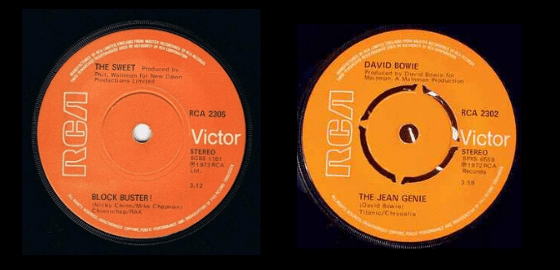
In January 1973 at the height of the glam rock craze, two singles with instantly memorable but remarkably similar riffs were both enjoying chart success: The Sweet’s ‘Blockbuster!’ and David Bowie’s ‘The Jean Genie’, each released by RCA records. Which came first? Were they both dreamt up independently? Did one copy off the other? Or did they both draw on influences from somewhere else?
In the folk world songs have always been adapted, evolved and passed on. In the rock world that sort of behaviour is more likely to get you involved in lengthy court cases and costly lawsuits. But in folk there has been over a century of legitimate and rigorous study looking into the often murky origins of traditional songs and tunes. A simple question therefore is: can the principles of studying folk in determining song origins also be applied to glam rock?
We start with the song ‘Blockbuster!’ written by The Sweet’s then songwriting team of Mike Chapman and Nicky Chinn, recorded on 1st November 1972 in London and released in January 1973. In Dave Thompson’s Sweet biography ‘Block Buster’, The Sweet’s Steve Priest recalls Chapman playing his idea for a new song on an acoustic guitar while they were backstage at the BBC waiting to go on Top Of The Pops to perform ‘Wig Wam Bam’ (most likely their appearance on 14th September 1972).
The riff was remarkably similar to David Bowie’s ‘The Jean Genie’ recorded on 6th October 1972, released in November 1972 and in the charts at the same time. “While en route to Tennessee, ‘The Jean Genie’ was developed from an impromptu tour bus jam,” in September 1972 recounts the Mick Ronson biography, ‘The Spider With The Platinum Hair’ by Weird & Gilly. This would have been just prior to the band’s gig in Memphis which is recorded as taking place on 24th September 1972, several days after Mike Chapman strummed the riff for Blockbuster to Steve Priest on the other side of the Atlantic.
Both sides have always denied copying one another and given both ‘Blockbuster’ and ‘The Jean Genie’ were recorded and released around the same time it seems unlikely that either would have had time to secretly copy the other, then get it recorded and released, all within the confines of the same record company, RCA.
What is far more likely is that they were both influenced by the Yardbirds’ 1965 hit ‘I’m a Man’.
Alwyn Turner’s website Glitter Suits & Platform Bootsquotes The Sweet’s Andy Scott as follows: “And then, you wouldn’t believe this, before our release we were in the office of the guy who was our contact at RCA and he played us the new David Bowie record, he played us ‘Jean Genie’. And I went, ‘That’s the same guitar riff,’ and he went, ‘Is it?’ This is a record company guy and I’m saying, ‘Haven’t you noticed?’ And he went, ‘No.’ I was horrified, I was thinking: that’s coming out first, and we’re coming out a week behind it, on the same label, it’s got the same guitar riff. I said: well, we don’t stand a chance of being #1. That was my thought. And within three weeks we were #1 and he was #2. I’ve since spoken to Trevor Bolder, the bass-player, and he said, ‘Remember “I’m A Man”?”
Here is that Yardbirds’ version of ‘I’m A Man’.
Interestingly, Iggy Pop and The Stooges also recorded a version of ‘I’m A Man’ during the sessions for the Raw Power album in early 1972. Bowie was involved in remixing this album and although ‘I’m A Man’ doesn’t appear on the album, he would certainly have been familiar with the Stooges cover version. Could this have had an influence on Bowie’s ‘The Jean Genie’ later that year?
We can hear Iggy & The Stooges version of ‘I’m A Man’ here.
Both recordings are, of course, cover versions of a 1955 original version of ‘I’m A Man’ by Bo Didley.
Bo Didley’s song is itself influenced by a song Willie Dixon wrote for Muddy Waters‘Hoochie Coochie Man’ recorded in 1954
The blues of Bo Didley, Muddy Waters et al can be traced back through the early electric blues of the 1940s to the acoustic blues of the 1920s, through the slave trade, plantations and back to African origins, where a number of the elements that would come to define key features of the blues could be traced back to.
But it’s worth specifically going back to that Bo Didley tune. The riff in ‘I’m a Man’ is significantly changed from that played by Muddy Waters in Dixon’s ‘I’m A Man’. Didley has adapted the tune as a simple repetitive four note riff repeated throughout the entire song, making it notably different.
So although it was influenced by an earlier blues song I think we can safely say that the riff that appears in ‘Blockbuster!’ and ‘Jean Genie’ first emerged in a Bo Didley song in 1955.
Thanks also to Michael Duthie for pointing me towards the Mickie Most video (below) and to Josh Beeson for pointing me to the Iggy & The Stooges version of ‘I’m A Man’.
Another fascinating release from the 60s that could have played an influential role in the later 70s glam releases was Mickie Most’s 1964 version of ‘Money Honey’.
Unlike earlier versions of Money Honey by Elvis and previously The Drifters, the Mickie Most version utilises that same Bo Didley riff. Most would go on to be a towering figure in glam rock as mentor and producer for Suzi Quatro and as RAK Records boss, home to the likes of Quatro and Mud. He knew Mike Chapman very well and could have helped plant some of the creative seeds for that Blockbuster riff, further strengthening those glam rock links back to blues history.







 Darren's music blog