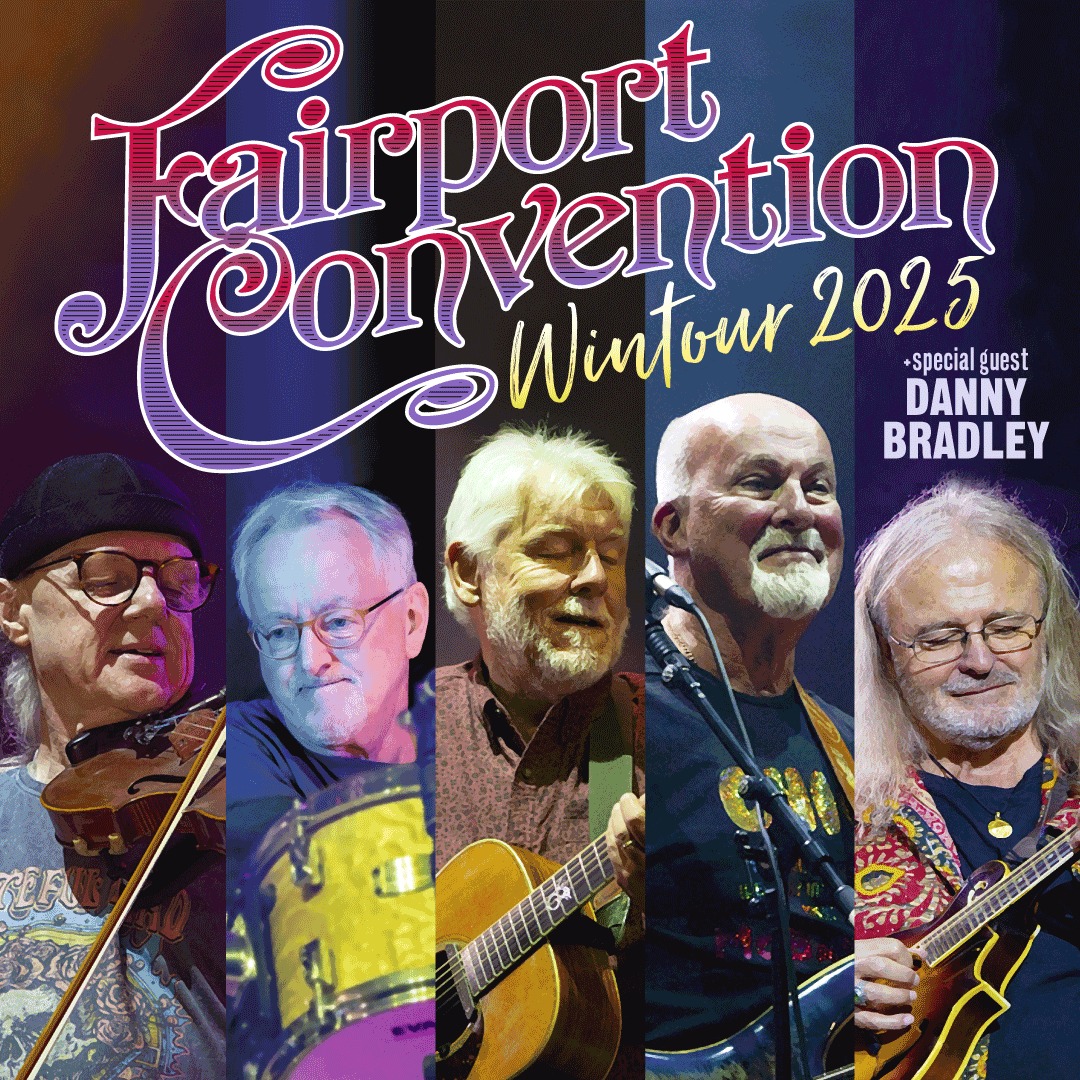
Both at their summer Cropredy Festival and on many of their winter tours, Fairport Convention have long striven to provide a platform for newly-emerging artists. This current tour is no exception. Support, this time, is the Liverpool-based singer-songwriter and finger-style acoustic guitarist, Danny Bradley, whose debut album Small Talk Songs has just been released. With a fine voice, some mesmerising finger-work, a great set of songs and some wryly, self-effacing stage patter (“This is the first time I’ve been on the bill with anyone that my dad’s heard of”) and he opens proceedings very nicely indeed. As is traditional on their winter tours, the Fairport guys join Bradley on stage to act as his backing band for the final song of his set, before launching into their own.
Fairport themselves then kick things off with a rousing rendition of ‘Come All Ye’ from their genre-defining 1969 folk-rock masterpiece Liege & Lief. “An opening song that’s had a few decades off” is how Simon Nicol put it. They then stick with the Sandy Denny era for a version of Denny’s ‘Fothingay’, with beautiful twin fiddles courtesy of Ric Sanders and Chris Leslie. In fact, with the band revisiting a couple of band-composed tracks from the post-85 Fairport, we are almost coming to the end of the first set before we hear anything that can be properly considered a folk song but an equally rousing ‘Claudy Banks’ finally inserts a bit of trad. arr. into the setlist.
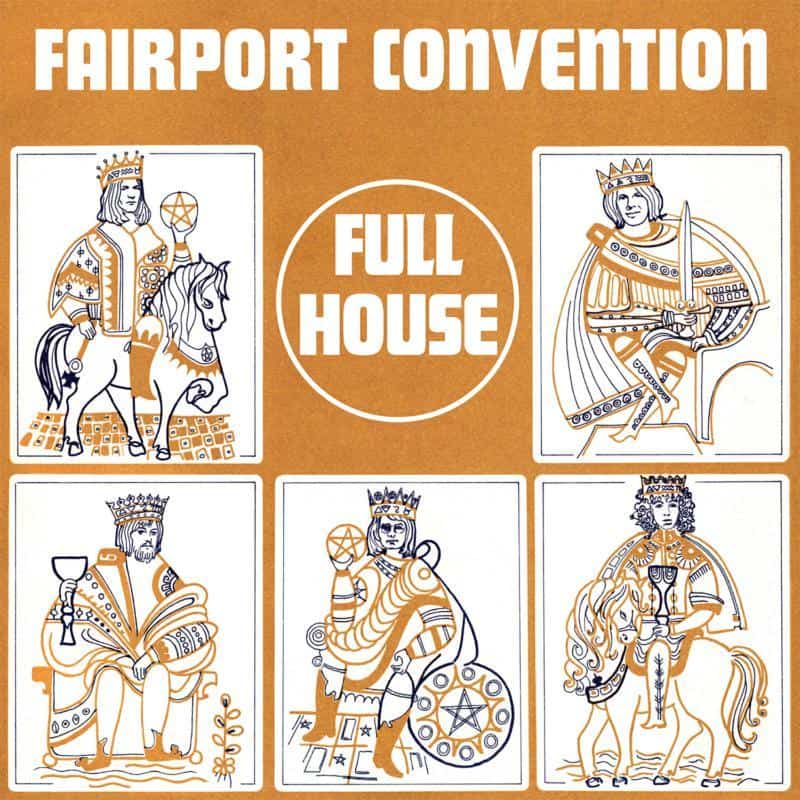
That’s followed by Chris Leslie’s own ‘Banbury Fair’ before the band delve back into the early days once more and round off the first half with a magnificently sprawling, brooding version of ‘Sloth’ from the much-celebrated Full House album. As I was soaking up Dave Mattacks’ wonderfully-atmospheric drumming, such an integral part of that song’s epic status on the original album, I’m reminded that with the return of Mattacks (following the retirement and subsequent untimely death of long-time drummer Gerry Conway), we now have three of the five players from that classic 1970 album performing as part of the band’s regular touring line-up. There aren’t many bands who made an album fifty-five years ago who can still claim that sort of on-stage quota!
After a short interval, the second set kicks off with another trad. arr. offering in the form of ‘The Hexhamshire Lass’. When I interviewed Dave Pegg last month ahead of this tour, he told me that the band were prompted to include the song in the set-list for this tour as they would be playing Hexham on Valentine’s night – even though “it’s quite a complicated arrangement”! No matter, even without the legend that was Dave Swarbrick, they do have the incredible musical talents of Sanders and Leslie to draw on for a superb rendition.
Photo credit Kevin Smith
Indeed, as he shares with us when introducing the next tune, it’s now 40 years since Sanders played on his first Fairport album – Gladys’ Leap. Sanders tells the audience that he was phoned up by Pegg who had asked him if he was interested in contributing fiddle to three tracks but initially he had no idea he was being asked to contribute to a Fairport Convention album. Until he heard the tracks, and the distinctive drumming of Dave Mattacks, he assumed he was merely being asked to contribute to one of Pegg’s side projects. Sanders added his fiddle sounds, of course, and the rest is history. So to mark the anniversary of that significant moment in the Fairport chronicles, the band revisit the instrumental medley from Gladys’ Leap, along with a beautifully-evocative version of ‘Hiring Fair’ with some gorgeous keyboard flourishes from Mattacks. Written for them by Ralph McTell, it’s a song that has rightly become a fan favourite over the past four decades.
Back in 2011, the band revisited the whole of their 1971 concept album, Babbacombe Lee, the tale of the convicted murderer who was condemned to death but given a reprieve after the gallows failed three times in succession. Unlike other past albums it’s not usually one where odd tracks are performed live but here we get two, the contemplative ‘Cell Song’ and the exhilarating, death-defying ‘Wake Up John (Hanging Song)’. Just as he did back in 2011 when the band performed the full album live, Leslie does a fine job singing Swarbrick’s original lyrics.
The second set is beginning to draw to a close at this stage but there’s still time for a couple more numbers before the band finish proceedings with the inevitable show-closers. There’s a joyous rendition of ‘Rising For The Moon’, Sandy Denny’s celebration of the simple pleasures of touring and performing. And, after marking Sanders’ induction to the Fairport ranks earlier in the set, we are then reminded that it’s coming up to almost three decades since Chris Leslie joined. It was his second album with the band where he really started coming into his own as the band’s principal contemporary songwriter and they revisit the title track of that album, ‘The Wood and the Wire’, Leslie’s impassioned paean to coveting, cherishing and learning to play a stringed instrument.
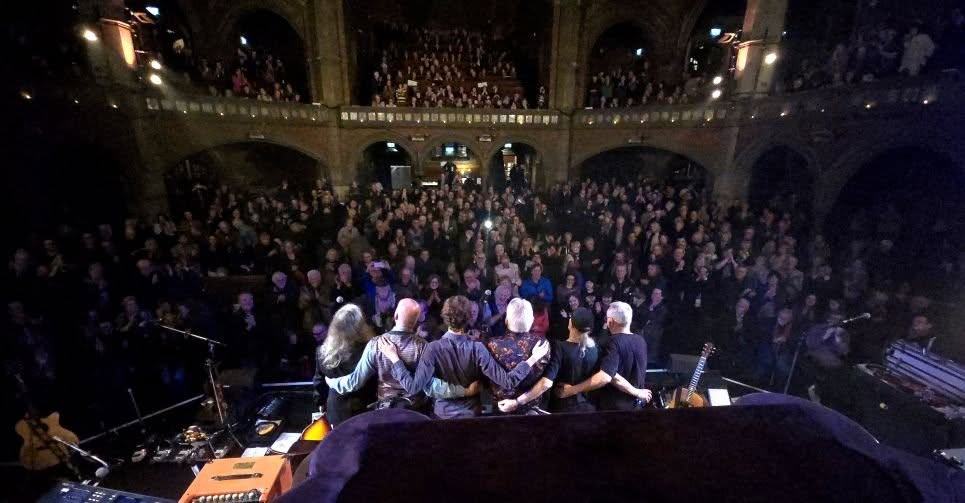
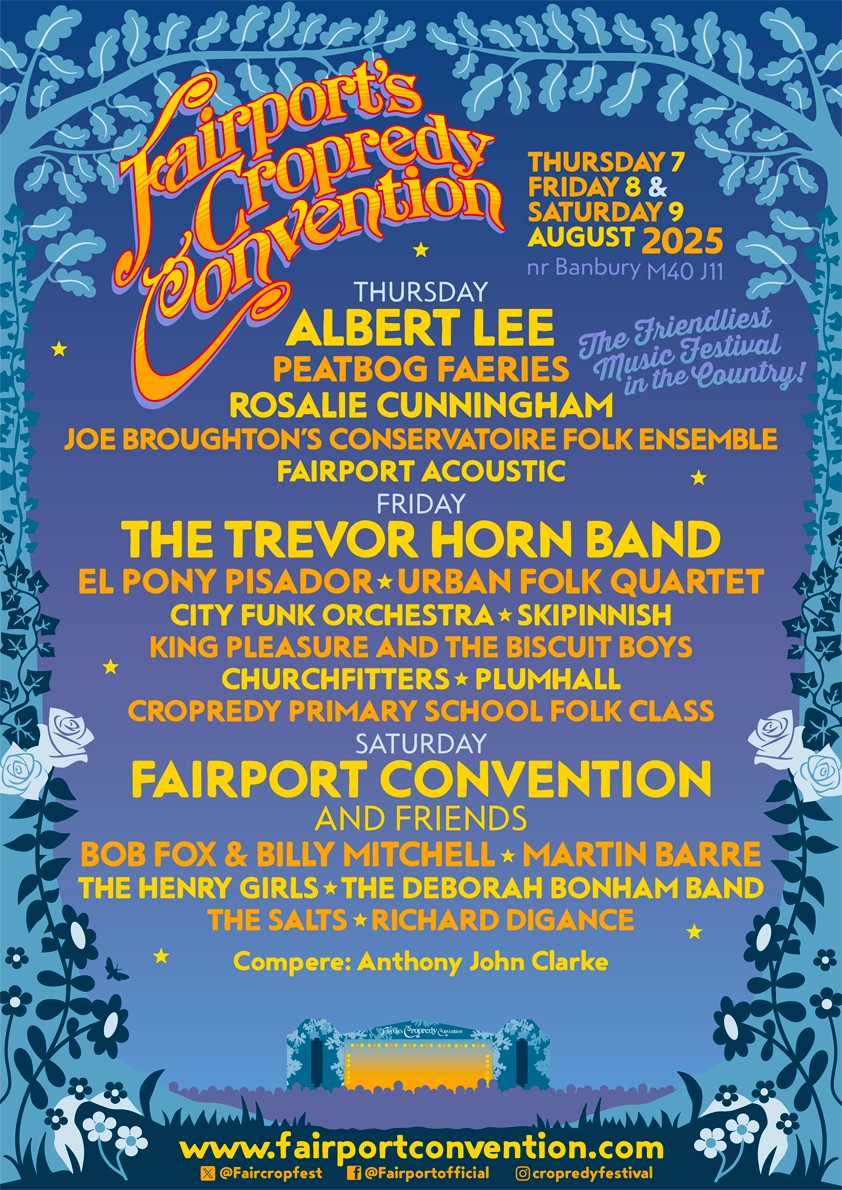
As we come up to curfew time there’s normally three things that happen around this point. Firstly, a sales pitch from Simon Nicol about the band’s Cropredy festival in August, followed by two perennial crowd-pleasers ‘Matty Groves’ and ‘Meet On The Ledge’. This year, there’s less of a need for the sales pitch as the now reduced-capacity festival (a financial necessity in the current climate) is very close to selling out. So, after a brief exhortation to check the website in the coming days for the final few tickets, it’s banjo-at-the-ready and time for all nineteen verses of ‘Matty Groves’, some heartfelt applause from an appreciative audience and the inevitable ‘Meet On The Ledge’. Me and my group of camping friends got in nice and early with our Cropredy ticket purchases for this year so I’ll be looking forward to singing along to it once more, as midnight approaches on 9th August. It all comes round again.
Photo credit: Kevin Smith
Setlist:
First set:
Come All Ye Fotheringay I’m Already There The Rose Hip Claudy Banks Banbury Fair Sloth
Second set:
The Hexhamshire Lass Instrumental Medley ’85 The Hiring Fair Cell Song Wake Up John (Hanging Song) Rising for the Moon The Wood and the Wire Matty Groves Meet on the Ledge
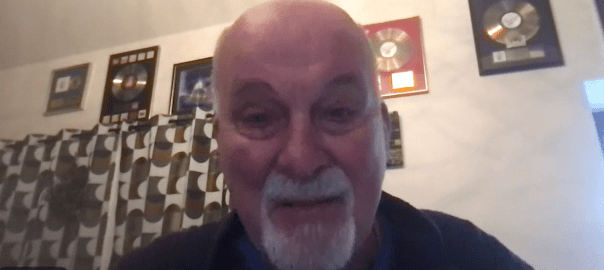
Ahead of Fairport Convention’s Winter Tour, I catch up with Dave Pegg. We discuss the making of the Full House album, the crucial role that Jethro Tull played in Fairport’s resurrection, changes afoot at Cropredy this summer so that the festival survives the financial pressures facing the sector and the forthcoming tour, starting 31 January.
We’ll talk about the Winter Tour and about Cropredy later but first I want to start right at the very beginning – well the very beginning for you. I was re-reading the Fairport by Fairport book and it was Swarb who really pushed for you to be auditioned after Ashley left. It seems that the others were a bit sceptical at first?
Well, what happened Swarb used to be in the Ian Campbell Folk Group and he’d left a couple of years before I joined them to go off to play with Martin Carthy. He knew of me through the Campbells because he joined the Campbells for an album that they did. It was just a reunion kind of album and I played on it. He was aware that I wasn’t really a double bass player, which I played with the Campbells. I said, “This isn’t really my instrument, mate. I can get away with it but I’m a bass guitarist. I’m a rock musician really.” He remembered this and when I saw Fairport on my 22nd birthday at Mothers Club, it was the last time the Liege & Lief line-up played together and I was blown away. I thought it was fabulous. I thought I’d love to play with that band and literally the next day I got a call from Swarbrick saying Ashley was leaving and they were looking for a bass player. And that’s how I got the audition. The others were a bit scared because when he said I’d played with the Ian Campbell Folk Group, they thought I’d be like the Aran sweater and the beard, like a proper folkie, but I knew absolutely zilch about folk music at all – and still don’t!
And when you did join did it feel like you’d found your natural home or did it take a while to settle in?
No, I kind of settled in pretty quickly. I mean because the Fairports are great players and they were from the same background as myself. Richard was an astonishing guitarist, even at that age. And the rhythm section, Simon and DM, they were just fantastic to play with. And then there was the added bonus of Swarb who was re-inventing the way that he played the fiddle. Because now he was kind of getting into rock music and was using his Echoplex and he’d got a really crude pickup on his violin made from a telephone (laughs). But it was very early days in terms of electric violin. But the weirder thing about it, we were rehearsing stuff, we’d moved into this place, The Angel at Little Hadham and we were rehearsing songs but without a vocal, without anyone singing. Because, of course, Sandy had left the band as well and it meant the band didn’t have a vocalist so it was a case of drawing straws to see who got the short straw. It was Richard and Swarb who did most of the vocals. Simon, after a while – Simon’s a great singer – but in those days Richard and Swarb hadn’t really sung at all.
Yes, it great how everyone’s confidence as vocalists grew.
Yeah – we made the Full House album. We recorded most of it in London and we went to New York to overdub the vocals. It was made at Sound Techniques in London, engineered by John Wood who was a fantastic engineer and Joe Boyd [producer] allowed us to do whatever we wanted, musically. But Joe kind of trusted the band. What was great about his production for Fairport was the fact that he’d allow us to do whatever we wanted. And he also he knew lots of people in America and we went to New York and we overdubbed most of the vocals in New York, in a studio where Dylan had recently recorded.
Now when I interviewed Simon this time last year, he said this was like being asked to name your favourite child, but I’m going to ask it anyway. What’s your favourite Fairport album?
It’s a very hard one for me because I’ve been involved ever since Full House, which was the first one I played on in 1970. There’s been so many different Fairport line-ups and I find it hard to compare one album against another one. Well, for me, my favourite album before I joined was Unhalfbricking, which I think is a remarkable album. Things like ‘Percy’s Song’ – it’s just incredible that song. I know Dylan really rates that version. Unhalfbricking was my favourite pre-joining Fairport. And the albums that I’ve played on, where there’ve been different line-ups, things like Fairport Nine mean a lot to me because it was a re-establishment with some great players and some great tracks on it. Obviously, Rising for The Moon is another great one for me because it was Sandy coming back. And things like Gladys’s Leap which was again…
Another coming-back album!
Yeah, another coming-back album. And the last one, Shuffle and Go, that we did which I think stands up as good as anything Fairport’s ever recorded. I can’t pick one album. It’s impossible, Darren, for me in that sense!
The second half of the ‘70s looked like it was all going pear-shaped for the folk rock genre. Steeleye Span split up in ’78; Sandy was dead, tragically; Richard and Linda had gone off to a religious commune. Do you think the Cropredy Farewell concert in 1979 played a big part in turning things round again?
Well in terms of turning things around, it was a kind of the end of Fairport as it was because we had split up. Swarb was going to live up in Scotland. There was no longer a working band. I went off and joined Jethro Tull, which was a lucky break for me and I was with them for like fifteen years. And what happened was Cropredy Festival kind of evolved as a get-together, because we’re all mates in Fairport. When we split up there was never really any animosity when people came and then left the band. It was always because they had ideas about what they wanted to do personally. And people like Richard, his talent was too big for Fairport Convention if you like – his ideas about what he wanted to do musically. The group was a bit inhibitive for him. We couldn’t do all the things he wanted. Same with Sandy. We couldn’t do orchestral arrangements. And they were both great songwriters. Well, Richard still is, obviously. But when they left the band the rest of the guys didn’t feel bad about it. We would do everything we could to encourage it. Because we were all mates, it was nice for us to get together.
And, basically, because of Jethro Tull I was in a better situation, financially. My ex-wife, Christine, and myself – we thought it would be nice to keep the band going, even just for a reunion. So, we would plan these things at Cropredy. And we started a little label, Woodworm Records in order to put out our own product and to put out stuff by people who we thought were really good – like we put out an album with Steve Ashley called the Family Album, which is one of my favourite albums. And we made albums with Beryl Marriott and, later on, with Anna Ryder, and Bob Fox. And with Simon Nicol we did two of Simon’s. This was all due, thankfully, to Jethro Tull. Ian [Anderson] and Martin [Barre] kind of adopted me and invited me to join the band and looked after me, financially. So instead of buying a Rolls Royce, I converted a Methodist Chapel – an old chapel next to our cottage in Barford St Michael – into a studio in order that we could make our albums.
In the Fairport book I think you talk about it being a hobby that got out of hand.
Yeah, it did get a bit out of hand (laughs) but it paid off in terms of having a facility where we could all make albums and we could rehearse at. In fact, it’s still a great studio, Woodworm. We’re there in a couple of weeks rehearsing for our tour. And we do record there still. Stuart [Jones] who runs it, the investment that he’s put into it is something that I couldn’t have done. Everything got kind of out of hand in terms of the cost of doing stuff and a lot of studios closed down. Basically, because of the invention of the laptop! And things like Garageband [software app]. My laptop that I’m looking at now seeing your face on it, has more equipment on and is a better studio than my studio in Barford St Michael that was. If only I knew how to operate it!
Primitive though the technology was at that time, it clearly provided, along with the festival, the foundation for the rebirth of the band.
Exactly, yeah. It was brilliant and the album, Gladys’s Leap – we’re looking at a few tracks that we haven’t played for years on this upcoming tour. It’s great for us. And it’s great having Dave Mattacks back on the tour because he comes all the way from America and the Gladys’s Leap album was such an important step in the reformation of Fairport Convention.
And another question on Cropredy before we move on to this tour. To keep the festival viable, you’ve made some changes. It’s funny because there was a group of us sitting in the camping field at Cropredy last August discussing this very thing and we all agreed that to keep the festival financially viable you’d have to downsize so you weren’t tearing your hair out about whether you’d get the numbers each year. And that seems to be what you’ve done, pretty much.
Well, luckily, Gareth Williams our CEO came up with several formulas for trying to make it pay. It’s always been such a gamble, the last couple of years especially. Because when you don’t know how many tickets you are going to sell, you can’t budget. You’re guessing about the number of people who are going to turn up. Gareth’s idea – we’re only going to sell 6,500 tickets and we’re only selling three-day tickets. Because we know we’ve got that lump of income and we can budget accordingly without the risk of going bankrupt. What happens to a lot of festivals is they overspend. Stuff like building the site at Cropredy is the most expensive aspect of our festival because you’re building a town in the middle of nowhere. There’s no electricity, there’s no water, there’s nothing. You’re putting everything on that site and as the years go by, it gets more and more expensive. And we could no longer risk it. We didn’t want to go bankrupt and it happens so easily and it’s happened to so many other festivals. The price of just the actual infrastructure for all these events went up so much. It went up like 30% over the space of a year and that’s why a lot of these festivals went down. And also, the fact that to get kind of headline acts is an absolute fortune nowadays. Little festivals like Cropredy can’t attract huge names.
So, we won’t be seeing the Alice Coopers any more but you’ve still got a fantastic line-up within the budget constraints. Within the world that you operate, you’ve got a fantastic line-up.
It’s a fantastic line-up and it’s a line-up of people that want to play at Cropredy and people that we want to see at Cropredy… But we’ve been very lucky that we’ve had people like Brian Wilson, for example, at the end of a European bash. Alice, for example, said Cropredy was the best audience he’d played to in Europe. But looking at it from a pure economical point of view, we can’t run the risk of doing that. So, what we’ve done now is rationalised things. Only doing the three-day ticket, which some people will complain about because some people only want to go for one day. It’s a shame but we’ve designed the festival for the people who’ve been with us over all those years, who come for three days, who come for the fact that Cropredy means a lot more to them than having a huge act on that’s probably their only chance to see. And we’ve put acts on that we think are really good.
I think it’s reassuring because we’ve got happy memories of your flirtation with the big league, with acts like Alice Cooper or Chic or whatever. But at the same time, we’ve got that reassurance that we know the festival can go ahead and it’s not going to go bankrupt.
Yeah, that’s it. It’s the only way that we could carry on. It’s a kind of test year this year because if it works, we’ve got a formula that we can kind of stick to. It’s adaptable. We may be proved wrong. There might be such a swell of people wanting to come. Last year we sold something like 9,700 tickets which was 2,000 less than the year before. Cropredy, it’s like a mature kind of crowd you get there with all due respect. A lot of them are ageing. They don’t want to camp any more. They enjoy the glamping and a lot of them have got motor homes or caravans. That’s great. But there are very few hotels about available nowadays and a lot of people think twice before taking a bivouac out and roughing it in the field. Although as we all know, Darren, the weather’s always perfect at Cropredy!
We’ve never had any rain! The sun’s never been too hot!
I think we’re going to have a fantastic year and I’m really pleased about the line-up. There isn’t a bad act on it and I’m so pleased that we’ve got Albert Lee because we’ve been trying to get Albert for years. And Martin Barre coming back – Martin is a great guitarist. And we’ve got Deborah Bonham – I love Deborah’s singing. The Churchfitters are coming back. And Trevor Horn’s coming back. We missed him last year because he was poorly and he had to cancel so it’s great having Trevor back.
I think that within the financial constraints that you’re operating in, it’s still a fantastically diverse line-up which has some of the folky elements and some of the classic rock elements and I’ve always liked that mix. You’ve still managed to maintain that.
Yeah, the diversity musically is one of the attractions of Cropredy, I think, because it’s not all folkie and it never has been because we’ve always had a real mix of music, like reggae, rock. We’ve never really had punk bands but we’ve had some very diverse kinds of music on there – and that will always be. The criterion is whether we think the acts that we book musically fit the bill. If the bands are all really good, the only people that suffer are us because we have to follow them all. It’s not funny. Two years running I’ve sat out in the field and I’ve watched and I’ve thought, “This is fantastic. The sound’s great, the screens, you can see everything, you don’t have to move, the bar’s only like a minute’s walk away and everybody’s so friendly and having a great time.” And then when it comes to Saturday night, I’m like, “Oh hang on, we’re on now. We’ve got to follow that lot!” It’s not easy. There’s a lot of nerves when we get up on that stage, because we play for about three hours.
In fact, this year’s going to be really fun for us because when we open on Thursday, we do our twenty-minute acoustic spot. We do Chris’s song the ‘Festival Bell’ and then we’re going to be joined by Joe Broughton’s Folk Ensemble. So, fifty students from Birmingham Conservatoire who are monster players and we’re going to do the biggest version of the ‘Lark in The Morning’ medley from Liege & Lief. Which should hopefully set the mood for the rest of the weekend.
Let’s move on to the tour then. What do you want to tell us about the Winter tour, starting 31 January?
I think we’ve got 27 dates altogether. We try and cover the whole country. We start off in Nottingham and we finish up in Tewkesbury. We’ve only got one Scottish date, although it’s great to be in Edinburgh. It’s nearly sold out. The tickets are going really well which is great. And we still enjoy touring enormously and treading the boards has always been what Fairport is good at. We’ve had more success playing live than we’ve had making albums.
Thinking back to when you first joined it must fill you with a certain sense of pride, knowing you’ve helped keep the show on the road all these years. In spite of all the problems in the festival industry, in spite of, sadly, former members no longer being with us, you’re still getting out there. It must give you a certain sense of satisfaction when you’re about to head out on tour again.
Absolutely. It’s great to get in the van. Getting in the van is easier than getting out of it. We’re banned from making pain noises now when we get out the van. But, Darren, I can assure you, I’m really ready to get in the van again and get ready to go out on the road. All I’ve got to do is learn two hours of music! Or re-learn. You think, “Oh I know all that stuff. I’ve played it hundreds of times.” And then you go, “Oh-oh”. We might be doing ‘The Lass from Hexhamshire’. We actually play in Hexham – on Valentine’s night – so it will be a great opportunity to get that song in the set – but, of course, we’ve got to learn it. And it’s quite a complicated arrangement from what I can remember. So that’s this afternoon’s work. I’ve lit the fire here because it’s really soggy and cold in Brittany so that’s my afternoon – learning the set.
Well good luck with the preparations and I look forward to seeing you at Union Chapel.
Tour dates:
January 31st Nottingham – Playhouse
February 1st Edinburgh – The Queen’s Hall, 2nd Alnwick – Alnwick Playhouse 4th Milton Keynes 5th Southend – Palace Theatre 6th Bury St Edmunds – The Apex 7th Canterbury – Colyer Fergusson Hall 8th Farnham – Farnham Maltings 9th Worthing – Connaught Theatre 11th Wakefield – Theatre Royal 12th Newcastle under Lyme – New Vic Theatre 13th Manchester – RNCM – Royal Northern College of Music 14th Hexham – Queen’s Hall Arts 15th Colne – The Muni Theatre 16th Lytham St Annes – The Lowther Pavilion 18th Lincoln – The Drill 19th Sunderland – The Fire Station 20th Leamington Spa – Royal Spa Centre 21st Harpenden – The Eric Morecambe Centre 22nd London – Union Chapel 23rd Corby – The Core Theatre 25th Swansea – Taliesin Arts Centre 26th Exeter – Corn Exchange 27th Southampton – Turner Sims 28th Bath – The Forum
March 1st Bridgnorth – Castle Hall 2nd Tewkesbury – Roses Theatre




 Darren's music blog