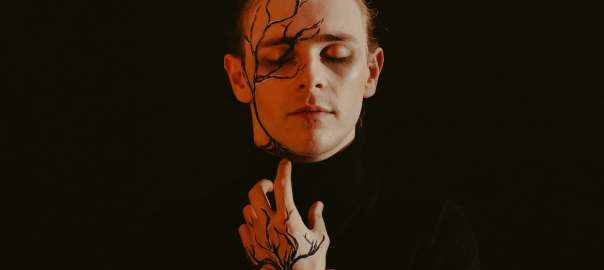
Following the release of his debut album (reviewed here) back in April, the alt-folk musician James Auger aka A Choir of Ghosts releases a new single. ‘Skin & Bones’ is released on November 20th with an accompanying video.
“The song is about the realization that you can’t always ‘fix it’ for the people you love. Sometimes they have to solve it themselves, and you can’t do anything but watch and hope for the best. In order for things to grow to its full potential, you sometimes have to let go,” says Auger.
“It’s a hard realization but I think a lot of people can identify with the feeling of sudden emptiness, when you come to something in your way that you cannot share, but rather have to go about alone. Your only hope lays in that once the obstacle has been passed, you can rendezvous on the other side.”
A spring 2020 European tour was cancelled due to Covid-19, but Choir of Ghosts has now sprung back into life with this gentle, longing beautiful song and atmospheric video filmed deep in the Scandinavian forests.
Describing themselves as “vaguely acoustic music for the vaguely thinking person” The Sunny Smiles Three are a new alt-folk trio composed of John Parkes, Alaric Lewis and Simon Smith. All three have spent a good few decades as stalwarts of the UK’s indie music scene. Frontman, John Parkes, has been in the likes of the Greenhouse, Fuzzbird and the Sinister Cleaners. Alaric Lewis has played bass with Breaking the Illusion, Cyanide Pills and Suzi Blu as well as being an in-demand guitar tech for some of rock/pop’s royalty. Drummer, Simon Smith, meanwhile was in the Wedding Present, the Ukranians and Cha Cha Cohen.
Fireman Spaceman Mermaid is the trio’s debut album but also includes bonus songs from a recent EP, giving you a whopping sixteen tracks of delightful indie alt-folk-rock.
Named after the retro ‘Sunny Smiles’ charity booklets back in the 1950s and 60s, the three do a nice line in slightly quirky-but-beautifully-crafted acoustic songs with bitter-sweet lyrics and catchy melodies. Parkes is a gifted singer-songwriter, able to conjure up lyrics that so perfectly capture slices of everyday life – like a Ray Davies for the modern era. And with their impeccable indie pedigrees the three have enough musical clout between them to ensure Fireman Spaceman Mermaid is nothing less than a cracking debut.
Released: The Orchard / FR Records 16th November 2020
“The Living Mountain was written by Aberdonian Nan Shepherd, in the last years of the Second World War and it sat in her desk drawer until it was published in 1977,” writes Jenny Sturgeon in the album sleeve-notes.
Inspired by Shepherd’s memoir, once described by the Guardian as “the finest book ever written on nature and landscape in Britain,” Sturgeon’s album of the same name celebrates Shepherd’s nature writing and the Cairngorms mountain range in the eastern Highlands. Each of the twelve songs on the album take their titles from the chapter headings in Shepherd’s celebrated volume.
From the gentle birdsong and low mournful dulcimer hum of the opening track ‘The Plateau’ to the hypnotic piano and slowly pounding percussion of the final song ‘Being’, Sturgeon uncannily captures a sense of the beauty, bleakness and wonder that this very special landscape instils. Ten of the twelve songs are inspired directly by Shepherd’s writing while the remaining two are Shepherd’s own poems, set to music.
Joining Sturgeon who plays piano, harmonium , dulcimer, whistle and guitar are Mairi Campbell (viola and vocals), Su-a Lee (cello), Grant Anderson (bass and vocals) with additional field recordings from Jez Riley-French and Magnus Robb.
Beautifully sung and exquisitely played The Living Mountain is a captivating celebration of the natural world and timeless and inspirational nature writing.
Simply Whistle pretty much does what it says on the tin. For the past five decades Pat Walsh has been part of the north-west traditional music scene and across each of its nineteen tracks this album puts Walsh’s tin whistle and her beautiful jigs, reels and flings centre-stage.
Walsh was born to an Irish family in Manchester in the mid 1950s. This beautifully-packaged CD with its informative twelve-page booklet details not only the background to the tunes, both the traditional numbers and original compositions, but also Walsh’s own life story and her abiding love of traditional music.
“I have tried to describe the really important part that Irish traditional music has played in my life,” she says in the sleeve-notes. “And my enduring passion for playing and listening to it. I have often wished that my great grandfather John Ryder, the fiddle player from Longford had done something similar for later generations to read. If my grandchildren or their children get the bug for trad music, I hope they find that this memoir and the tunes fill in the back story, or maybe even it will pique their interest. Either way, this is for them.”
Produced by Mike McGoldrick, who has played alongside Walsh and also features on the album, the production retains a clean and simple feel which works so well. Within seconds of putting the album on Walsh’s evocative playing has immediately transported you to another time and place.
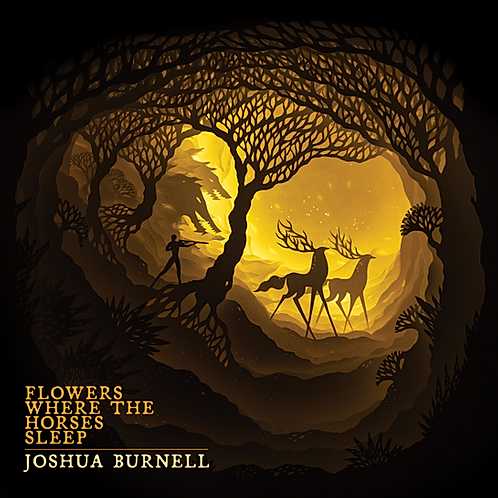
From trad folk to prog rock to avant-garde pop there are many influences at play on Flowers Where The Horses Sleep, the latest album from singer-songwriter, Joshua Burnell.
Following his well-received folk-rock interpretations of traditional song on his two previous albums, Burnell returns to original compositions.
“Having dedicated the past three years to rearranging traditional material, I wanted to build on that experience to produce an album of folk songs for a modern audience,” says Burnell. “The songs were all inspired by people past and present and explore humankind’s remarkable ability to find beauty, even in the hardest of times.”
Nicely packaged with beautiful cover art, the album takes its title from the recollections of a Japanese-American woman who was interned during World War II and spoke of the prisoners growing flowers in the stables they were obliged to take residence in, bringing beauty to the ugliness surrounding them.
Burnell himself is a talented multi-instrumentalist and his impressive musicianship is as much in evidence on this album as his gentle but beguiling vocals. Guests on the album include Frances Sladen on lead and backing vocals, Nathan Greaves on electric guitar and Katriona Gilmore on fiddle and mandarin.
Flowers Where The Horses Sleep takes us on quite a musical journey from the gentle acoustic strumming of opener ‘Labels’ to the lush grand piano of closing track ‘Two Stars’ with many detours along the way. It’s testimony both to Burnell’s creativity and his love of traditional material, however, that for all the quirky left-field musical influences, these freshly-composed songs still manage to retain a strong folk sensibility.
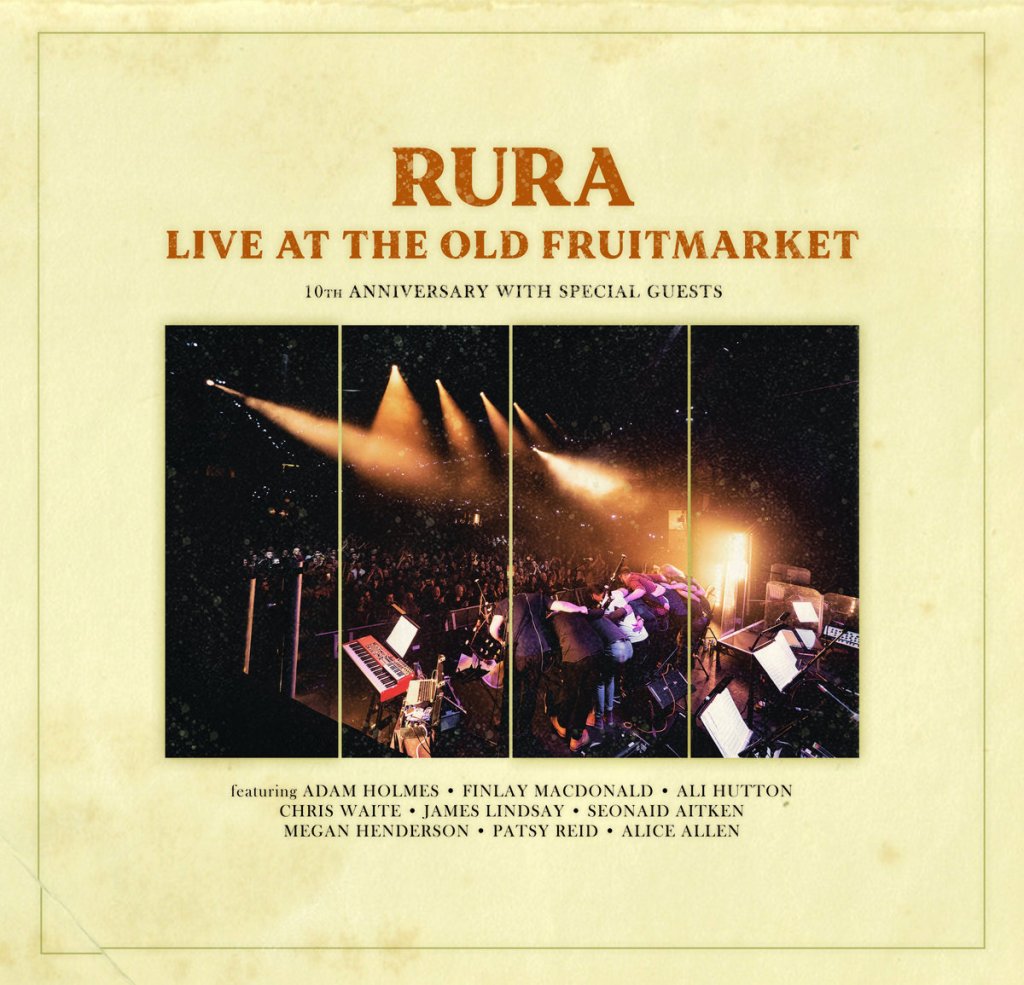
Recorded live at a home-town gig in the month before lock-down commenced, Glasgow’s folk instrumentalists Rura celebrate their tenth anniversary with this brand new live album. Live At The Old Fruitmarket documents Rura’s performance for a 1,200-strong crowd on the final day of the Celtic Connections festival back in February.
The foursome – Steven Blake (pipes and keys), Jack Smedley (fiddle), David Foley (flute and bodhran) and Adam Brown (guitar) are joined by former, past collaborators and long-time musical friends to celebrate the band’s decade of music-making. The concert includes guest slots for the band’s former singer and songwriter Adam Holmes, who contributes two songs, and guitarist Chris Waite in addition to other musicians, including Ali Hutton (Treacherous Orchestra) and James Lindsay (Braebach).
Fiddler, Jack Smedley, reflects: “Over the past ten years we have made incredible friends, made ridiculous memories and played a few tunes along the way! We want to thank everyone who joined us on stage that night at The Old Fruitmarket as well as every single person who has come to see us. We had a blast!”
Capturing some of the magic and atmosphere of what was clearly a very special night, the band and their guests are fizzing with energy as they revisit highlights from their back catalogue.
From fast and furious to melancholy and mournful anyone with a love of Scottish pipes and fiddle is going to love this album. And for anyone who was lucky enough to experience this as one of their last gigs before lock-down they are almost certainly going to want to purchase it as a memento of that evening.
This review was originally published by Bright Young folk here
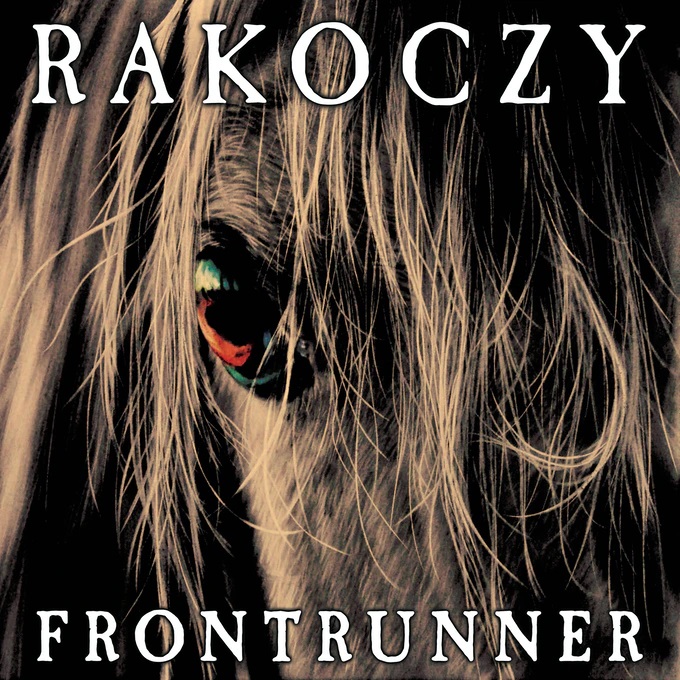
From traditional horse fairs, to the wooden ’obby ’oss, to the racehorse, to more mystical creatures, the horse has been an enduring fixture in traditional folk song. Racokzy brings such songs together in an inspired and ambitious approach for her debut album.
Rakoczy, full name Fruzsina Zsofia Rakoczy, was born in Budapest but has lived most of her life in Manchester. Coming to folk music via the Euro dance scene and local sessions, she sings and plays recorder, concertina and bagpipes, all of which can be heard on the album.
The album draws together traditional favourites like Skewbald, Poor Old Horse and Creeping Jane along with covers from the likes of US singer-songwriter Tucker Zimmerman and pastoral prog rockers Jethro Tull, in addition to a couple of originals.
In her biography Rakoczy cites influences as diverse as British and European traditional song, early music, classic rock, gothic and steampunk and draws inspiration from artists like Tom Waits, Marilyn Manson, Lady Gaga, David Bowie and Joan Jett. With a versatile vocal delivery and excellent musical accompaniment, the spectrum of emotions, moods and influences the artist and her backing band take us on over the course of this album is an exhilarating ride.
From the powerful bagpipe and drumming arrangements which lend atmosphere to opening track Hooden Horse, a Kentish calling-on song celebrating the parade of the wooden hobby horse through the streets of Broadstairs, to the sparse and mournful guitar and vocal arrangement on Little Dun Dee collected from septuagenarian Gypsy traveller Mary Anne Haynes in the 1970s, there is plenty for the traditional folk enthusiast to fall in love with on this album.
For their cover of Zimmerman’s Taoist Tale meanwhile, Rakoczy and her band, the Horror Show, channel the spirit of Mancunian indie favourites The Stone Roses. The album ends with a little bit of folk rock – not the late 60s variety but a blast of 1950s rock and roll as the traditional song Dead Horse is repurposed as a vintage electric guitar romp, a glorious and fitting tribute to our equine friends everywhere.
Quirky, inspired and creative Frontrunner is a superb debut and Rakoczy will most definitely be a name to watch out for.
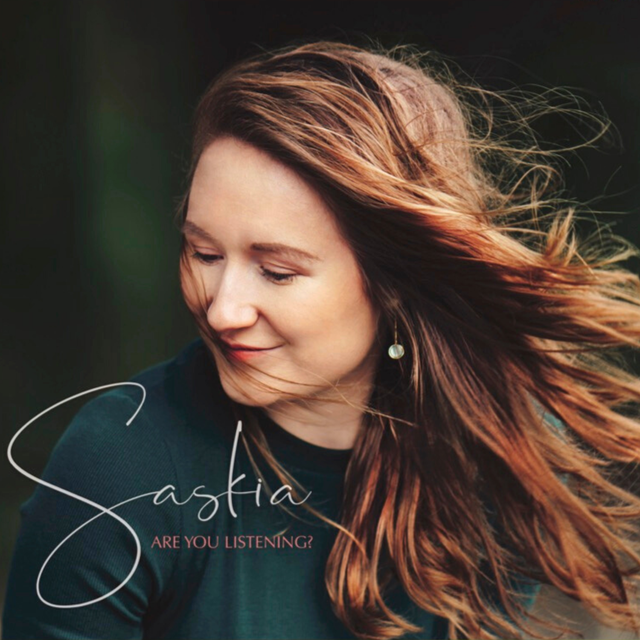
Crystal clear vocals and songs that veer between folk and country with just a sprinkling of smooth slightly jazz-influenced pop Are You Listening is the latest release from London-based singer-songwriter, Saskia Griffiths-Moore.
The first of two-album deal with Suzanne Marcus Collins Foundation, it includes re-workings from her back catalogue as well as two brand new songs and a Leonard Cohen cover.
Whether or not you are familiar with her back catalogue Saskia turns in some fine renditions of her older material here, backed by David Ian Roberts (guitar), Thomas Holder (double bass), Ali Petrie (piano) and Gabriella Swallow (cello) giving the whole album a gorgeously mellow acoustic feel. Of the brand new songs both the optimistic and upbeat ‘Best of You’ and the sad and wistful ‘Come Comfort Me’ compliment the older material nicely.
I do like Leonard Cohen’s ‘Hallelujah’ and here Saskia sings it well. However, I’m not sure it’s entirely essential on this album given there are so many Cohen songs that haven’t been covered quite so many times. Never mind, she does sing it superbly.
A beautifully-recorded album and a fine showcase for Saskia’s burgeoning talents as a singer-songwriter – yes: we’re listing. An impressive album.
Paths & Stories is the debut EP from Liverpool-based folk singer-songwriter Alison Benson. The five-track release comprises five of Benson’s own songs, each looking at the life of an individual, both real and imagined. From a tragic Victorian fortune-teller to a First World War conscientious objector to the heroine of a pioneering piece of 1950s lesbian fiction, Benson draws from a wide range of historical and artistic sources for her inspiration, be it paintings , novels or local landmarks. And she produces some quite unique and utterly captivating folk storytelling in the process.
“Folk music doesn’t exist without stories,” says Benson. “Whether real, mythical or fictional.”
“Focusing on one person’s experience, for me, is a way to get even deeper into a story – to empathise and think about motivations. Singing songs in the first person, as someone else , also gives the narrative a different quality.”
Showcasing her distinctive and appealing vocals, Paths & Stories is pretty much Benson, her songs and her ukulele. I’ll be honest and say that this is not normally my favourite instrument but Benson’s technique is such that any preconceptions about overly-upbeat enforced jollity and cloyingly twee melodies are instantly cast aside as soon as you hear her playing. Gently evocative, the ukulele in Benson’s hands makes for the perfect accompaniment to her thoughtful and poignant storytelling.
And what storytelling there is. Well-produced and highly listenable this is a lovely EP from a singer-songwriter who is clearly emerging as a serious and noteworthy talent.
Virginia Kettle’s vocals have been a key element of of Merry Hell’s sound since the band’s inception a decade ago. Before joining her husband John, brothers-in-law Bob and Andrew, and sundry others in the eight-piece folk-rock outfit, however, she’d established herself as a singer-songwriter in her own right. As Virginia Barrett, she released two solo albums: ‘The Quiet Bridge’ and ‘Sense of Human’ prior to joining the band. No Place Like Tomorrow is her first solo album since Merry Hell began, however.
It’s a more intimate affair than a typical Merry Hell album, both in terms of personnel and in terms of subject matter. The songs have far less of an obvious political tone than many Merry Hell songs and here Kettle tends to touch on more personal matters: love, relationships, family life. ‘Union Jack House’ is the most political song on the album but is structured and delivered in a way that has surprising echoes of Victoria Wood (with a little bit of Are You Being Served thrown in!)
Fans of Merry Hell will already be familiar with the title track, given it appeared on their 2015 album The Ghost in Our House and Other Stories, sung by Andrew, was reworked for their 2018 album Anthems to the Wind, sung by Virginia, and is now reworked once again. A beautifully tender, less anthemic and more delicate rendering than before, this is now the definitive version in my view.
Although Kettle is not backed by the full band she is, at various points, supported by the Hell’s fiddle-player Neil McCartney, bass-player Nick Davies and her guitarist husband John Kettle. Indeed, on a couple of tracks the stripped-back, more intimate feel of the solo album really allows McCartney’s elegant fiddle-playing to take centre-stage: the title track and ‘Valentine’s Waltz’. For me, that tailor-made combination of Kettle’s vocals and McCartney’s fiddle make these two of the real stand-out tracks on the album.
A mellower and more personal offering than a Merry Hell release No Place Like Tomorrow is a charming album that showcases Virginia Kettle’s obvious talents as a singer-songwriter.