Formed in Chicago almost thirty years ago Sons of the Never Wrong are an alt-folk trio with a signature sound of soaring harmonies and lush acoustic arrangements built around of thoughtful, witty song-writing.
Their ninth studio album, Undertaker’s Songbook is something of a celebratory release as the band approach their 30th anniversary.
Founder members Bruce Roper (vocals, guitar) and Sue Demel (vocals, guitar, djembe, dulcimer) along with long-time member Deborah Lader (vocals, banjo, guitar, mandolin) who joined the trio in 1998, replacing original member Nancy Walker, are joined by a range of musical guests and spoken word collaborators for this special release. Guests include Marc Kelly Smith, Karen Savoca, Anne Harris and Pete Heitzman helping bring colourful texture to Sons of The Never Wrong’s trademark blend of folk, jazz, pop and rock influences.
Opening track, the gorgeous gospel-tinged, soul-flavoured ‘Muddy, Muddy River’ with guest, Bob Long, on organ and piano is clearly destined to be a centre-piece of future live performances and is a modern-day classic in the making – absolutely gorgeous.
Elsewhere on the album, the melancholic, ecologically-themed piano and vocals number ‘Shorebird’ is another stand-out track, along with the Indie-ish anthem ‘Om Not This Time’. Tracks like ‘Everyone’s In The House’, meanwhile, take us into more classic folk singer-songwriter territory, evoking the genre’s golden age.
Beautifully presented with hand-painted cover art from Lader, Undertaker’s Songbook is a fine album to mark the trio’s thirtieth anniversary.
When I came to review Called Back the latest album from Scottish singer-songwriter John Hinshelwood recently, on checking out his biog I was struck by the high regard he held for the Byrds and the influence that they were to have on his own music. Moreover, it went beyond mere musical influences. As well as sharing a stage with Roger McGuinn, he was involved in putting together a tribute to ex-Byrd and ex-Burrito, Gram Parsons, and actually came to record with former Byrd, Gene Parsons, who was with the band in its latter period, playing on five albums from Dr Byrds & Mr Hyde in 1969 to Farther Along in 1971.
I mentioned all this in my review and said it was certainly recommendation enough for me that this was going to be an album worth exploring. After I published my review, John got in touch. This led to a more detailed chat about how the Byrds came to have such a profound effect on his career and how he came to record with Gene Parsons.
I have already talked about my own particular Byrds journey here. There was clearly a meeting of minds between John and myself and he very kindly sent me a copy of his album on which Gene Parsons appeared.
Titled Holler Til Dawn the album was released in 2002. Recorded in various locations, including Scotland, Tennessee and California the album features eleven Hinshelwood originals, plus three covers: Kathy Stewart’s ‘Your Secret Love’, Lowell George’s and Keith Godchaux’s ‘Six Feet of Snow’ and Gram Parsons’ and Chris Hillman’s ‘My Uncle.’
The album boasts an impressive line-up of guest musicians and singers including, Rab Noakes, Cathy Stewart, Colin Macfarlane and Cathryn Craig as well as the aforementioned Gene Parsons, who plays on two tracks.
So how did he go about getting Gene Parsons to play on his album? John fills me in on how the two came to connect:
“I got to know Gene through Chrissie Oakes in Bristol, who used to run the Byrds Appreciation Society. I have known her since the early 70s and have kept in touch with her right up to the present. She contacted me back in 1995 to ask if I would be interested in organising a gig for Gene in Glasgow as part of his UK tour. Despite never having promoted a gig before, I agreed, and indeed had him back again a few years later. On both gigs, we did support, and agreed that on his next tour we would do some stuff together. Unfortunately, that tour has never happened, but I still live in hope.”
Prior to going on to record with Gene Parson, John was also able to bag himself a support slot for none other than Byrd’s founder, Roger McGuinn:
“The McGuinn gig came about as part of a roots festival in Glasgow in the late 90s. I knew the promoter, the late Billy Kelly, who was a great and genuine guy. I was really chuffed when he asked me to do an opening spot, not least because a lot of much better-known folk were desperate to do it. He knew how much it would mean to me as a Byrds fan, and he kept his word and gave me the gig. I must admit that it was somewhat surreal to be sitting in the dressing room pre gig, and listening to McGuinn practising ‘Eight Miles High’ next door!”
Reflecting on Gene Parsons contributing to the Holler Til Dawn album, Johns notes:
“As is the case with lots of recording nowadays, I wasn’t actually present when Gene added his contributions to the two tracks on Holler Til Dawn. Things have even changed a lot since 2001 when ‘Holler’ was recorded. Today, it is done by emailing files back and forth, but then I had to send the tracks by post to California where Gene recorded his parts, then posted them back to me!”
“The first track we did was the Gram Parsons/Chris Hillman song ‘My Uncle’ which appeared on the Flying Burrito Brothers debut album “The Gilded Palace of Sin” in 1969. The basic tracks of Alasdair Kennedy (mandolin), Tim Clarke (acoustic bass), and myself on acoustic guitar and lead vocal were done in Glasgow, then sent to California where Gene added two banjo tracks and two vocal harmonies.”
“The second track was one of my own songs “We’re all in this together” and has just myself and Gene on it. I play acoustic guitar and sing lead and harmony vocals, and Gene did banjo, acoustic guitar and harmony vocals. Again, I recorded in Glasgow and Gene in Albion, California.”
“Recording in this way requires a lot of trust, as I could not be present to direct and produce, but with Gene’s track record and wonderful musicianship, I was confident that all would work out well, and that did indeed prove to be the case.”
Our respective Byrds journeys
As a non-musician with no discernible musical ability whatsoever I can’t really claim anything so grand as ‘musical influences’. However, the Byrds were certainly had a big influence on me in terms of expanding my musical tastes and interests. I explained in my own post here about how listening to the Byrds as a teenager led me to start exploring the words of American folk-rock and English folk-rock and eventually English folk as well as Americana and country.
John chips in his own two-penneth:
“Your Byrds story is interesting, and I can relate to much of it. I also love Fairport and have seen them more times than any other band. The Byrds also got me listening to folk music, and a lot of our gigs are in folk clubs. It was also “Sweetheart of The Rodeo” that got me interested in country music which, like most ‘rock’ fans I thought I hated. I have, in fact, been in quite a few country and country rock bands over the years, including The City Sinners, which played the music of Gram Parsons.”
Holler Til Dawn is a fine album of first-rate Americana and picked up many favourable reviews at the time. Whether you’re a Gene Parsons fan specifically or a lover of Americana more generally it is well worth checking out.
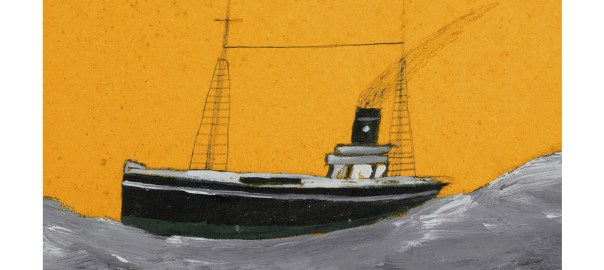
‘Johnny’s Gone to Hilo’ is a second single from composer and folk artist Roly Witherow ahead of a forthcoming EP set for release later this year. Roly’s rendition is a characteristically inventive yet mournful interpretation of the traditional sea shanty. The single also features guest backing vocals from celebrated East Anglian folk singer, Nick Hart.
Check out ‘Johnny’s Gone to Hilo’ on Spotify here
A prolific composer in the world of film, TV, and theatre, Roly’s credits have included Channel 4’s On The Edge, 2015 BIFA nominated film Gregor and David Hare’s The Permanent Way. His debut folk album ‘Ballads and Yarns’ attracted a slew of highly favourable reviews in the UK media and beyond.
As a folk musician and singer, Roly’s influences include Pete Seeger, Ewan MacColl, Peggy Seeger, A.L. Lloyd, Richard Thompson, Nic Jones, Pete Bellamy, John Martyn, Shirley Collins, Dick Gaughan, Lisa O’Neill and Will Pound.
Of the new single Roly says:
“Johnny’s Gone to Hilo is a sea shanty originating from the sailors of the nitrate trade off the Pacific coast of South America in the 19th century. Hilo likely refers to the Peruvian port of Ilo, and whilst the tone of the shanty varies a great deal in all its different versions and iterations – from drinking song to lament, I thought the melody of the song lent itself best to a sorrowful arrangement with guitar, harmonium and two voices. The backing vocals are provided by acclaimed local folk singer Nick Hart of the Nest Collective, who, raised in a family of morris dancers, is renowned for his evocative voice that is rooted in the folk tradition.”
“The recording of the harmonium with all its noisy stops, billows and pipes was a particular challenge for producer Joe Garcia, but, with some ingenious microphone placement, he managed to capture the instrument’s unique and idiosyncratic sound with tremendous accuracy and warmth.”
Speaking on his five-track EP, set to be released in Winter 2021, Roly added:
“The forthcoming album is a very new direction for me. If my first album, ‘Ballads and Yarns’ had an experimental bent, stemming from my experience as a film composer and combining traditional songs with electric instrumentation, spoken word and elements of world music, this new album has a “back to basics” approach, focussing on the song itself in its most minimal form. The vast majority of the songs are for just acoustic guitar and voice, and the recordings have a very live feel to them, realised in large part by the expert production of Joe Garcia of Joe’s Garage, in Bristol.”
“This new album also has quite a playful, innocent and childlike quality to it, influenced in part by the children’s songs of Pete Seeger, Ewan MacColl and A.L. Lloyd, but also by my experience of recently becoming a father. One of the songs on the album ‘Ernie’s Song’ is dedicated to my son. The album is a combination of traditional songs from the British Isles and further afield, and originals, such as this first single ‘The Bird and the Frog’. There are also some collaborations on the album, including with renowned local folk singer Nick Hart. The album in general touches on themes of rural vs urban life, family and growing up, love and love lost, nature and animals, industrialisation & mechanisation, death and religion.”
What they say:
“Witherow’s resonant voice sits beautifully against a spacious guitar arrangement”– The Times
“mixes up art-rock, atmospherics and folk on his personal project” – The Guardian
“a modern yet classic celebration of the art of folk music” – Folk Radio UK
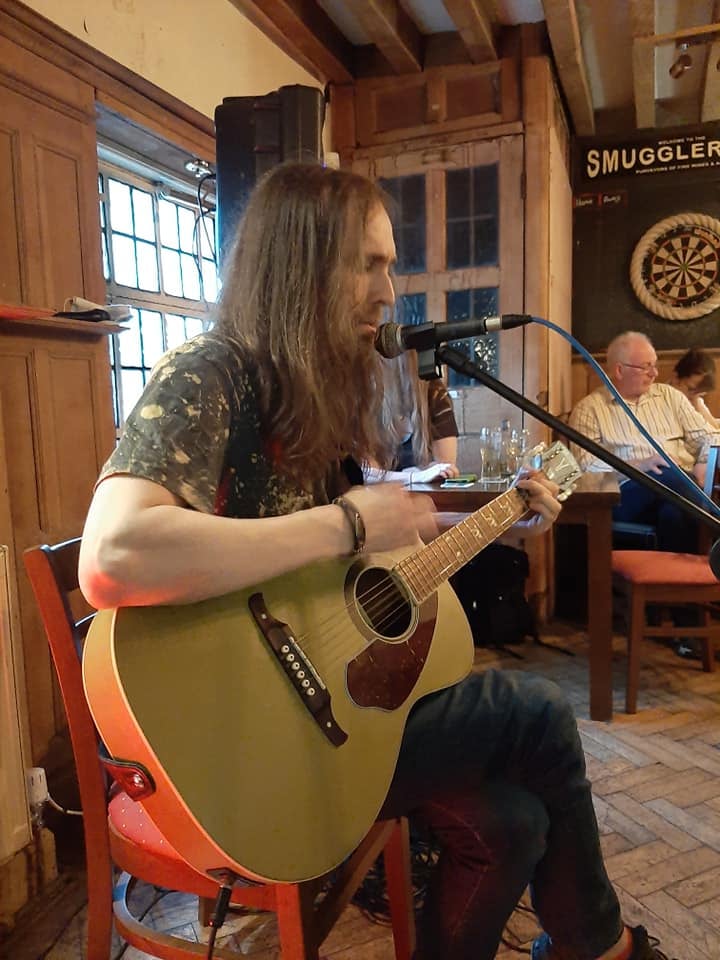
Guitarist/vocalist/songwriter Ryan O’Donovan, is a Sussex-based musician who has built up a solid reputation through the learning disabled music scene. Whether it’s providing backing vocals and guitar for Beat Express, vocals and lead guitar for Zombie Crash (both bands of which are managed by Brighton-based charity Carousel that facilitate learning disabled people in the arts), lead vocals for Lost Asylum or venturing place to place solo, as his favourite saying goes, he is always out to rock out.
During the past year or so through lockdown, Ryan has attracted a significant following through a variety of online events, hosted by the likes of Carousel, Gig Buddies and, most recently, Electric Umbrella – as well as his own regular ‘Rockin at Home With Ryan’ online gigs.
I caught up with Ryan recently to discuss his musical background, influences and what inspires his song-writing.
How I got into music:
The way I got into music was rather extraordinary. I did terribly at it in school and college, I’ve never done a good job of reading musical notation or scores, yet I always seemed to be able to pick up sounds, pitches and keys by ear and identify them that way, which made me a very projective type when using my voice. I can still remember one or two examples of feedback from teachers highlighting how I put the most effort in to singing during nativity plays (I was in a Church of England primary school). According to my mum, as a baby I was even able to sing back (or more so hum at that age) a tune on the radio in perfect key with it! I grew up seeing my dad’s guitars on the walls here and there and hearing him practice; around the time I was born, he had a short-lived stint as the lead vocalist of a band called Blue Parish, though he only got as far as one gig with them where he was plagued by stage fright and never performed in another gig. Still, it would later be an influence, as well as my mum’s brothers being guitar players in their own time. I even later on heard that my great-grandmother (mother to my paternal grandma) was involved in theatre.
As well as those influences, the music of Busted made me want to pick up a guitar all the more, as well as seeing the cast of Rock School get going as a group (albeit temporary) under the coaching and guidance of Kiss’s Gene Simmons. With a few pointers on the tuning of whatever guitar I could borrow from my dad, I started playing songs I knew when I was 15; not by looking up any tabs or scores, but by remembering what key the songs were in and played the notes from there. Anything else I learned in pointers here and there over the years to come.
My musical influences:
My influences as they are now depend on which band, or any kind of group capacity, that I’m active with. As a solo artist, my influences (in alphabetical order so that I don’t miss anyone significant) include the likes of Alanis Morrisette, Alter Bridge, Avril Lavigne, Black Stone Cherry, Busted, Def Leppard, Fightstar, Fozzy, Godsmack, Guns N’ Roses, Kid Rock, Linkin Park, Nickelback, Nirvana, Pearl Jam, Puddle of Mudd, Saliva and Queen. It was music I grew to love that typically involved heavy guitar playing to varying degrees – and made me want to be more and more of the sort myself.
What inspires me to write:
Aside from the musical influences of artists I’ve talked about as well as my family’s influence, there are varying inspirations for me to write songs. I started by writing an abstract collection of songs that had more fun with whatever was on my mind at the time. Then I wrote songs reflecting my insecurity with being a single man, in varying tones of looking at where I was both in a positive and negative light. Now I write about my own personal acknowledgements towards seasonal traditions, when not writing about my main life experiences in hindsight. But most of all, my main inspiration is how far I’ve come along, especially now that I’ve been playing guitar for half my life and only developed along the way as a musician, performer and individual. This IS my life’s main worth, as nothing else has stood the test of time with me like my way as a musician. And I have nothing else in mind other than to live this lifestyle to the full and make the most of it all. That’s why my saying is “Always out to rock out”.






 Darren's music blog