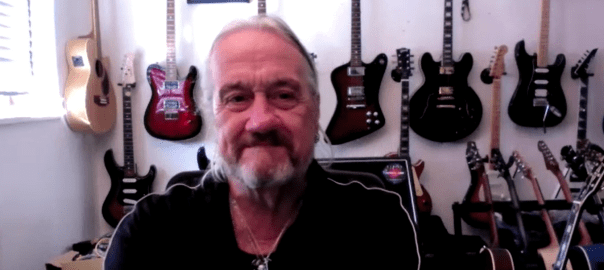
Back in the early 70s, David Smith formed a band with a former school-mate called Steve Harris, better known as the man who went on to create heavy metal icons, Iron Maiden. I catch up with David to talk about those early days playing with Steve in Gypsy’s Kiss, about reforming the band back in 2018 and about the enthusiastic response from both fans and reviewers to the band’s live gigs and recent album.
So back to the very early days. Steve Harris was a schoolfriend. When did you decide that you both wanted to be in a band together?
The middle of ’73 – when the world was in sepia, Darren! I had left Leyton County High School for Boys. Steve was also a pupil there but the year below me… And we met up after we left school – accidentally, I would say in the middle of 1973, because we knew each other and we had mutual friends. Our interests were aligned. We were both fanatical West Ham supporters. We loved football. We both loved rock music and, interestingly, we’ll come on to this – the influences for Steve and myself at the time were not always what you might think. They were obviously rock – but tons of prog and lots of other things.
It was a great time for music across all genres!
If you looked at an albums chart or even a singles chart between ’72 and ’74 you would be amazed that it’s the music people still listen to today. Because it’s so damned good. So, we became good friends. We’d see each other three or four times a week, we’d go to the pub together. We’d talk about music. We’d talk about football. We’d share the bands we liked and we’d go and see a lot of gigs together. And then it would seem natural… “Why don’t we form a band?”
I played guitar for about two years before that. Steve wanted to be a drummer but couldn’t get drums in his nan’s living room which is where we rehearsed. Where he lived in Steele Road about half a mile from where I lived. And so, you get that lightbulb moment: “I think I’ll be a bass-player…” Well, there you go. And that’s what he wanted to do so he and I went to – I wish I could remember the shop we went to – and he bought a Telecaster copy bass. And I taught him the rudiments because I could and then he took it from there.
And then, we must form a band! This band was just he and I for a month or two but we still rehearsed and we did mostly covers but not all because we were writing stuff, as you’re probably aware. Stuff that we’re still playing now and Steve references quite a lot. And so, we were doing that and we looked at other guitarists and we looked for drummers and eventually we decided to have only one guitarist which was me. And then we found a drummer. His name was Alan – I can’t remember anything more about him and there were, essentially, three of us in Influence [original band name prior to the adoption of the name Gypsy’s Kiss].
And for reasons why bands evolve, particularly when you’re only 19, we brought in Paul Sears on drums. And Paul is still one of my very best friends today. And then we rehearsed quite a bit and rehearsed in front of family and friends and did sort of pseudo-shows. I then wanted to concentrate on playing guitar more and I found singing and playing guitar a bit of a distraction so we brought in Bob Verschoyle and Influence became Gypsy’s Kiss.

And it became really clear – and the reason Gypsy’s Kiss dissolved away I would say in the summer of ’75 – was because Steve was a workaholic. He just wanted to rehearse and rehearse and rehearse. Like he is today. Rehearse and rehearse and play and play. And you know, “We can’t go out for a drink. We’ve got to rehearse this song”, “Oh, we’ve got to write that.” Paul and I had enough of it really at 20 years old and then Steve moved on. And when I saw him recently, I always reference his work ethic which he’s got right now.
You obviously saw the work ethic; did you get an impression from Steve early on at that stage that here was a Bonafide rock star in the making?
No. Because I wouldn’t know what one of those looked like to be honest. I saw them on album sleeves and at gigs and on TV. No, what he had and still has was a drive. I don’t think his ambition was to be the greatest rock bassist ever – but he’s in that league isn’t he? I think he wanted to be a professional musician. That’s what he wanted to be. And he wanted to be a good professional musician. And if you look from when Iron Maiden was formed in ’75 and, without being harsh, they didn’t do much for five years. Honing the craft, getting better, doing gigs.
But the thing about that period – and I played in other bands – is that there were so many places to play. And every place wanted an original band. Chuck in a few covers if they didn’t have enough of their own material. And so Iron Maiden and other up and coming bands, gigged and gigged and gigged and gigged. And they got so good at playing that the rest naturally followed. So, the long answer. Did I think he was going to be a rock star? I don’t think so – maybe he did. But he certainly had drive and that’s the most important thing.
So, Gypsy’s Kiss ran through ’74 and into ‘75. You were playing a mixture of covers and writing original songs. Did the drive to write original songs come from yourselves because you had that ambition or was it more that this is what the venues were expecting?
No. This is what we wanted to do. I don’t know if bands are the same now but bands who want to – not make it – but just wanted to do well and perform to audiences, we always wanted to write our own songs. In fact, we were writing stuff, or I was at first, and playing that. And when we started to get gigs after that it was, “God, we’ve only got half an hour. We’ll have to do something else.” So, we threw in… you know good covers. Ones that everyone was doing and a few that they weren’t doing and it filled out our hour-and-a-half set. So, then the set was based on the originals and there were about six or seven covers that we used to fill.
So, yes – our ambition was to write and record our own stuff. Steve’s done thousands of interviews. You’ve already read many of them. But one of them came up quite recently… and Steve said that when Gypsy’s Kiss folded, he joined Smiler. And the reason he left? Because they were doing too many covers. He wanted to write and do his own stuff.
When Gypsy’s Kiss came to an end did you always carry on playing in bands after that or was it just a matter of getting on with life and focusing on the day job and stuff?
Probably always in a band. You have some years where you lay off doing it and then go back. But when Gypsy’s Kiss came to an end, oddly, I was invited to join a country and western band. And I joined – you know Stetson hats and bootlace ties and satin trousers – and I was 20! And I played bass, by the way, which is even more weird! But it was twenty-five quid a night for me which in the mid-70s was actually quite a lot of money. So, I did that and then I went with other bands. I played in a band with Doug Sampson who was in Iron Maiden for a bit. And then I did other bands, other things, years off here and there. Yes, so pretty much all the time. I’ve probably been whatever full-time means now, i.e.: doing it constantly since the mid-90s.
So, let’s move on to the band today then. You reformed in 2018 for the charity gig, Burrfest. That was initially just as a one-off. How soon after that did you decide to make things permanent?
I’d been asked to reform Gypsy’s Kiss – out of Iron Maiden fans’ curiosity. I’d say more with an explosion of information online. Lots of people became curious and I was asked a number of times to reform some version of Gypsy’s Kiss. And I didn’t want to. Because I thought it was yesterday and it wasn’t right. Bizarrely, I was in a covers band from 2010 to 2017 – quite a reasonable one. And we played a gig in Gidea Park in Essex and without going through the boring details all of the original Gypsy’s Kiss members – including Steve – were there. He came to see us. Along with Teddy Sherringham, the footballer, for some bizarre reason. And during that gig, at the end of it, I said, “We’ve got friends here from my musical past. Do you mind if they come up and busk a song with me?” The band I was in didn’t mind. So, I got Paul on drums and Bob to sing – and I didn’t invite Steve to come up and play bass. The reason being it was already full of people filming. I thought, this is the last thing he wants. Everybody loved it. I’m sure it’s online somewhere. Steve came over to me at the end and he went, “I’m upset you didn’t ask me!”
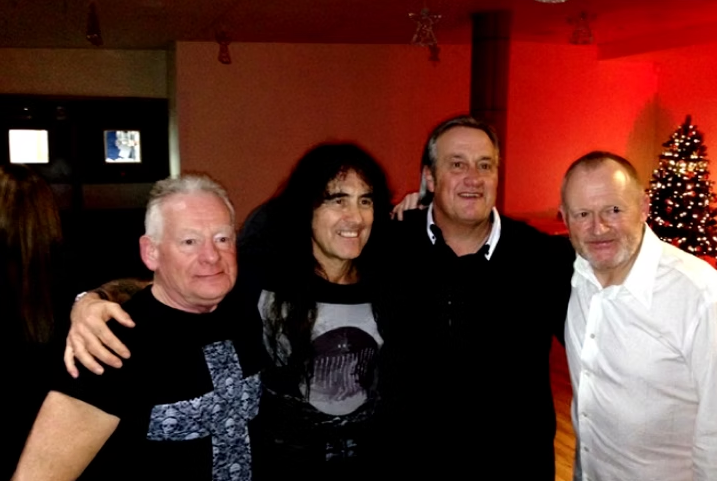
And you were trying to give him a quiet life!
I was trying to not put him in an online spot. So that was 2013. And I’d been asked a number of times. Darren. I just didn’t want to do it. However, I buckled to the pressure in 2017. And it was, “Would you play Burrfest?” I think it was in the March 2018 and I went, “OK.” I asked Paul to play drums. He didn’t feel up to it at the time. I asked Bob to come and sing. And, again, I didn’t ask Steve – and he’s moaned at me about that since!
So, using musicians I knew locally and whatever, I put the band together. A real one-off. And it was such a great gig. The audience’s reaction to this thing that they wanted to see – and they wanted to hear some of the original songs that Steve had played on – was just amazing. And I sort of thought, well this is a bit silly , not to do this again.

Obviously, our fanbase such as it is was Iron Maiden fanatics. Probably still is. But we’ve worked really hard to try and widen that and maybe we have. You’ve probably seen – and I still use it when I find it helps – our tagline ‘top of the Iron Maiden family tree’. And if we’re doing something specialist, we do occasionally play some Iron Maiden songs. The early songs. We’ll do one or two of those if the audience is clad in Iron Maiden t-shirts. It seems a bit churlish not to, doesn’t it?
And no way would I ever forget the past because it’s why the band exists but you try and move on. In saying that, I got very, very friendly with Paul [Di’Anno – former Iron Maiden singer] again about five years ago. Because we had the same interests – rock music. He was born just up the road from me. We went to the same school. We knew the same people. And we met up – I went round to his flat – and we chatted for ages about stuff. And Paul and I became really, really good friends. And we did gigs with him and, you know, his loss was enormous. He was such a nice guy. And when we did some gigs with him it was huge fun. And his passing – his funeral was a bit of a celebration really, as it should be. At the service Maiden songs were played which was quite touching. And the point I’m getting to now is, I sang a few tribute shows as Paul after that. I really enjoyed it… So, I’ve not completely forgotten the past but we do try and shuffle on.
I think if you’d had a grand plan for all this over a fifty-year period, you chose a good time to reform in many ways, with a renaissance for classic rock on the live gig circuit.
What I’m most grateful for is the period I was born and grew up in which was just so changing, so iconic, so wonderful – for me anyway – from the flow of music from the ‘60s to the ‘70s. You know, in my formative years I was able to grow up with some of the most fantastic music and great influences. That’s what I’m really grateful for.
And then, as you say, as you get into your dotage, if you reform there’s been a resurgence in classic rock. And what we’ve tried to do – I hope we’ve succeeded in a small way – is to take that fantastic genre and to slightly update it. Without losing its heart. And so, you give the audiences what they want but something a little extra. And we certainly have elements of prog in our songs. Our third album is coming out this summer – it’s not quite finished – which I’m really pleased with.
But I think essentially, we are a live band. You know, we ham it up a lot on stage. We swear a lot. We’re involved with the audience. That’s what I think we are – a live band but we try to bring out our diverse musical influences, based on classic rock.

You must be pleased with the reaction to the 74 album which I think very much stands up on its own terms, regardless of any historical Iron Maiden connection.
That’s very kind of you and, interestingly, a lot of reviews said the same. If I’d have gone back to 1974 and thought, one day, David, your album will be reviewed in Classic Rock and people will say what you’ve just said – it’s not a curiosity of Maiden, it’s a stand-alone band – I’d have thought, well that will be good. I’ll take that as a pinnacle of one’s career!
Yeah, we were really pleased with 74 and I still am. And it’s the basis of our set for the new album – which hopefully will be out in July. There’s some of the past in the style of music. We can’t do an album that doesn’t have a gallop in it somewhere because that’s how it all happened. So, there’s, what I would say, more retro songs and some that I think are probably more up to date. But you know we’ll see. I just enjoy playing stuff live to be honest… I would say that’s why any musician wants to do what they do because there is nothing like standing on a stage in front of a number of people – it doesn’t mater if there’s twenty or thousands – and you enjoying what you’re doing. And if you get one person in the audience who looks like they’re having fun I find that great.
In some of our earlier Gypsy’s Kiss gigs, once we’d been a few years in. I still found it quite odd that people in the audience were singing back the lyrics that I’d written probably knowing them better than I do. And I still find that quite a sensation.
I think that’s also testimony to the skill of writing really catchy songs that instantly grab people’s attention. That is a skill.
That’s very kind. You’ve probably heard in our music – and it’s where Iron Maiden evolved down a parallel track – is that I was brought up on Wishbone Ash and Thin Lizzy. You know, guitar bands, harmony guitar bands. And like Iron Maiden, we are three guitars doing guitar harmonies and rock riffs. I get asked, “Who do you think you’re like?” Well, I think we’re like ourselves. But I hear in our writing and playing, bits of Wishbone Ash and Thin Lizzy, bits of Uriah Heep. And I’m not ashamed of that at all. That’s the music I grew up on.
So, what next for Gypsy’s Kiss then?
It crossed my mind, thinking of age and circumstances that last year was our 50th year which we did quite a lot on and it went really well. And I did wonder whether the 50th was a good time to stop doing it – and we’ll see what Iron Maiden do after 1975. But I said, “Ok, we’ll do another year.” So, this is out 51st anniversary tour and we’ve got a lot of gigs already confirmed.
I enjoy festivals more than anything because I can listen to other bands and you just enjoy the vibe and you meet all the people there so we’ve got quite a number of festivals. The album coming out in July, I hope. Gigs start in April and run through until end of November so we’ll be here there and everywhere. And I’m looking forward to it. The live stuff is what we all look forward to and we’re three times this year back at our spiritual home. I say the Cart & Horses is actually the birthplace of Gypsy’s Kiss rather than Iron Maiden.
Well, you came first!
We did our very first gig there. We’ve got three gigs there. You’re probably aware, we’re playing at a midnight show at the Cart & Horses after the Maiden gig fifteen minutes up the road – which sold out in about fifteen minutes. It was really quite odd! But we’ve got other gigs at the Cart & Horses and we’re doing a short tour with Soulweaver. We’re doing about five or six gigs with them because we get on well and the music’s complementary, I think. And we’re doing a few gigs with a prog band called Ruby Dawn who are really, really good. So yeah, we’ll be here there and everywhere, with an album to flog in the middle of the year.

Forthcoming Gypsy’s Kiss gigs here

Related posts:
Live review: Gypsy’s Kiss / Praying Mantis at the Carlisle, Hastings 2024
Live review: British Lion at Blackbox, Hastings 2024
Behind the mask: interview with Thunderstick’s Barry Graham Purkis


 Darren's music blog