I’ve been to several memorable gigs at the excellent dedicated live venue adjoining the Brunswick pub in Hove but until I turned up on Sunday afternoon I’d never even realised they also had a downstairs cellar bar venue. It was here in this small, sweaty cellar that the recently-formed X Generation X played their debut gig. As the tour’s official warm-up gig we were treated to a short but explosive set, followed by an equally lively band Q&A and some impassioned reflections from some of the old punks in the audience recalling those heady days of the birth of punk.
Read my interview with X Generation X’s Mark Laff here
A few hours later we’re back in that same tightly-packed, low-ceilinged venue for a full-length gig and an even more explosive performance. Assembled to mark the coming 50th anniversary of punk and to celebrate the music of Generation X, the band features Generation X’s own Mark Laff on drums, Spandau Ballet’s Steve Norman on guitar, Westworld’s Elizabeth Westwood on vocals, Vice Squad’s Michael Giaquinto on bass and, as a late addition, James Stevenson from the final Gen X line-up also on guitar.
Mark Laff shares memories with fans during the Q&A
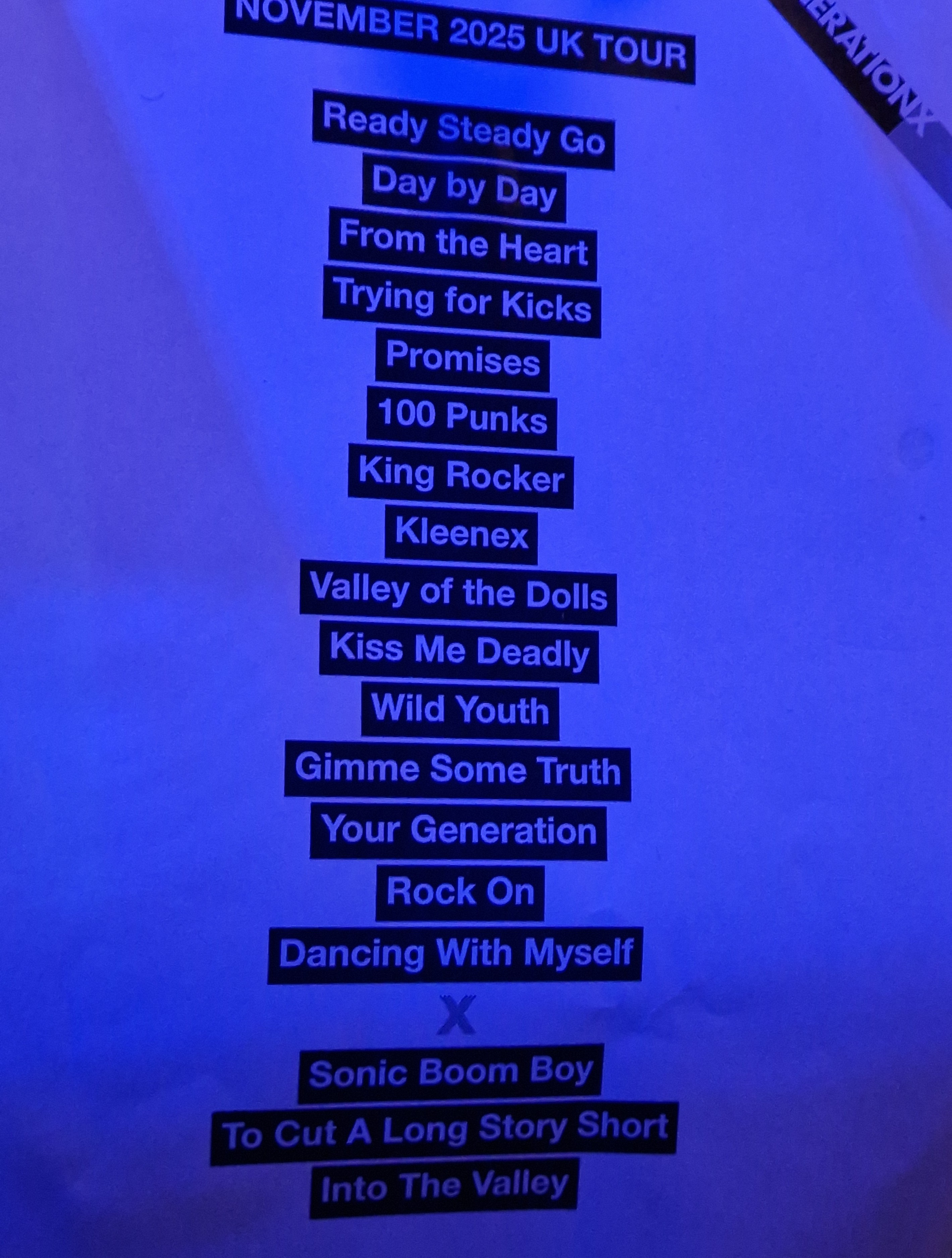
Kicking off with punk anthem ‘Ready Steady Go’ and with Norman and Stevenson cranking out those fast and furious riffs, it’s the perfect opener and Westwood immediately proves herself to be an inspired choice to front this project. She’s not trying to be Billy Idol, of course, as Laff himself noted when I interviewed him ahead of the tour. But she truly inhabits the spirit of these songs with energy and verve.
Elizabeth Westwood
The earlier part of the set is heavily dominated by songs from the first Generation X album and a thunderously tight Laff and his bandmates more than do justice to old favourites like ‘Promises Promises’, ‘One Hundred Punks’ and ‘Kiss Me Deadly’. There’s a couple of songs from the second album, Valley of the Dolls, thrown in as well though: the title track and ‘King Rocker’, introduced by Laff as his “biggest hit” – the only Generation X single to almost make the Top Ten. Throw in the essential early singles, ‘Wild Youth’ and ‘Your Generation’, a couple of deep cuts in the form of a cover of John Lennon’s ‘Gimme Some Truth’ (originally recorded as a B-side) and Gary Glitter’s ‘Rock On’ (originally recorded for a Peel session) and you’ve got the perfectly-curated Generation X set-list.
As things begin to draw to a close there’s one song left that we’re all expecting and we’re not disappointed. The band launch into a wonderfully raw and frenetic version of ‘Dancing With Myself’, from the third album and the album that Stevenson recorded with the band before the song went on to develop a more familiar life of its own outside of the confines of Gen X.
Steve Norman and James Stevenson
We’re then treated to an encore of Westood’s own “biggest hit”, Westworld’s ‘Sonic Boom Boy’, along with a cover of Norman’s debut hit with Spandau Ballet ‘To Cut a Long Story Short’ and a cover of the Skids ‘Into The Valley’. It’s an unforgettable gig and an energy-packed night to kick off the X Generation X tour in style.
Making light of the seeming incongruity of launching a UK tour on a Sunday, Westwood asked the happy but clearly refreshed crowd at one point if they all had to be up in the morning. “No!!” the crowd yelled back in unison. “They’re all retired!” quipped Steve Norman. That’s as maybe but for 75 glorious minutes it was 1976 all over again and here in this sweaty cellar bar the spirit of punk was recaptured in all of its incendiary glory.
In November, Generation X drummer, Mark Laff, tours with his new project X Generation X – featuring Mark, alongside Westworld’s Elizabeth Westwood on vocals, Spandau Ballet’s Steve Norman on guitar and Vice Squad’s Michael Giaquinto on bass. I catch up with Mark to discuss the emergence of punk, the rise and fall of Generation X and the forthcoming UK tour.
So, the first question: we’ll go right back to the beginning. It’s coming up to 50 years, what are your reflections on the emergence of the punk scene in the UK in ’76?
For me, at the time, it was a situation whereby you felt with the bands that you liked, they had stepped across a great divide. And you really were not connected anymore. So, when the punk rock thing came you had an opportunity to get involved or not. I took the chance to get involved.
The emergence of it was incredible for me. I was a big fan – I still am a big fan – of the Sex Pistols. All the bands to me were making a statement, which I felt I could connect to and was, most importantly, really exciting.
Mark Laff – Photo Credit: Olga Rozewin Photography
After playing with Subway Sect, as punk was taking off, you then got a call to join Generation X in time to make their first album. How did that come about, moving from Subway Sect to Generation X?
Well, I won’t pass this one lightly because I’m eternally grateful to all the members of Subway Sect and The Clash camp for almost parental guidance, really. Subway Sect was a wonderful opportunity and great guys.
I think what’s important to say, just for the record also, is that I auditioned for The Clash the same day as Topper Heaton did. And Topper got it. I didn’t. And they liked what I was doing and offered me back to another situation, which I initially was told was with a guitar player, Keith Levine. But over the weekend, the Subway Sect drummer had left to join the army. So, I did the audition with the guys. Really liked it, went upstairs to Bernard (Rhodes – Clash/Subway Sect manager). And he said, “What do you think?” I said, “Yeah, let’s do it”. And he said, “Have you got a passport? I said, “No.” He said, “Well, can you get one by Wednesday? We’re going to Paris on Thursday.”
So, it was a dream come true from playing the drums at a really early age. And to be thinking those things maybe aren’t possible. To be in that situation where somebody says, “Get a passport, you’re going to Paris.” I’d never been abroad, Darren!
It was incredibly exciting. You had the Buzzcocks. You had the Jam on some of the dates. You had the Slits. You had the Subway Sect, and of course the Clash. This was like watching the future happen all on one night!
So, hearing the Generation X tape, I thought I really like that. So halfway through the tour, I was at Dingwalls in London. And who was there? John Ingham, who was the manager of Generation X. And we got chatting, and he said, “Why don’t you come down?” So, there was a little gap in the middle. I went for an audition. I didn’t hear anything back and I was just pleased that I went really because I was making myself available. I decided within myself that I probably wasn’t going to stick with the Subway Sect for a period much longer than the tour. And it really was just a musical thing. I wanted a bit more chaos. So, the tour started, I think, in St Albans and Tony James came up to me and said, “You’ve got the job.”
So, I finished the tour and literally we finished at Dunstable – California Ballroom. The drum kit came off the stage into the manager’s car and we were off. It was a seamless transition from one band to another.
And you toured with Generation X and then you made the first album?
Well, there were some rehearsals to be done and… actually the first few dates weren’t too successful. We were falling a little bit flat. And as it happened we ended up at Dingwalls and it all clicked. And record companies were there and the interest started. And yes, the rest is music history, I suppose.
We tried to stick with our first plan, which was to work with high-end engineers who knew their stuff. And we went in to do ‘Your Generation’, which was always gonna be the first single. I really liked that song. And ‘Day By Day’ was the B-side. And it didn’t work in the studio. We kind of realized, everybody realized, that the song was just falling a little bit short. We kind of thought, well where do we go with this? So, in discussions with the record company, Chrysalis Records, we decided to go with a guy called Phil Waiman who had, at the time, a real notable resume.
Yes, Sweet, Mud, Bay City Rollers and all that from the glam era a few years before.
And he was a drummer and he knew what he was doing. And we got to record… four songs, three and a half really. Well, we did some more but it just wasn’t clicking. It wasn’t clicking, I don’t think, with Billy and Tony with Phil. Probably a little bit too sweet-sounding.
So, we ended up with Martin Rushent. I don’t mean that to sound as a failing, Martin was fantastic in creating ‘the room’. He was like almost the fifth member of the band in terms of conversation and making sure everyone was happy. Just getting it to feel good in the room because, you know, we were young guys then, 18, 19. Tony was a lot older, but we were still young people and a little bit naïve. Wet behind the years with it all. So, he created a great feeling. And I think that’s the feeling that people really like after all these years on the first album.
It absolutely stands up as a classic rock and roll album. Absolutely.
Thank you very much.
And then looking at the second Generation X album, I believe you clashed with producer, Ian Hunter, in the studio. Ian is one of my all-time musical heroes so I will be fascinated to hear a little bit about this (laughs). But was that a frustrating album to make and was that the beginning of the end in terms of your involvement?
Yes, yes and yes are the short answers. But I will colour it in for you. I should say that we arrived at that situation with Ian Hunter because we’d released ‘Your Generation’, which did well but it didn’t chart in the Top 30. And we went with ‘Wild Youth’ – which again did well, but it didn’t chart Top 30. You’ve got to understand we signed a very big record deal that year. I think it was the biggest record deal of the year.
Then we stuck out ‘Ready Steady Go’, which did well again, got a lot of radio play. It was a real fans’ favourite, but it didn’t chart particularly well. We were aiming for Top 30. All of these got Top of the Pops performances so the record company dug deep and suggested that we go with somebody that we liked. Tony and Billy were all over the Mott The Hoople thing. I thought they were okay. It wasn’t my favourite band. I had a couple of records but I understood the process there.
We were all asked who should produce it. I went out on a limb and said I think Jimmy Page should produce us because he’ll make it sound incredibly different and very, very rock and roll.
You could already feel that commerciality was coming onto the table. “We’ve got to get commercial. We have to have hits to pay back the debt so that we can blah blah blah…” And especially America. So, Ian came in, and it was a rehearsal room in Camden, Chalk Farm I think. Atlantic rehearsal rooms.
And we worked a song. Ian didn’t like my drum kit. It was a Premier drum kit, and he said, “This is shit. You need a Ludwig.” Because his drummer had a Ludwig and they obviously sounded much, much better than mine. And Ludwig drums do sound rather sweet, especially the maple ones. So, he said, “Get yourself a Ludwig kit.” And, of course, I didn’t have the money for that. Ludwig drums are an absolute fortune, so it was a very difficult situation for me. We had to record the drum track three times. So, I had to layer it, layer it, layer it. You’ve got to understand here, I’m 18, 19. This is all too much for me, you know? It would have been too much for Phil Collins! Plus getting the right feel and not playing together was a different dynamic to control for me and for everybody else.
So anyway, we came out with ‘King Rocker’, which was a hit record. Very successful. So, everybody suggested that we move forward with Ian and go again. We did a second single called ‘Valley of the Dolls’. I was under pressure again. He wanted this four-on-the-floor, with a drum machine. There were no proper drum machines at the time, so I had to listen to this bossa nova beat and try and play a straight rock beat over that. So, it was a hellish experience, once again. I really like that song, I really like both those songs, ‘King Rocker’ and ‘Valley of the Dolls’. Playing with the drum machine was a bridge too far for me at the time.
We got it done. I was happy with it. He didn’t like the fact that it was taking that amount of time to do it. We got it done in an afternoon, but he wanted it done in three takes. So, I was at home one night. I think we’d been just rehearsing and I got a call very late in the evening about a band meeting. I think it was like one o’clock in the morning. Ridiculous you know. I went across and I was told that Ian had said, “Look, there’s a deal on the table for you here. We want you to seriously think about this.” Ian’s take on it was he didn’t want to spend that amount of time on the drums. I understand that. He felt that time was better spent on Billy’s vocals, and certainly the guitar playing. I get that. The deal was three takes. If you’re not done in three takes, we need somebody else to come in and do it very quickly. So, I was under pressure again to do this. I was given a choice of either Clive Bunker from Jethro Tull…
…and listen, punk rock fans don’t like to hear it, but I like Jethro Tull. I really do. Some of the songs, they are fantastic, especially the early stuff…
So, I had the choice of either Clive or Paul Thompson – Roxy Music. I don’t think Paul was available so Clive came in and was very, very supportive. He saw the pressure. He understood the situation and it was a pleasant working relationship with him and me. So, I think I did all the tracks and Clive did some tracks, and we did some tracks together.
And I was in a strange situation, Darren, because I’d be playing the drums, with Clive over there playing, and I’m thinking, “This is nuts! Why is he recording two drummers?” It was a bizarre situation. What really threw me off was that I was very emotionally involved in terms of influence with a drummer called Keith Moon and I think within the first week of doing the album he passed away. And it was a shocking experience for me. I was really, really upset. It was like, I hadn’t lost a close family member but it felt like the removal of someone very, very special – the whole thing you’re never going to see them again.
We’d just recently been rehearsing and Billy was at one function – I think it was Paul McCartney’s – I can’t remember what it was. Anyway, Billy very kindly brought Keith Moon down to the rehearsal room to see me. He came with Graham Chapman from Monty Python. So, I’m at the back of the rehearsal room, and in through the door I could see it’s down there, you know. I thought, oh my God it’s Keith! It’s all the crazy stuff that you feel, you know. And Graham Chapman walked in and Keith sat at the drum kit, and they did three songs with the band. It was absolutely incredible. He broke the bass drum pedal. Fantastic! He wasn’t in great shape, bless him, at the time. You could see he was suffering badly and he was only 33, I think. And it was kind of sad to see. And he was bloated, and there was obviously medication going on there which wasn’t helping.
And for Keith to die at that period was, well, it’s the death knell for me. I lost a lot of enthusiasm for doing that album, and it became a chore to me. But we got it done and it was well received to a point.
It was a transition process. We all knew that. That it was going to move away. We weren’t going to do the first album – part two. For Bob Andrews, it was a direction in the wrong direction, in that his influence on that record was not recognised copyright-wise. Neither was mine. I think he’s only one credit, which is ‘Running With The Boss Sound’. Which is shocking, really, because Billy and Tony should have sat down with the two of us and said, “Look, this is what we’ll do.” Come up with some arrangement.
The band was polarised anyway, and this is important, in that there was a class divide. Myself and Bob, you’d have to say, were working class. I came from a council flat, albeit a very posh one, Darren! Bob was from a working-class family, and Billy and Tony were middle class. So, there was a university divide there, if you will.
So that created a problem in itself as time went on and I think, possibly, Bob pressed the mute button. Became silent, non-responsive. And had he spoken up, he would have got what he wanted because I think what’s important to tell you here, Darren, is that Bob Andrews was by far the best guitarist in town at the time. 17, 18 years old, playing that stuff. Incredible. There was no one around to touch him, not within the punk rock thing, and he’d wiped the floor with a lot of notable guitar players. And I’m not blowing his trumpet. I don’t need to. That’s how it was.
But he pressed the mute button and went further into reclusive behaviour. And it was a divide of me and him, and Billy and Tony. And it made things a little bit uncomfortable to the point you could feel it. You could feel it where it was going to break and it eventually did break after a period. A very short period after the album. We did tour that album, and it was fun. The irony here is that that was meant to introduce us to America. We never went to America, sadly. Billy went on a promotional visit, but that was it. During this time, also, there were very uncomfortable managerial problems. We lost John Ingham because he had an argument with Tony James. And Tony wasn’t going to be listening to any of that so John had gone.
Time went on I think in ’79 and Bob decided to leave and I thought well that’s probably it. I can’t remember that period too much, other than speaking to him and he’s saying, “It’s not happening… blah blah blah.” All the usual suspects of why a group splits up. You know somebody in a band that you don’t like at all wants to bring in the influence. You’re thinking, “Well this is not where I want to go.”
Also, it must be said that we were still growing up at that time. 18, 19. You’re not fully formed. And Tony, being six years older than us, he was ahead of the game. And was using that to his advantage, I think.
In fairness they went to Bob and said, “Look, come on. We can probably sort this out.” And he decided to come back. And we went to Japan and tried to do a third album. We went into Olympic Studios in Barnes with an engineer again. We’d reverted back to the initial idea. What was coming through the speakers wasn’t sounding great. There were some good songs there. ‘Dancing with Myself’ was there. We’d done that. Done enough stuff for an album which we’d had rehearsed. We’d all gone away for a week to Banbury in Oxfordshire. All being together and trying to make it up, if you will, which kind of worked. At this time, I think Billy was finding the frustration of the non-communication and the lack of response to his ideas not working.
It was uncomfortable for us to be together. And Bob decided to go again. We came into the end of the year. I thought, “Well, I’m just going to have to wait for the call here and see what happens.” Rather than throw the hat in. So, I went to Chrysalis Records one day only to find Billy and Tony in a management meeting with the record company. I thought, “Well, that’s it. It’s done.” So, it was done. It wasn’t a big surprise but there was some hurt there that it could have been done a lot better than that. So that was it.
Unfortunately, matters got worse with the band in that Billy and Tony decided to hang on to the equipment. Made us all sign the disclaimers for God knows what. And we parted company. And then, as you know, Billy and Tony recruited Terry and James for a tour. Then, I’m told from Tony that he found out that Billy was on his way to New York without saying goodbye. So, there you have it.
Billy obviously went on to stratospheric levels of success as a solo artist. Are there regrets that it wasn’t Generation X having that kind of success and longevity? Or do you just feel that there were so many personality differences, musical differences or whatever, that it could never have worked anyway?
I think the latter really, Darren. I still had this yearning for craziness. And we were going down the big commercial route now. We were trying to find formulas. And with the influence I had, that was all getting quashed. And Bob felt the same. It was all getting a bit – and this isn’t a slant on Billy – it was all getting a bit ‘Mony Mony’. I mean, I’ll go on record as saying I think Billy’s Rebel Yell would have been the album that Bob and I wanted Generation X to do.
Interesting, yeah. I can see that.
That’s what we would have loved to have done. It’s a fantastic record, as you know, with those songs. And so it’s ironic that Billy would have to go to America. I mean, he tried with ‘Mony Mony’. Please don’t think this is me having a go, and I’m very pleased for his success. He tried with ‘Mony Mony’, which wasn’t a particularly good hit. Met Steve Stevens via the Kiss manager, Bill Aucoin. Hugely influential in Billy’s career, it must be said. Bill Aucoin introduced him to so many different aspects of how to be a star, and you can see that he became the Billy Idol that people know him for today. It certainly wasn’t the Billy Idol that was in Generation X. So, a total change of character, if you will, to meet the American market.
The Americans love guitar bands. A pop thing could be very momentary, so for longevity the big rock thing – which Rebel Yell really is – a big rock album with some great commercial songs on it. And you know the following one Whiplash Smile I thought was really good. He tried to go into a more European feel with Keith Forsey, with the big drum machines all going on – but still with a big rock guitar with some great tunes on there.
And it must be said that for anyone that doesn’t know, Tony wrote the words and Billy came in with tunes, you know, or chords I should say. And some songs. And it was all coloured in by the band. So, I think Billy felt frustrated at the time that we were together because the journalism at the time was vicious, to say the least. If they wanted to kill you off, they would. You had some notable people at the NME, Charles Shaar Murray, who wasn’t shy in saying what he felt, Tony Parsons, Nick Kent. I think Nick Kent liked us, actually, but we were savaged in the press. I think because of the Pistols having their facial was totally different to a Generation X facial. It was a pretty boy thing versus ‘don’t bring that boy home’, you know? Yeah, so there was frustration in the press as well, but we would have got around that.
I think had we gone to America, it would have broadened our horizon. We would have understood a lot more about how it should be, but it didn’t happen, Darren. You know it was meant to be the way it was meant to be. So, I would have to say I blame that on management, who’d have another story to tell but we should have gone to America. Everyone had gone to America. The Damned had gone, the Clash had gone, Pistols had gone famously and ended up in San Diego. Susie had gone. We hadn’t, you know. Went to the Isle of Man!
Credit: Olga Rozewin Photography
So, to bring things right up to date now, what do you want to tell us about the X Generation X tour in November?
Well really for me, it’s wanting to be a part of the 50th anniversary of Punk Rock. I wanted to do something in 2019 with Bob Andrews and another group that I was in, Twenty Flight Rockers. And obviously we know what happened in 2020. So, two, two and a half, three years ago, I thought, what should I do? And I thought, well, we’ve got this anniversary coming up. It’s going to take me a while to find the right people to launch it.
And there is nobody going out there doing Generation X songs. I think it’s the right time for me to do that. And I think people will appreciate seeing it. There’s no Billy Idol. I’ve chosen female singers to front it. I think the comparison would be too difficult. I think Billy Idol’s shoes – although a small foot – probably a nine – they’re probably still too big to fill, you know. To get a guy in. So, I see this as a rolling thing of maybe working with different musicians in the X Generation X thing over the next few years and just trying to enjoy it really. And I feel that it’s very relevant today. The way things are in the UK at the moment is there are similarities to be drawn on, with the political side of things which are happening.
X Generation X – Photo Credit: Olga Rozewin Photography
Absolutely, yeah. A blast of punk could do us all the world of good! I actually think this kind of template you’ve got with the band is a is a great way forward for celebrating the music of iconic bands. You’re not a tribute band. You’ve still got a connection to the original band. You’ve got great professional musicians who come with their own CV and their own admirable track record. No one is dressing up, pretending to be Billy Idol or whoever. So, I think that’s a really good template for authentically celebrating the music of an iconic band like Generation X.
That’s very kind of you to say so, Darren, and it gives me a lot of inspiration to hear that It’s very hard to be in a band these days because the music industry, the way it is, everybody’s so busy in other projects. So, I’m left with no choice but to use other musicians in the future, really, because people aren’t available. We’re lucky to have all of us available at this time to be able to do it. So, Steve’s particularly busy with his own career; has been for some time. Elizabeth is incredibly busy. And Michael is seeking employment— I’m kidding! Probably the nicest guy in the band, actually, Michael. Why does he have the most ribbing? I don’t know. No, Michael’s fabulous. He makes me sound good, so I really appreciate what you said there. Are you going to be able to come to any of the shows?
Yeah, I’m going to be at Hove. Because I’m based on the south coast in so I’m going to be at Hove on the first night and very much looking forward to it. Is there anything else you want to say before we wrap up?
Hey, listen, come and check it out. This might be the only time you see these four people do this this which is exciting in itself. Makes it sound a little bit like a theatre production but it’s not at all, it’s really a rock and roll thing. But it’s going to be exciting. It’s going to be loud. Thunderous. Angry. And yeah, I hope people enjoy it!






 Darren's music blog