
NWOBHM legend, Barry Graham Purkis, resurrected his Thunderstick persona back in 2017 and released a critically-acclaimed album, Something Wicked This Way Comes – the first all-new Thunderstick product in thirty years. The revitalised band has since proved a popular live draw at festivals. Now they’re back with a new single and a new studio album set for release in October 2023. Here, Barry updates me on what’s been happening.
You were one of the pioneers of the New Wave Of British Heavy Metal (NWOBHM) back in the late 70s. Apart from one or two obvious examples it’s an era that tended to get overlooked. Do you think the New Wave Of British Heavy Metal is finally starting to get the recognition it deserves?
Yes and no… I often get asked, “Did you think it was something special at the time?” Well, the answer is no to that because it was very much a kind of work-in-progress. It was after we’d had total domination by punk. The record companies were only signing punk bands. And a lot of them got their fingers burnt through doing so because there were only a handful of bands that were really iconic and of their time. We all know the Sex Pistols – absolutely amazing album, Clash, Siouxsie & the Banshees, there are a number of them. Whereas a lot of other bands, there was a lot of dross as well. But because of that domination, nothing was happening with any other musical genre. And there was this underground movement of all these bands that were learning to play as a throwback against punk, because of the simplicity. Punk was all about a feeling, wasn’t it. It wasn’t so much about musical proficiency. It was more about an attitude and everything else that it signified. And so be it. Because before that we had the self-indulgence of the prog rock bands that would go for ten-minute drum solos. And then you’d have a five-minute bass solo and then a keyboard solo and it was just ridiculous. So there was a backlash against that. But there was also a backlash against punk – the simplicity of it and that a lot of these bands hadn’t even learnt how to play their instruments. And so there were a lot of metal bands or hard rock bands at the time that actually had.
So there were quite a few bands around but they didn’t have any exposure. And then, bit by bit, they started emerging. Samson, the band I was playing with at the time obviously had a great stake in that because we were one of the first bands to release an album that was considered to be New Wave Of British Heavy Metal. And that was the Survivors album. We also had a management company that were prepared to put money into that band and so they financed what was known as the Heavy Metal Crusade. Paul Samson knew a band from south London that he was good friends with because we were looking for support acts to come out with us. He recommended a band called Angelwitch and so they were put on the bill and we were still thinking about a third band and I said, “Well the band I played with prior to joining Samson was a band called Iron Maiden. Would you be interested in them?” And he said, “Yeah, sure.” So that’s how that came about.
One of the venues that we played at regularly was a place called the Music Machine in Camden in London. Quite a sizeable venue and when we played that – around 1979-1980 – there was no social media, there was hardly any VHS let alone DVDs and there were no real rock magazines. They were all black and white weekly music rags – Sounds, Melody Maker, New Musical Express etc. One of the main contributors to Sounds, a guy called Geoff Barton, came down to have a look at this gig with Samson, Iron Maiden and Angelwitch. And he went away and wrote up his piece and that was the very first time when he coined the phrase ‘This is the new wave of British heavy metal’. I mean up until then it wasn’t even called heavy metal, it was called rock – hard rock. And because I was doing the Thunderstick thing with the mask, I got on the front cover of Sounds and they said, ‘Is this the new face of heavy metal?’

And that’s how it came about. And now, let’s move forward up to these days and there are so many bands who like tag themselves in on NWOBHM and say, “Oh yeah, we’re a NWOBHM band.” A lot of which you can totally disregard because it was only a handful of bands at the time that were there and doing it. A lot of publications at the time thought that bands such as Def Leppard were part of that movement. I think they’ve distanced themselves suitably enough now but there are the bands that are still trading on that such as Tygers of Pan Tang and Diamond Head. And I guess it’s the same for me. Whenever we play, I always seem to get the phrase New Wave Of British Heavy Metal coming up. Which makes me laugh because I’m not heavy metal at all. My band, Thunderstick, are purely hard rock, pushy, punchy rock. We’re not metal by any stretch.
The Thunderstick persona that you developed, that was captured on that cover of Sounds, it brought an element of that very theatrical style of rock from the mid-70s to a new generation in the early 80s. Was that a conscious decision?
Very, very much so. The way the mask came about was the simple fact that there weren’t very many glossy colour magazines that catered to a certain genre or anything like that. And when they did start bringing out posters of bands, you would always get the singer at the front strutting his stuff, you would get the guitarist pulling all the stereotypical poses and then you would get the top of somebody’s head and a row of cymbals. And that was the drummer! Now there were certain drummers that were obviously iconic. There was Keith Moon and Ian Paice and John Bonham and drummers of repute such as that. But I’m talking about grassroots bands. Nobody would really be able to tell you who the hell the drummer was. So I went ahead and I created a faceless drummer. And in doing that I then came up with the name Thunderstick. Now the theatricality came in with that image. Well it kind of wrote itself. Because the moment I put the mask on, that’s it – I kind of became that person.
You stopped being Barry and you became Thunderstick while the mask was on.
Exactly! And also the fact of my love of theatricality in bands. To this day I still worship at the altar of Alice Cooper because I just love that. The Tubes was another band that I really, really used to love going and seeing when they toured over here. So it’s always been paramount in my thinking. Always.

Who are your favourite artists and who have been the big influences on you? You’ve mentioned a couple. Are there more?
Well there are but the main thing about my musical taste is that I like to regard it as very eclectic. There’s bands like The Residents. I used to love them. Very, very strange band. But then, as I’ve just mentioned, I would love Alice Cooper. I would love hard rock. I also loved experimental music like Brian Eno, for example. As well as that, I’ve always loved female vocals. So, yeah, I have got a very eclectic taste. As regards drumming, very strange influences. Obviously, I’ve mentioned Keith Moon. John Bonham I loved and it’s only at an older age as I am now that I can appreciate exactly what he did.
So my influences at the time, there was a guy called Guy Evans, who played for a band called Van Der Graf Generator. Another one was a guy called Pierre Merlin who played for a band called Gong which I love. I used to go and see them quite regularly – and that harks back to the theatricality in music. And what a fantastic drummer. The hi-hat stuff that he used to do was just quite incredible. Prairie Prince from the aforementioned Tubes – absolutely amazing drummer as well.
And I just thought they were able to treat the drums as a musical instrument rather than just a rhythm-making machine. And I’ve always maintained that. I can’t abide drum solos. I hate them. I have had to do them in the past, many years ago. With my particular style of playing, I have always tried to put everything I can into the musical arrangement. And so for drum solos I haven’t really got a great deal more to say. All I’m doing is a repetition of what I’ve done within the song anyway. And also the fact, technically, I’ve never had a drum lesson in my life. I literally learnt to play from the heart and that’s my style. I really wish that I could be more technical and I see these young kids of 8 or 9 and they sit down behind a drum-kit and they’re just wizards and they hardly break a sweat and I think how the hell do they do that? Because it’s something that I’ve never been able to do. In some ways I’ve found it frustrating and I suppose to a certain extent it’s held me back. But the other side of the coin is that I bring something to my style of playing that is unique. And I hope I am one of those drummers that when you hear them for the first time you know exactly who it is. And you can go, “That’s Thunderstick!”

So when you left Samson did you have a very clear idea about the kind of band you wanted and the kind of music and image you wanted?
Yeah.. there was a stop-gap between Samson and Thunderstick. That stop-gap was Bernie Torme’s Electric Gypsies. I was the drummer with them for a little while and we did selected dates. I also did a Capital Radio session… But then some of the press jumped on the fact that I was ‘Thunderstick unmasked’ and that became a bit untenable so it was time to move on. Bernie didn’t want any of that. It was Bernie’s band obviously.
So I then started putting together Thunderstick and, yes, I was totally focused on what I wanted from it. I used to even design the lighting – nine times out of ten it was design of lighting that I could ill-afford – but I used to design the lighting, the choreography, and just anything and everything regarding Thunderstick, as well as being the songwriter. I had a clear-cut idea of what I wanted it to be. I also immediately thought that I wanted a female vocalist. There were two reasons for that. One being the fact that I always liked writing for a higher register voice. But more so because the Thunderstick image within Samson was very stark. And it was during the time of female emancipation and the women’s lib group were really quite active in what they had to say, and rightly so, but felt that my image was very detrimental to women and belittled women. It didn’t help that we all know the story that there was a guy called the Cambridge Rapist who wore a mask very, very similar and was breaking into women’s homes and raping them which was just horrific. I’ve never viewed the Thunderstick character to be anything but the knock-about character that it was.
Like Alice Cooper and his guillotine…
That’s it. Exactly right. You can read into things that happen on stage so easily and with certain people in their hands it becomes quite an incendiary type of thing. So I thought, you know what, I’m going to put a female vocalist at the front of the stage and then that way if I do get any comebacks from other women I can just say, “Look, go and talk to her.”
And there’s an obvious counterpoint then on stage.
Yeah the ‘Beauty and the Beast’ thing.
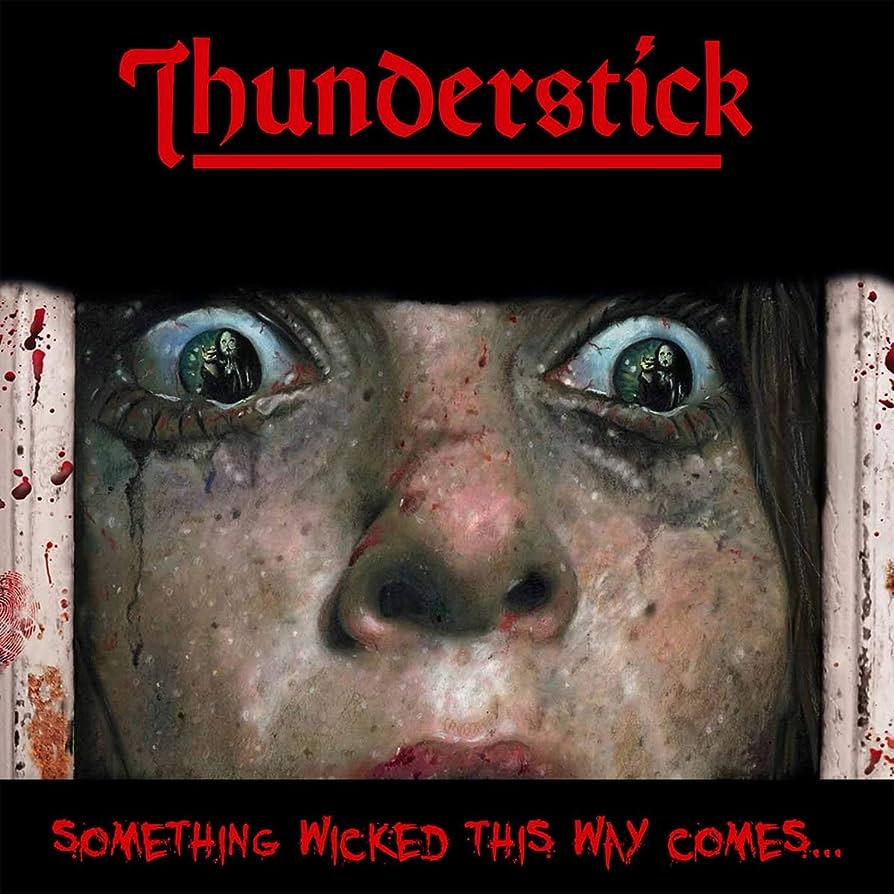
In 2017 Something Wicked This Way Comes was the first new Thunderstick album for thirty years, picking up many positive reviews. Were you surprised by the response to that album?
Yes, totally. I didn’t know because I hadn’t put any product out for, as you’ve said, thirty years. Thunderstick had died a death within the ‘80s. The reason behind putting that album out, as you also know, is it was due to Jodee Valentine’s death after her fight with dementia. For those that don’t know, Jodee was an American singer who loved everything English regarding rock bands. Her all-time favourite band was The Who and she came from the States, on the east coast, and had a degree in classical piano and decided that she wanted to just jump on a plane and come to England, home of The Who. So she did just that and in the meantime I’d gone through a few singers because they weren’t right. The first singer was a lovely lady called Vinnie Monroe and then I had another lady called Anna Borg and through one thing or another they and the band parted company. It was nothing acrimonious. With Anna she kept losing her voice and I had to blow out a tour because of that.
So in goes the advert for another vocalist and Jodee came along. My main rule regarding the band was no fraternisation amongst the band because it really doesn’t work. And what do I do? I commit the cardinal sin and I move in with Jodee. So Jodee and I became an item but it was great on stage because we were, as you just said, that counterpoint. We were able to really work off each other. But the music industry being the volatile environment that it is, has had many a relationship that has fallen foul of it and we were just another one. So she jumped on a plane, went back to the States and that was that.

And many, many years later, I read that there was a guy that had been visiting her in a care-assisted home. I had recently remixed all of the early material and put it out on an American label and it was called Echoes From The Analogue Asylum. The reason I called it that was because purely and simply it was of its time and all of the songs were recorded analogue. Digital didn’t exist. So it was the first time that I was able to put it out in a digital format. He got a copy of it unbeknownst to me and he then went and saw Jodee because he was a musician and he would go to these care-assisted homes as a visitor. And he took a copy of the album and played it to her and she didn’t even recognise her own voice. She was just staring out of the window. Which is absolutely terrible. And he told me that she’d been in there for five years before she passed. It was, for me, a very emotional time. Although at that time I’d moved on and I have my wife and I have a daughter and what have you. But there was just so much material there that I thought, you know what, she would have loved it to actually come out on an album. So that’s what I did. That’s when I went into the studio and the studio found me a session vocalist at the time and she was good enough to be able to put on the album and the rest regarding that album is history.
It came out and it received really, really positive reviews all the way around the globe. And I was just amazed by that. I really was. It was simplistic in its approach because I didn’t have a great deal of money. In fact, I mixed the album in two days, with the engineer. And it was funny because a lot of the reviewers picked up on it and said, “You’ve managed to encapsulate that simplistic late ‘70s, early ‘80s type of NWOBHM sound and projected it into the now. Is that something you actually worked at?” Yes, it was something I worked at but also it was the fact that I had no money and I had to mix it in two days! Which was great, because they picked up on that. That was wonderful and yeah, it received some very good reviews.
And you now have a new studio album coming out in October. Tell us about that.
Well, after the reviews of Something Wicked people were asking why I didn’t have a performing band going out and promoting the music. And it was purely because I hadn’t even contemplated putting a playing band together to be able to do it live. Getting those reviews, I started having to have a rethink. And I started thinking along the lines of, maybe I should put a live band together. And I did. I put a live band together and used a young lady who I’d seen something of in a band that she was singing in and so I approached her. She came with her partner who’s a guitarist and I started putting together a live show to be able to play the material that was on the Something Wicked album. It didn’t work out with them because they were a partnership and without going into too much detail they were promoting their band rather than promoting Thunderstick.
So then we started looking for another vocalist and one of my friends, who also played in a NWOBHM band – the guitarist from More, a guy called Dave John Ross – he came to me and said, “Have you seen this vocalist? She plays for a covers band and she also does solo material with backing tapes.” I was completely taken aback when I listened to her. I thought, oh my god. She had this unique vibrato in her voice and she had never sung in front of a real loud, hard rock band before but she came along for the audition and she blew me away. Completely! And I also hope that we did her. And we got together and she’s been with me a good three years or so. She has great stagecraft and she has an amazing voice. So there was all this material left laying around that I had written in the ‘80s that had only got as far as the demo stage. And I thought, yep, it’s time to do this thing that musicians do of getting in the studio and bringing out another album. With her on it. It was so important for me to get something out with her on it.
So yes, it’s been a long time in the making. I can tell you a little bit about it. There was a lot of material taken from the early days. I also started writing with one of the ex-Thunderstick guitarists, a guy called Dave Killford, who had appeared on Something Wicked as well. And I also started writing with Rex (bass-player with Thunderstick). Thunderstick was, for me, always my baby. Completely. And I used to write the material, I would produce it etcetera, all the way down the line. So, for me to start writing with other people, I found it was quite cathartic for me to actually do that. Because instead of having all the responsibility, all the time, I was able to work off other people and that was really, really good.
So we started writing and I put the drums down in 2019 with the thought that we would release it sometime in 2020. But we all know what happened. We’d just started putting the bass tracks down when it came about that we had to self-isolate and nobody was allowed to get together in a room and it just absolutely decimated my timetable. I then had guitarists, a lot of guitarist that are friends saying, “If you need me to do anything you know where I am.” So a lot of the guitar work is my friends that have recorded remotely and sent all the files in but therein lies a problem because my drums when I put them down, they weren’t done in a recording studio. They were done in a rehearsal studio and I just found that there was so much wrong with the drums. There was spillage onto different mics and there were problems with mics that weren’t connected properly, just one thing after another. Technical problems. And then most of the guitarists that had contributed to the album always wanted to put their effects on it. At the time I should have insisted and said I want a dry signal which enables me to then at a further date when we mix be able to do what I wanted. I thought it was saving time but in the long run it didn’t save time at all.
So, I have a plethora of guitarists on it – but they’re all good friends and they’re all people that I regard highly as musicians and their contributions have been amazing. I have now, obviously, my own live band that continues. Raven has done some amazing vocal tracks on the album. She really has. And where are we now? 2023! And it was only about two to three weeks ago that I actually finished the mastering of the album. It’s a long album. It lasts for about an hour and twenty-five which is really good. I think material-wise, it’s some of the strongest stuff I’ve ever written and my co-conspirators I hope are also pleased with what they’ve put on it so, yeah, I’m looking forward to it coming out.
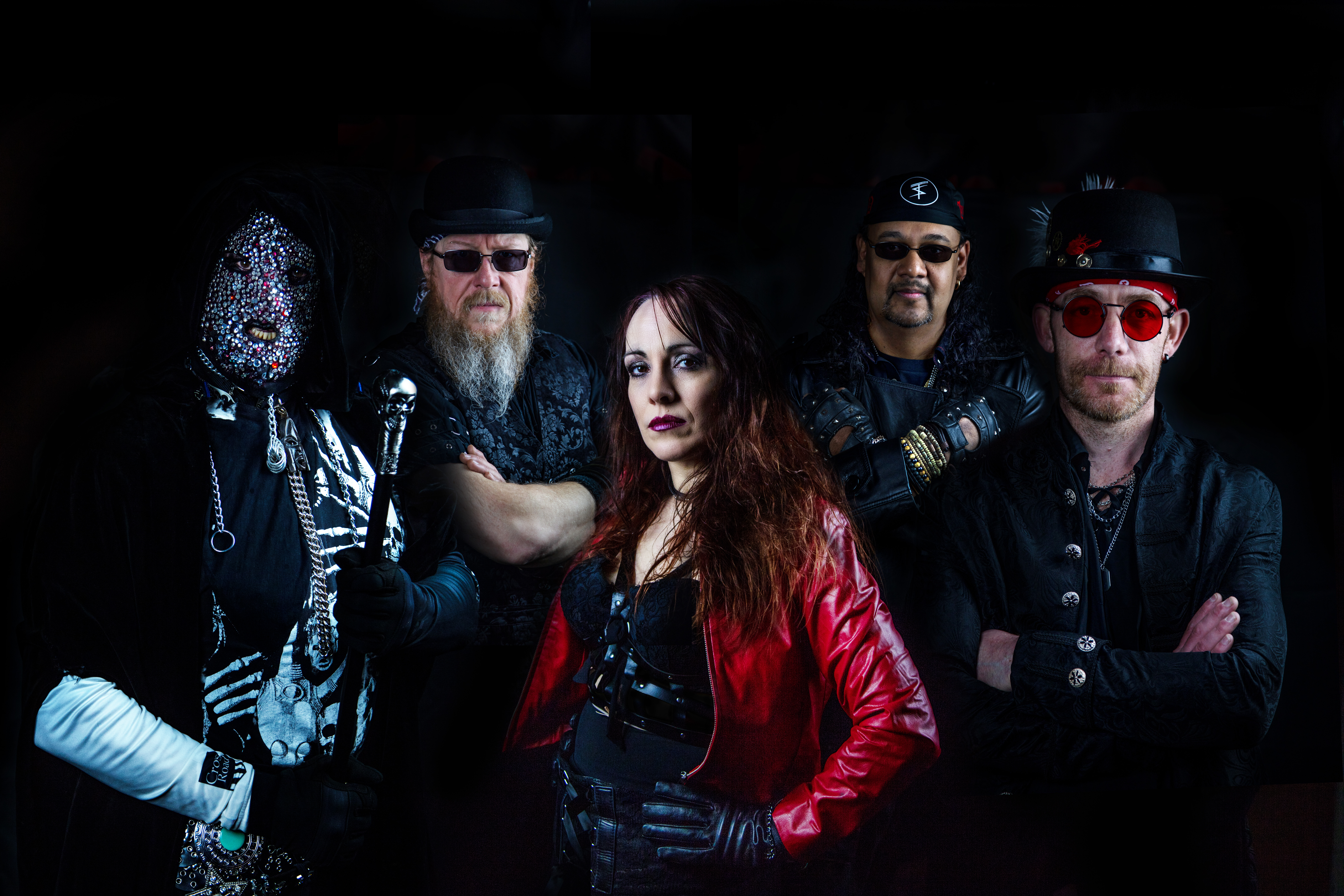
And you’ve got a new single coming out later in August?
I said earlier that I needed to get something out with Raven on it. We put out a single called ‘Go Sleep With The Enemy (I Dare You)’ and it was a limited-run which we sold at gigs. So I’ve revisited that because I thought it would be good to have something that represents the album and the way that we’ve moved forward as a band on that album. It is a heavier version of the original track but I think it’s more representative of the way that the album will sound so, yeah, I’m looking forward to putting that out again. I’m looking forward to people’s response on it.
Thanks Barry. Before we wrap up, is there anything else you want to tell us?
I’d just like to say, check us out. We’re doing a couple of festivals. We’re also doing one in France in October called British Steel. Obviously, we’ve just done the Iron Maiden after-party (at the Cart & Horses in east London) when Iron Maiden did the two nights at the O2 and we did the first night as an after-party. It was really well-attended. It sold out. I’m also very happy that we put one track up that had been recorded by somebody. The sound quality was really quite good and we’ve had two-and-a-half-thousand views on that, which is amazing and, as you said, the album will be out in October. And I’m just hoping and praying that everyone receives it as well as they did with Something Wicked because I think the material on it is even stronger. And thanks for supporting Thunderstick if you are, indeed, a supporter. And if not, check us out and welcome you on board!
Facebook: https://www.facebook.com/thunderstickofficial/
Facebook fan site: The Thunderstick Stormtroopers
Twitter: https://twitter.com/ThunderstickUK
Instagram: https://www.instagram.com/thunderstick.official/
Related posts:
Thunderstick album – news, reviews and interviews round-up
News: 40 years of Thunderstick celebrated with limited-edition live album – released 20/3/20
 Darren's music blog